iscover





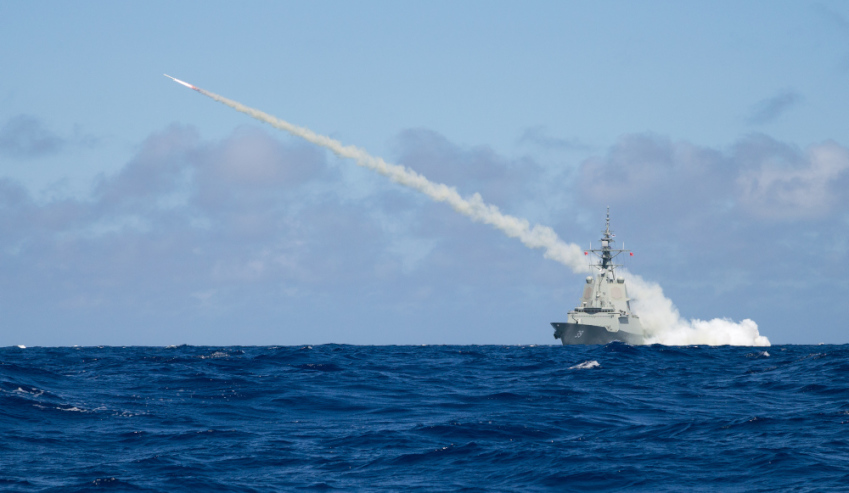
The Royal Australian Navy sailors, ships and helicopters deployed to the 2020 RIMPAC exercises have once again proven to be highly capable fighting force, participating in a range of high-intensity, live fire scenarios.
As part of Australia's participation in the biennial exercises, the Royal Australian Navy has proven its warfighting capability with devastating effect.
Anzac Class frigate HMAS Stuart successfully fired two harpoon missiles and coordinated the missile firings of three other ships during one of RIMPAC’s best-known serials called the SINKEX, where participants sink a decommissioned warship.
Two of the Navy’s Fleet Air Arm MH-60R Romeo helicopters embarked in HMA Ships Hobart and Arunta also fired Hellfire missiles during the training serial on 29 August.
Gunnery officer in Stuart, Lieutenant Naomi Muir, said live-fire training was critical to ensure Australia maintained a highly capable, agile and lethal fleet, "It is critical we test our systems to their full capacity. Not only to ensure we are familiar with how our systems operate but also how we operate those systems with other navies."
Able Seaman Electronics Technician Callum Fox is the Fire Control Officer in Stuart, responsible for pushing the button that ultimately launches the missile.
AB Fox explained that HMAS Stuart had trained to fire the missile since leaving Australia in July: "Events like these allow us to prove that we are capable of high-end warfare with allied nations. They also allow us to prove our systems and training, and prove to the Australian government and public that we are a professional and capable navy."
The RAN ships participated in a sinking exercise (SINKEX) of the decommissioned amphibious cargo ship ex-USS Durham (LKA 114) - each SINKEX is required to sink the hulk in at least 1,000 fathoms (1.8 kilometres) of water and at least 50 nautical miles from land. Surveys are conducted to ensure people and marine mammals are not in an area where they could be harmed during the event.
RAN Captain Phillipa Hay, commander of RIMPAC 2020 Task Force One, said, "Simulation is a critical part of our training but there is nothing better than to conduct live fire training. Sinking exercises are an important way to test our weapons and weapons systems in the most realistic way possible. It demonstrates as a joint force we are capable of high-end warfare."
Ten nations, 22 surface ships, one submarine, multiple aircraft, and about 5,300 personnel have participated in RIMPAC this year.
Alongside HMA Ships Hobart, Stuart, Arunta and Sirius, the exercise has included forces from Brunei, Canada, France, Japan, South Korea, New Zealand, the Philippines, Singapore and the US.
Ten nations, 22 surface ships, one submarine, and approximately 5,300 personnel are participating in RIMPAC from 17-31 August in the waters surrounding the Hawaiian islands.
The at-sea-only construct for RIMPAC 2020 was developed to ensure the safety of all military forces participating, and Hawaii’s population, by minimising shore-based contingents, while striking a balance between combating future adversaries and the COVID-19 threat.
RIMPAC provides a unique training opportunity designed to foster and sustain co-operative relationships that are critical to ensuring the safety of sea lanes and security on the world’s interconnected oceans. RIMPAC 2020 is the 27th exercise in the series that began in 1971.
Want to see more stories from trusted news sources?
Make Defence Connect a preferred news source on Google.
Click here to add Defence Connect as a preferred news source.