iscover





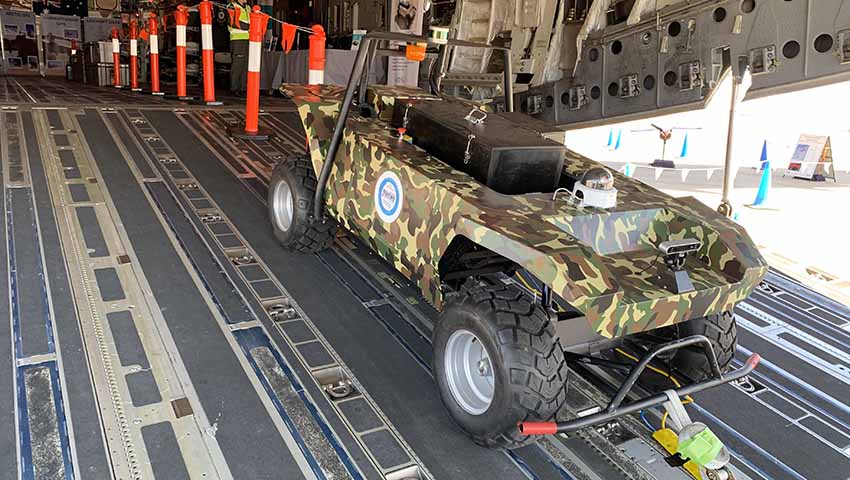
The Royal Australian Air Force has played a key role in supporting the development of the Kelpie multi-purpose autonomous ground vehicle (AGV) as part of the Plan Jericho transformation.
Kelpie is a manifestation of this strategy, and is funded by Plan Jericho, the RAAF’s innovation organisation. Electrically with autonomous navigation capability, it operates off road, such as on military bases.
It hosts the iSight intelligent intruder tracking system developed by Agent Oriented Software (AOS), which autonomously classifies and tracks to facilitate facial recognition. Kelpie is being developed by AOS in collaboration with Army’s Special Forces Training Facility and the Australian Centre for Robotic Vision, with funding from RAAF Plan Jericho.
Kelpie incorporates a number of key features, including:
- Low cost, using standard structural, mechanical components and battery/electric drive;
- Collision detection and avoidance system using LiDAR, cameras and (optional) radar;
- Designed for 80km/h speeds;
- Payload of up to 100 kilograms;
- Onboard PTZ (pan, tilt, zoom) video camera capable of streaming live video;
- Unique intelligent software agent technology, combined with machine learning and machine vision, underpins the autonomous capability;
- Teamed software agents allow multiple Kelpies to work as a team with humans; and
- Production release 2020.
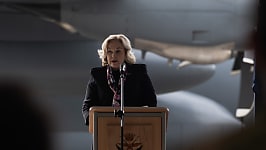
The Deputy Chief of the Air Force, Air Vice-Marshal Gavin Turnbull, called for the widespread introduction and rollout of autonomous vehicles to support the Air Force's ambitious transformation plan, saying, "We will seek to develop augmented intelligence that combines the strengths of humans and machines to create a human edge in the Information Age. Augmented intelligence is the Air Force's way of leveraging our unique attributes as a small force equipped with sophisticated technology operated by high-quality people."
AOS is an Australian AI company developing autonomous and intelligent systems, based on its own R&D program. It works closely with Defence and collaborates with a number of universities. It is currently developing robotic systems for agriculture, as spin-offs from its defence technology.
AOS’s software products provide the decision-making capability that underlies autonomy, including teamed intelligent software agents that enable human/machine teaming.

Stephen Kuper
Steve has an extensive career across government, defence industry and advocacy, having previously worked for cabinet ministers at both Federal and State levels.
Want to see more stories from trusted news sources?
Make Defence Connect a preferred news source on Google.
Click here to add Defence Connect as a preferred news source.