


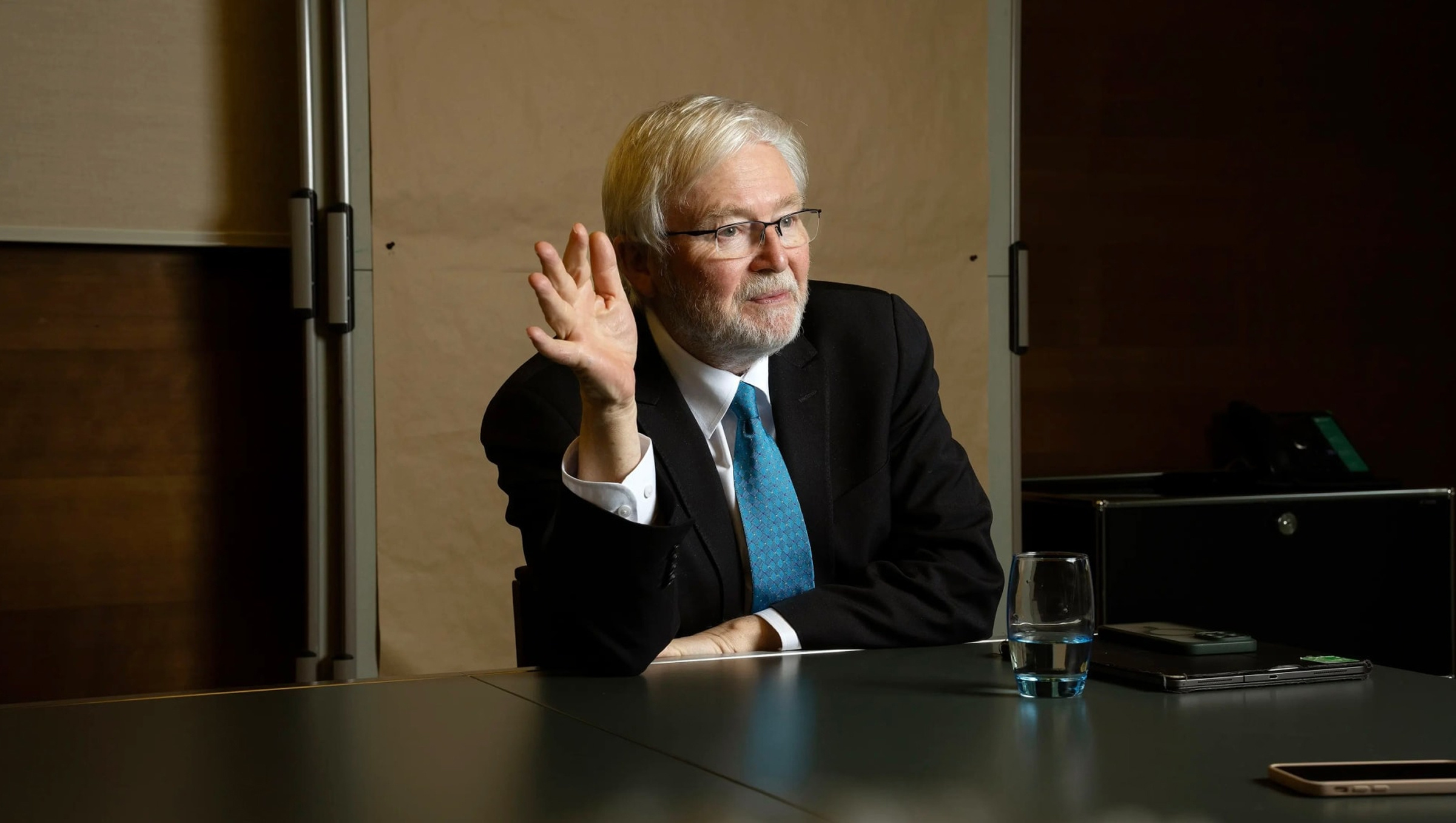
Former prime minister and former US ambassador Kevin Rudd made the comments during a discussion with German-language daily newspaper Neue Zürcher Zeitung’s Katrin Büchenbacher at the Asia Society’s annual State of Asia Conference in Zurich.
The former prime minister argues that the ambitions and long-term planning of the People’s Republic of China expand, while Australian policy decisions are consumed by risk aversion and fear of losing face.
“Europeans, much like us in Australia, are paralysed by procedures. What advantage do authoritarian systems have over us? They can act quickly. We, by contrast, get tangled up in processes. Brussels is a good example of that,” he says, when asked about complacency of the Western world.
“Then there is the fear of risk in our politics and public administration. If something goes wrong, I am to blame. So, the safest thing is to take no risks and do nothing.
“We have a problem with officials and business representatives having a lovely time together at seminars and, how can I put this tactfully, doing fuck all.
“That is a disease in our systems. The others are moving ahead; we are standing still.”
Then there is the fear of risk in our politics and public administration. If something goes wrong, I am to blame. So, the safest thing is to take no risks and do nothing.”
- former prime minister Kevin Rudd
The former prime minister also highlights that he considers there to be two competing forces at work in the technological space in China.
“On the one hand, there is the ideological leadership pushing the country towards greater state direction: Xi Jinping, the directives from the very top, the technology and industrial strategy,” he says.
“On the other hand, you have entrepreneurs striving with all their might to succeed. They want to grow, build something, and are inherently innovative.”
Rudd is further questioned on the technological might of China and its direct competition with the automotive sector and mechanical engineering industries in Europe.
“This is the deliberate result of a technology and industrial policy China has been pursuing for a long time. Think of ‘Made in China 2025’. That strategy began in 2015. China then followed up with its medium- to long-term science and technology strategy and enormous state investment funds for industry,” he says.
“Behind it lies Xi’s absolute determination to win the strategic race with the United States, in all the major cutting-edge technologies. It was built brick by brick. The fundamental principle of the Chinese system is this: China prevails through sheer scale.
“(It finances this) partly through the state budget and debt. But above all, through cheap credit from the banking system. Chinese people save a great deal but receive less than 1 per cent interest on their savings. At the same time, they have hardly any other ways to invest their money. This allows local governments to borrow cheaply from the banks and use that money to keep companies alive that would otherwise have collapsed long ago.
“(These inefficacies are kept alive because) Xi does not want these factories closed. The jobs have to be preserved. Europeans who think this problem will eventually disappear of its own accord should understand that a deliberate Chinese policy lies behind it.
“Private consumption in China is not getting going. People have lost a lot of money in the property market and feel uncertain about the future. They are not buying enough to absorb this enormous industrial output.
“But the factories keep producing on a large scale. That is what the leadership wants; that is what its industrial strategy demands. That is why Europe is now being flooded with Chinese industrial products, often at very low prices, because competition within China itself is so fierce.
“Chinese goods often arrive here at prices below production costs. This export model is cross-subsidised.
“Why are we even discussing industrial policy in democracies today? Because China launched an industrial strategy on an enormous scale 15 years ago. That is why everyone now takes the subject seriously. The usual ideas about how costs, supply and demand determine prices no longer apply in this situation.
“We have to respond with industrial policy of our own, until the Chinese realise that continuing on their present course is becoming too expensive.”