

In a recent interview, APV-T’s managing director, Harry Hickling, outlines how the company is using advanced simulation tools to revolutionise test and evaluation (T&E).
APV-T is best known for its safety and survivability testing, but its real breakthrough is in the growing application of virtual testing.
Hickling says: “Our lab tests a vehicle every four days, with a backlog of over 30 bull bars and other automotive accessories. We ensure their structural integrity and that they do not impact the performance of the safety management systems of these vehicles.”
Crash testing may last just milliseconds, but it requires weeks of preparation and days of post-test analysis. Hickling compares the control room atmosphere to a space launch.
“The team works through all the checklists, ensuring data acquisition, sensors in the crash-test dummies, and live camera feeds are all set before giving the green light for the test.”
Learning through failure
One of APV-T’s distinguishing features is its willingness to learn from failure. “In our novel testing, we’re asked to assess failures,” Hickling says. “For instance, a mine operator identified the risk of a 500-kilogram reciprocating unbalanced mass breaking free on their equipment with the catastrophic risk of causing havoc within the mine. Our team was tasked with testing alternate containment methods to prevent such incidents.”
This problem-solving mindset extends into the emerging world of electric vehicles. “We’ve done extensive work in preparing for electric vehicle safety, ensuring technicians don’t get electrocuted after a crash. We also provide these vehicles to emergency services for training,” Hickling says.
Simulation: the game changer
Perhaps APV-T’s most significant advancement is in the field of simulation. The cost of traditional crash and blast testing is immense; simulation provides a way to reduce these costs while improving outcomes.
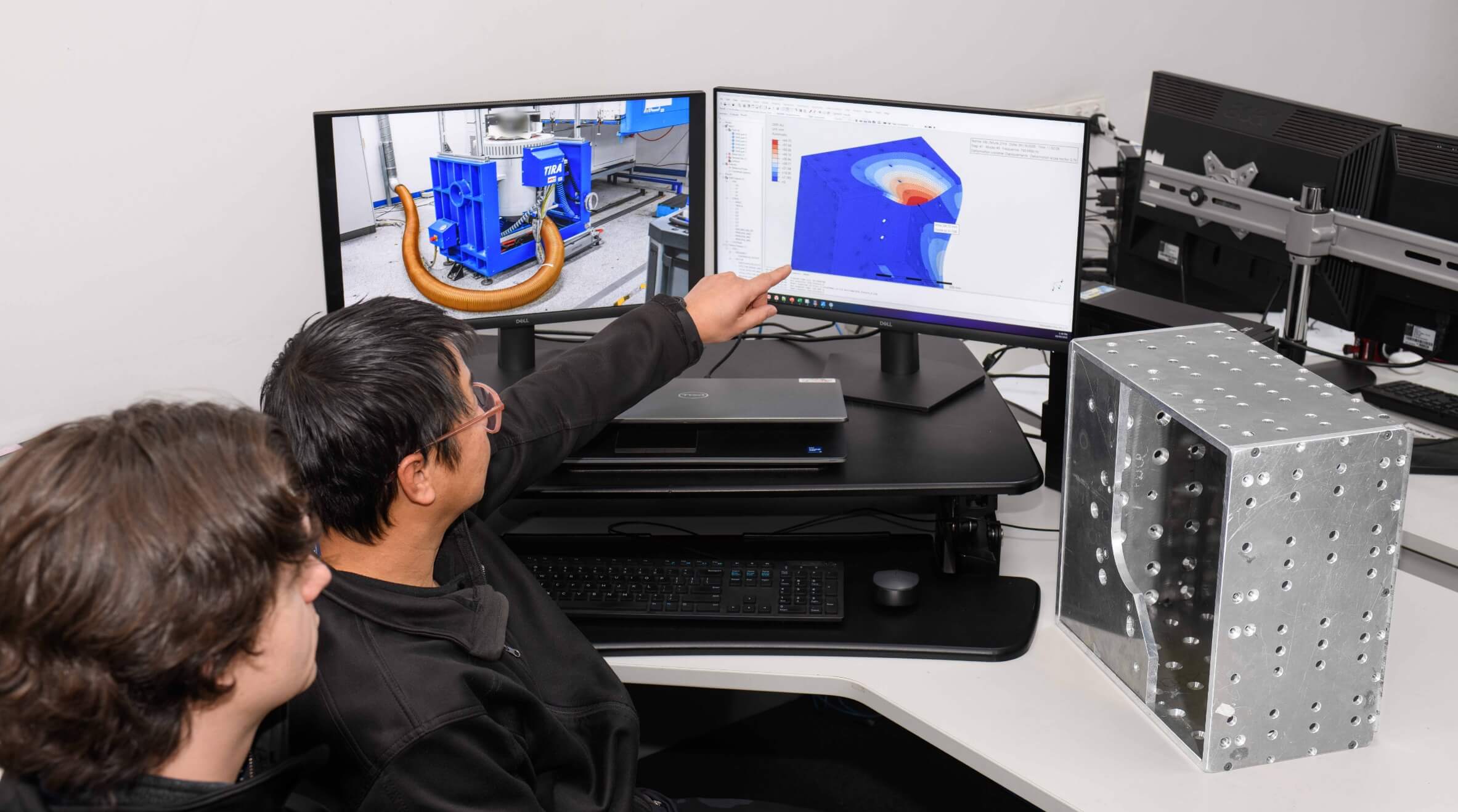
“We use simulation to run thousands of virtual test scenarios, which are correlated to physical testing. This allows us to advise customers on product performance before the design is completed, reducing development costs and time to market,” Hickling says.
We use simulation to run thousands of virtual test scenarios, which are correlated to physical testing. This allows us to advise customers on product performance before the design is completed, reducing development costs and time to market.”
- Harry Hickling
APV-T’s modelling has become so advanced that it can predict how accessories like bull bars will affect vehicle safety performance before a prototype even exists. This ability to identify risks early means fewer costly redesigns and quicker delivery to market.
The shift to simulation has been a gradual journey. Hickling recalls, “We initially recognised the prohibitive cost of procuring vehicles for testing and developed methodologies based on modelling. In 2020, we partnered with Ford, testing their vehicles from prototype to production. This collaboration uplifted our metrology scanning and data acquisition capabilities.”
Implications for defence
While the company has a strong automotive base, the defence sector stands to gain significantly from this technology.
As Hickling puts it: “Simulation can significantly cut costs, especially in scenarios where physical testing is prohibitive or impossible. It enables us to de-risk projects from the design phase, preventing costly failures.”
Instead of the destructive testing of vehicles or structures to test their survivability, simulation allows engineers to predict outcomes under controlled digital conditions. By creating a “digital twin”, APV-T can model how a product will perform under blast, rollover or extreme vibration events, reducing the need for destructive testing.
This capability is especially relevant in Australia, where access to specialist test facilities is limited. As Hickling says, “At a minimum, simulation makes it more accessible for industry to convince the primes and Defence that we can safely deploy Australian products on military platforms.”
Global demand and future growth
APV-T’s expertise has not gone unnoticed overseas. Hickling reveals, “We’ve shown examples of our work in the US, and as a result, a US prime has brought us onto their system for virtual T&E services.” With Australia part of the AUKUS agreement, APV-T is also well positioned to provide its services across trusted international networks.
Domestically, demand is also on the rise. The company is actively recruiting, with Hickling pointing out, “We’re looking to grow our team, particularly in simulation expertise. We also have research projects underway to study vehicle crash dynamics, which could inform government safety policies.”
A culture of innovation and safety
For engineers and technicians, APV-T offers not only cutting-edge technology but also a dynamic workplace culture. “APV-T is a fun place to work, and our team enjoys making a real impact on safety in advanced military vehicles and the transport industry,” Hickling says.
From its early crash tests to advanced digital simulation, APV-T demonstrates how Australian innovation can shape the future of safety and survivability. The company’s work shows that test and evaluation is no longer just about smashing cars into walls – it’s about harnessing the power of simulation to design safer, more resilient systems from the ground up.
As defence and industry face increasingly complex challenges, APV-T’s pioneering approach is setting a new benchmark for both safety and efficiency.