

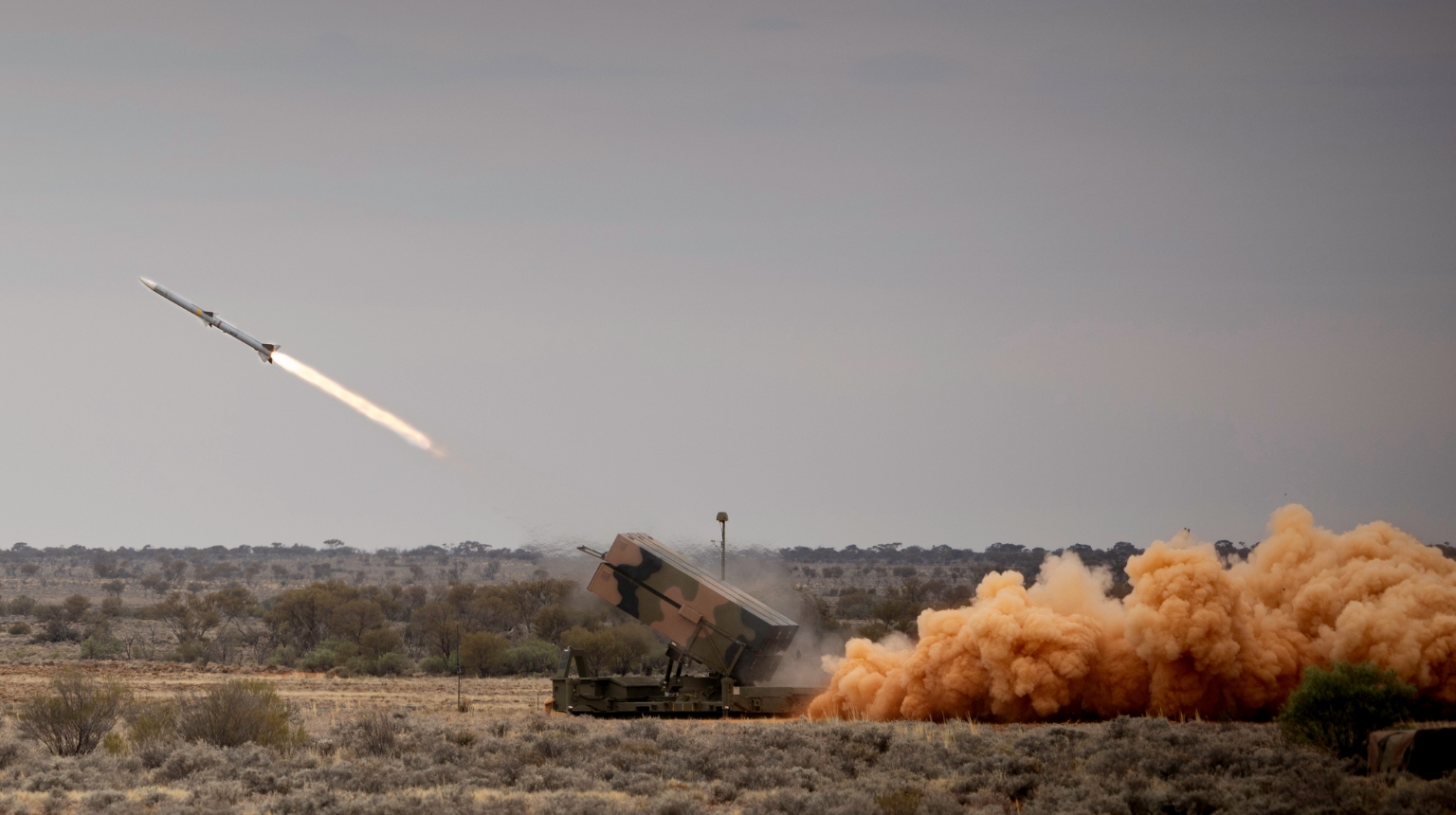

For Australia, the strategic implications are profound. The nation can no longer rely on geographic isolation or a handful of high-end platforms to provide the protection required in an era of rapid missile proliferation. The Australian Defence Force has taken important steps to introduce a modern ground-based air defence capability, yet significant gaps remain. Among the systems now available, the National Advanced Surface-to-Air Missile System (NASAMS) stands out as the most mature, scalable and strategically sensible way to rapidly strengthen Australia’s Integrated Air and Missile Defence (IAMD) posture.
A new reality shaped by conflict
No two conflicts have shaped global thinking on air and missile defence more dramatically than the wars in Ukraine and Israel. Both have faced thousands of incoming threats across multiple vectors, often delivered in waves designed to overwhelm or confuse defenders. In Ukraine, Russia’s combined use of cruise missiles and Iranian-made Shahed drones forced Ukrainian forces to adapt quickly. Early in the conflict, interception rates were low, but with the introduction of modern ground-based systems – particularly NASAMS and Patriot – Ukraine’s defensive performance improved dramatically, with interception rates rising to around 90 per cent. With more than 1,000 successful engagements, NASAMS has been among the most effective systems in Ukraine, with roughly 60 per cent of its intercepts involving cruise missiles and a significant proportion involving drones.
Israel offers a different, but equally sobering, set of lessons. Its multi-layered architecture – Iron Dome, David’s Sling and Arrow – has achieved interception rates of roughly 90 per cent even when confronted with hundreds of ballistic missiles and rockets fired in concentrated bursts. The Israeli experience underscores the importance of layered defence, persistent sensors and the ability to fuse data and assign interceptors at speed.
Across both conflicts, one lesson stands out: nations that fail to invest in modern, layered air defence pay a steep price in infrastructure damage, military degradation and national paralysis.
Australia’s strategic imperative
The 2023 Defence Strategic Review was blunt in its assessment. It identified the lack of a layered IAMD system as one of the ADF’s most serious capability gaps – one that must be addressed urgently. Australia’s northern bases, major population centres and deployed forces all sit within reach of cruise missiles, drones and potentially more advanced systems fielded by regional actors.
Despite this growing risk, Australia’s Ground Based Air Defence (GBAD) capability remains modest. For decades, Army relied primarily on short-range, line-of-sight systems designed for low-end threats. The introduction of NASAMS into the Australian Army was a transformative step, but two batteries cannot deliver the breadth of coverage required for a continent-sized nation with multiple critical infrastructure nodes and an increasingly important forward posture in the north.
The Chief of the Defence Force has noted publicly that Australia must now be prepared for the possibility of combat operations reaching its own soil – a shift not experienced since the Second World War. The reality is that neither the Royal Australian Air Force nor the Navy can provide continuous, 24-hour protective coverage for bases and deployed forces. Only GBAD can supply the persistent defensive shield required as part of a broader IAMD network.
The most likely threats are already here
Much public discussion focuses on high-end threats such as hypersonics or advanced ballistic missiles. Yet the most common and operationally disruptive threats today are far more familiar: cruise missiles and drones. These are the weapons that Russia, Iran and non-state actors have used in numbers that are difficult to absorb without modern air defences.
Cruise missiles remain especially problematic. Their low altitude and terrain-following profiles make them difficult to detect, and their accuracy enables them to strike the very assets that underpin national defence. Drones – whether reconnaissance systems, loitering munitions or improvised quadcopters carrying explosives – have proven equally potent and often devastatingly cost-effective.
Nations with outdated or incomplete air defence architectures have discovered that these threats can cripple combat power before a single fighter jet takes off. For Australia, this means the most urgent requirement is the ability to defeat the day-to-day threats that will shape the early period of any conflict – not just those that capture headlines.
NASAMS: A system built for the fight Australia is most likely to face
NASAMS, developed by Kongsberg and Raytheon, has emerged as the benchmark for modern short and medium-range air defence. Its worldwide adoption reflects its balance of cost, capability, mobility and robustness. For Australia, the advantages are particularly clear.
NASAMS, developed by Kongsberg and Raytheon, has emerged as the benchmark for modern short and medium-range air defence.”
NASAMS is optimised for the detection and engagement of cruise missiles, drones, helicopters and fixed-wing aircraft – the precise threat set dominating modern conflict. Its performance in Ukraine has validated its design philosophy, demonstrating accuracy and the ability to operate under sustained operational pressure.
The system’s use of the AIM-120 Advanced Medium Range Air-to-Air Missile and AIM-9X Sidewinder gives Australia an immediate logistical and sustainment advantage. Both missiles are already in service with the RAAF, meaning NASAMS can be supported using existing stockpiles, infrastructure and technical expertise – one of the reasons Australia can move faster than other nations when expanding the system.
NASAMS also excels in mobility and expeditionary flexibility. Its components can be dispersed to avoid presenting lucrative targets and reposition rapidly to cover changing operational needs. It is equally well suited to base defence, deployed force protection or rapidly creating an air defence bubble around critical infrastructure.
A capability already working in Australian hands
Australia’s NASAMS program has been an acquisition success story. The Army fired its first missile from NASAMS at Woomera in 2023, achieving a long-range intercept and marking one of the most significant advances in Army’s air defence capability in decades. Subsequent live firings, including during Exercise Talisman Sabre, have further validated the system’s effectiveness.
Beyond the firing range, NASAMS underwent extensive software integration in Australia, including adaptation to suit the Australian force structure and its joint command-and-control environment. This has ensured that NASAMS integrates cleanly with ADF networks, joint effects and emerging systems such as AIR 6500.
Just as importantly, NASAMS has laid a foundation that can be scaled quickly. The training pipeline, sustainment system, production processes and industrial partnerships are now mature. Australia can move faster than almost any other prospective operator because a local production capability, validated supply chain and in-service missile inventory are already in place.
A system designed to grow
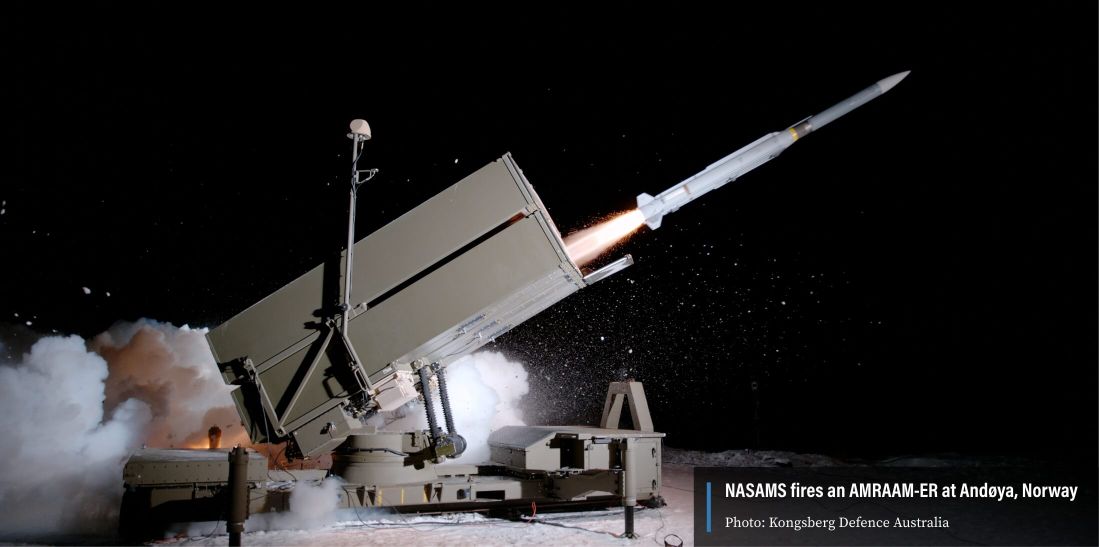
NASAMS is not a static capability. Its architecture supports iterative upgrades, ensuring Australia’s investment keeps pace with threats. The most significant near-term enhancement is the AMRAAM-ER missile, which extends both the range and altitude of the system. For Australia, this would significantly expand NASAMS’ defended footprint and offer a meaningful uplift in medium-range coverage.
The system also has potential to integrate longer-range interceptors, which could introduce an affordable missile-defence layer against short-range ballistic threats. These pathways highlight NASAMS’ long-term value: a system with a framework on which a layered GBAD force can be built.
Industry momentum Australia cannot afford to lose
One of the most compelling aspects of NASAMS is the depth of Australian industry involvement. More than 30 local companies contribute to manufacturing elements of the system, and Australia is the only nation outside Norway with a standing NASAMS production capability. This industrial ecosystem is the quickest path forward for expanding air defence, as the existing supply chain, skilled workforce and certified facilities can be activated immediately. Additional batteries can therefore be delivered far faster than any alternative requiring new infrastructure or training pipelines. Expanding NASAMS also strengthens sovereign capability, supports high-value local industry, and ensures the ADF benefits from responsive, domestically supported sustainment and upgrades.
This industrial ecosystem is rare in Australian defence capability development. It represents sovereign skills, export potential and a warm production line capable of delivering additional NASAMS batteries without the long delays that accompany new program start-ups. Allowing this momentum to lapse would be a setback not only for air defence but for Australia’s broader defence-industrial strategy.
The pragmatic path forward
A credible IAMD system requires layers, but building those layers must begin with the threats most likely to be encountered first. NASAMS is already in service, already proven in combat and already delivered through Australian industry. Expanding it is the most immediate, affordable and operationally sensible way to close the gap identified in the Defence Strategic Review.
Missile and drone threats are not abstract future concerns; they are shaping the global battlespace today. Australia has taken important steps, but the window to move from foundational capability to genuine defensive depth is closing. NASAMS offers a pathway that is achievable now, scalable tomorrow and vital in any scenario in which Australia must defend its people, its bases and its deployed forces.
In modern conflict, air defence is not a luxury. It is the backbone of national resilience. NASAMS provides Australia with that backbone – one that can and should be strengthened without delay.