

China has traditionally produced Soviet-mimic aircraft and armoured vehicles; however, the country is increasingly making experimental moves into the field of unmanned aerial vehicles and other drones.
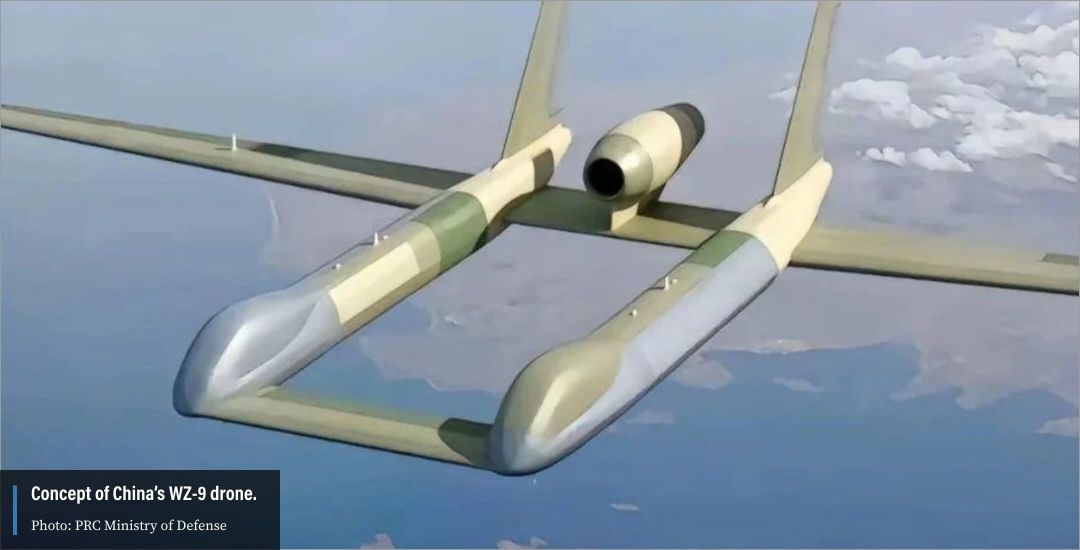
Alarm bells started ringing recently when China’s Wuzhen-9 Divine Eagle airborne early warning drone has been seen operating out of the PLA’s Hainan Island airbase in the South China Sea since December last year.”
The development of attritable, counter-stealth and persistent uncrewed aerial vehicles (UAV) represents a fresh approach to global combat by the PRC and an open challenge to the traditional air warfare powers such as the United States of America and Russia.
Alarm bells started ringing recently when China’s Wuzhen-9 Divine Eagle airborne early warning drone has been seen operating out of the PLA’s Hainan Island airbase in the South China Sea since December last year.
The eye-catching WZ-9 long-range surveillance drone features a twin-boom structure and 35-metre main wing under the power of a single turbofan jet engine positioned between the tail fins, a significant example of counter-stealth innovation from manufacturer Shenyang Aircraft Corporation. In addition, it’s speculated that the drone features a SATCOM antenna within its port side “head”.
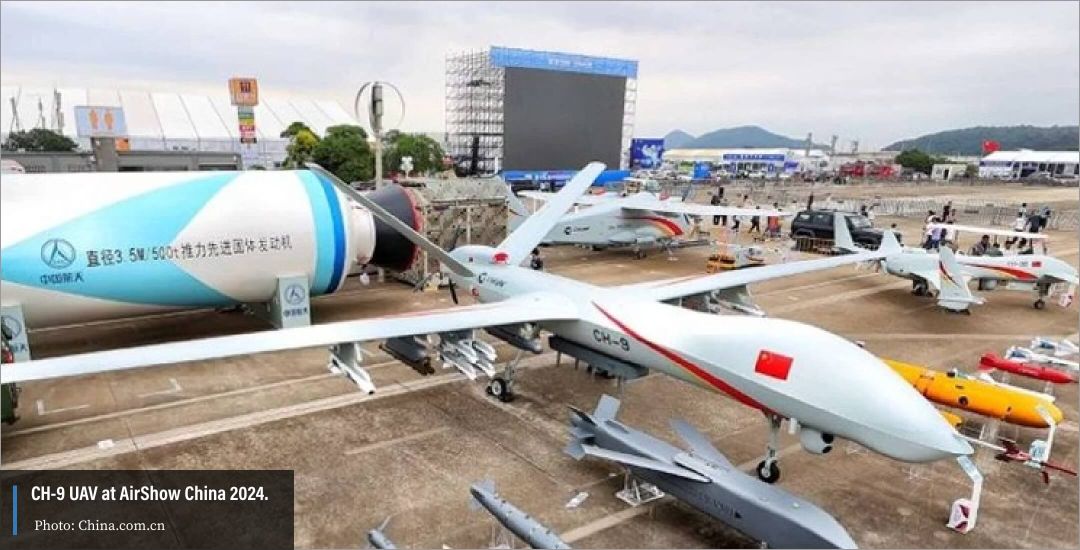
The PRC has also made progress with their CH-9 combat drone, manufactured by China Academy of Aerospace Aerodynamics, which can be armed with air-to-air and anti-ship missiles, bombs, torpedoes or loitering munitions.
The 12-metre long, turboprop engine-powered CH-9 has previously been shown at China International Aviation & Aerospace Exhibition in Zhuhai.
Diversifying their options, the PRC has also showcased their Aviation Industry Corporation of China-manufactured Jetank next-generation large unmanned aerial utility platform last year at Airshow China 2024.
The drone is expected to act as a “swarm carrier”, capable of carrying large numbers of anti-ship or air-to-air missiles, laser-guided bombs, glide bombs and smaller drones (for reconnaissance, communications, electronic warfare or strikes) on eight hardpoints and a heavy-load mission module.
Perhaps one of the country’s most famous unmanned aircraft system (UAS) is the WZ-8 high-speed, high-altitude reconnaissance drone released in April 2023. The aircraft, reportedly capable of Mach 3 speed and an altitude of 100,000 feet, is considered the world’s first hypersonic surveillance drone in operation.
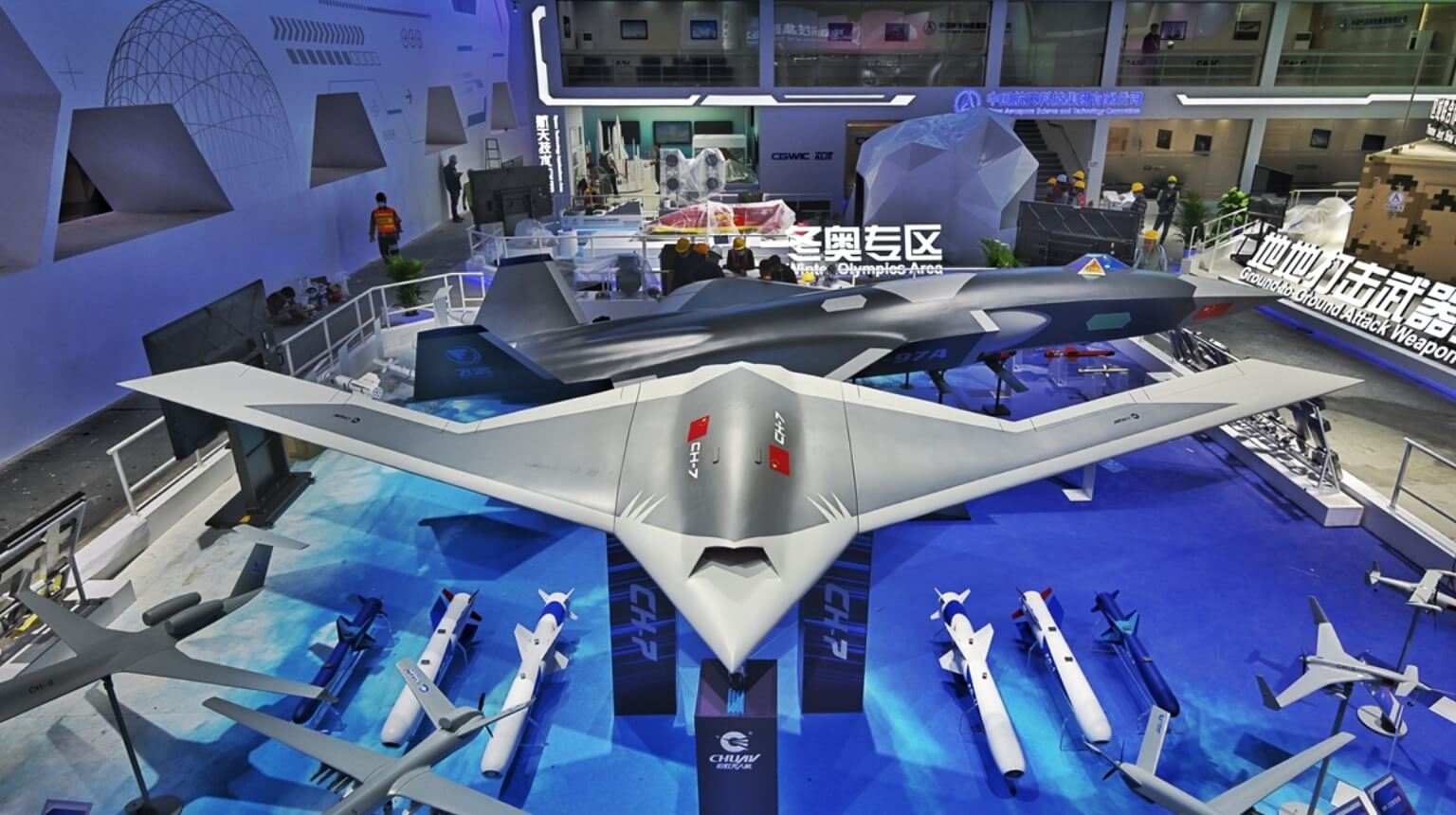
One of the PRC’s most mature uncrewed aerial vehicles is the CH-7 flying-wing stealth drone, which is expected to have completed final development late last year after making its debut at Airshow China 2018. The CH-7 is expected to carry missiles and other guided weapons for the targeting of high-value precision strikes.
Rounding out the drone line-up is China’s Chengdu Wing Loong-3 medium-altitude long-endurance uncrewed aerial combat vehicle. The mature design has been on show since 2022 and features a more traditional air-to-air missile-carrying design heavily influenced by the General Atomics MQ-9 Reaper drone.
Dr Malcolm Davis, Australian Strategic Policy Institute defence strategy and national security senior analyst, speaking with Defence Connect on the subject, says the People’s Liberation Army is investing heavily in UAS for the domains of air, sea and to a lesser extent, land.
“In terms of air capabilities, the PLAAF are developing a range of UAS for a range of tasks, including strike, as well as ISR and long-endurance high-altitude reconnaissance, and the PLAN are also developing advanced UAS capabilities including carrier-launched systems for use with their Type 076 class LHD,” he says.
“The Chinese see UAS as a key element of PLA force structure that contributes greater mass to an already massive military capability, enhanced endurance in areas of military interest, and an ability to launch a range of offensive tasks as part of anti-access and area denial (A2/AD) operations within a counter intervention strategy along the first and second island chains.
“This PLA UAS capability is only going to increase in size and diversity and sophistication, and is challenging US and allied capability advantages, where the United States of America and its partners have been slower to embrace the potential offered by UAS and have a smaller capability that is albeit still sophisticated.
“The United States is recognising the potential offered by Collaborative Combat Aircraft (CCA) which are now in early development as part of future generation air combat capability projects such as NGAD and F/A-XX, but so are the Chinese, with the Chinese developing similar capabilities – their CCA prototype is a virtual exact copy of the MQ-28 Ghost Bat for example.
“The Chinese have developed their own equivalent to the MQ-4C Triton in the form of the unique WZ-9 Divine Eagle, which would support PLAN and PLARF ISR and targeting as part of A2/AD. As with the Triton, a large, slow UAV is vulnerable in contested airspace, but in China’s case, they have the advantage of geography and a land-based force. The US and Australia must project platforms such as the Triton through heavily defended airspace and are unlikely to be able to deploy crewed fighters such as carrier-based F-35C or land-based F-35A close enough to threaten WZ-9.
The use of drones by the PLAN is commonplace and such capabilities provide ships with ‘over the horizon’ targeting capabilities.”
- Dr Malcolm Davis
“I think platforms like the WZ-9 are akin to ‘pseudo satellites’, able to exploit ‘near space’ (the region from the stratosphere upwards) for long-endurance ISR and targeting operations, and they’ll be difficult to target if we can’t get air or naval platforms within range.
“The use of drones by the PLAN is commonplace and such capabilities provide ships with ‘over the horizon’ targeting capabilities.
“The Chinese are moving rapidly in regards to UAS – probably more rapidly than what is happening in the United States and certainly much more rapidly than what is happening in Australia at the moment, where the department’s approach is very slow paced.
“China recognises that it can boost military power through investing in UAS as ‘high volume, low cost’ capabilities – which can be armed and employed across the full spectrum of military tasks. China is far less constrained in the use of lethal autonomous weapon systems, including armed UAS, in terms of ethical, legal or moral constraints, as compared to Western democracies.
“When China talks about ‘intelligentised warfare’ as a next step in the PLA development, its thinking in terms of how it brings AI and UAS together in a manner that gives it decisive military advantage.
“So, Beijing will ignore any efforts by Western states to impose legal or regulatory measures to constrain the use of AI and UAS on the battlefield – even if we democracies are constrained by such measures. That could give states such as China a decisive military edge.”
The US Department of Defense has previously identified the development of experimental aircraft and unmanned aerial systems as a key priority being seen in China.
“The PRC is advancing its domestic aviation industry through two major state-owned aircraft corporations, the China Aviation Industry Corporation (AVIC) and the Commercial Aircraft Corporation of China (COMAC),” the US DOD says in an annual 2024 report to US Congress titled Military and Security Developments involving the People’s Republic of China.
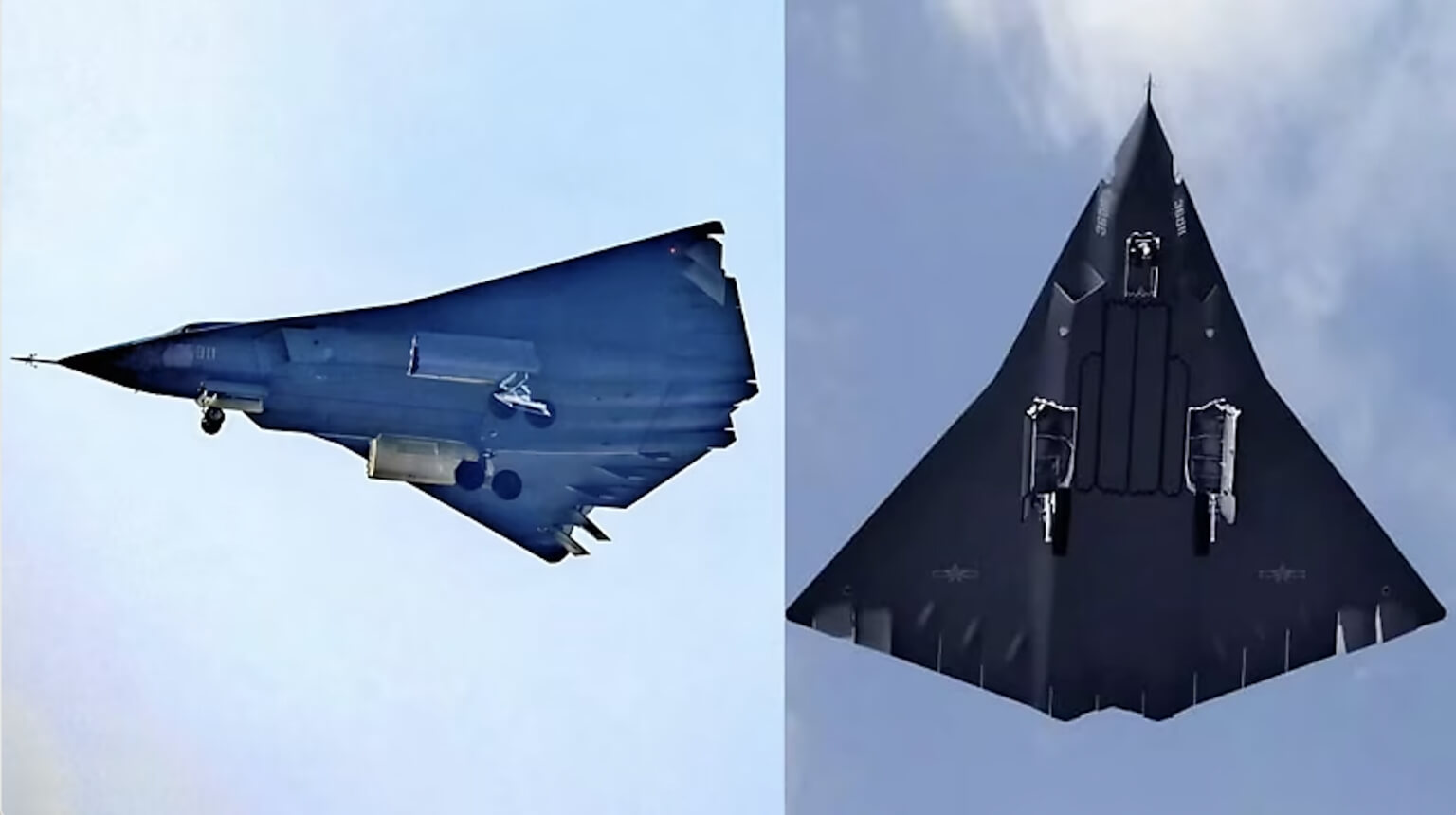
“AVIC designs and produces the PRC’s military aircraft, including the J-20 fifth-generation fighter, the Y-20 heavy transport and the future H-20 flying wing stealth bomber.
“In February 2024, AVIC displayed its Z-10 attack helicopter for the first time outside of the PRC at the Singapore Airshow. As of February, Pakistan is the sole known export customer for the helicopter.
“COMAC produces large passenger aircraft and has begun to export the ARJ21 regional jet to Indonesia, in line with its efforts to expand into the international commercial airliner market. COMAC has delivered its first narrow-body C919 airliner to China Eastern Airlines but cooperation with Russia on the wide-body CR929 may be stalled because of the effects of Western sanctions on Russia.
“In early 2024, a model of the J-35 stealth fighter appeared on the deck of the PRC’s first aircraft carrier, the Liaoning – a test bed for PLA carrier capabilities. Although the J-35 is in the development and prototype phase, it could be in operation in the coming years.
“The PRC’s decades-long effort to improve domestic aircraft engine production is starting to produce results, with the J-10 and J-20 fighters beginning to switch to domestically produced WS-10 engines, although some Russian AL-31F engines may remain in use.
“As early as 2023, Chengdu Aircraft Industry Group began increasing the production capacity of the J-20 as it is building a new assembly plant to prepare for the subsequent further expansion of production.
“The PRC’s first domestically produced high-bypass turbofan, the WS-20, has entered flight-testing on the Y-20 heavy transport aircraft and probably has begun to replace previously imported Russian engines.
“UAV development has proceeded rapidly with new flight tests of experimental craft, such as the Y-5U transport UAV. The PRC’s military aviation industry has continued to export UAVs abroad, including its sale of nine armed drones to the Democratic Republic of Congo in 2023.”