

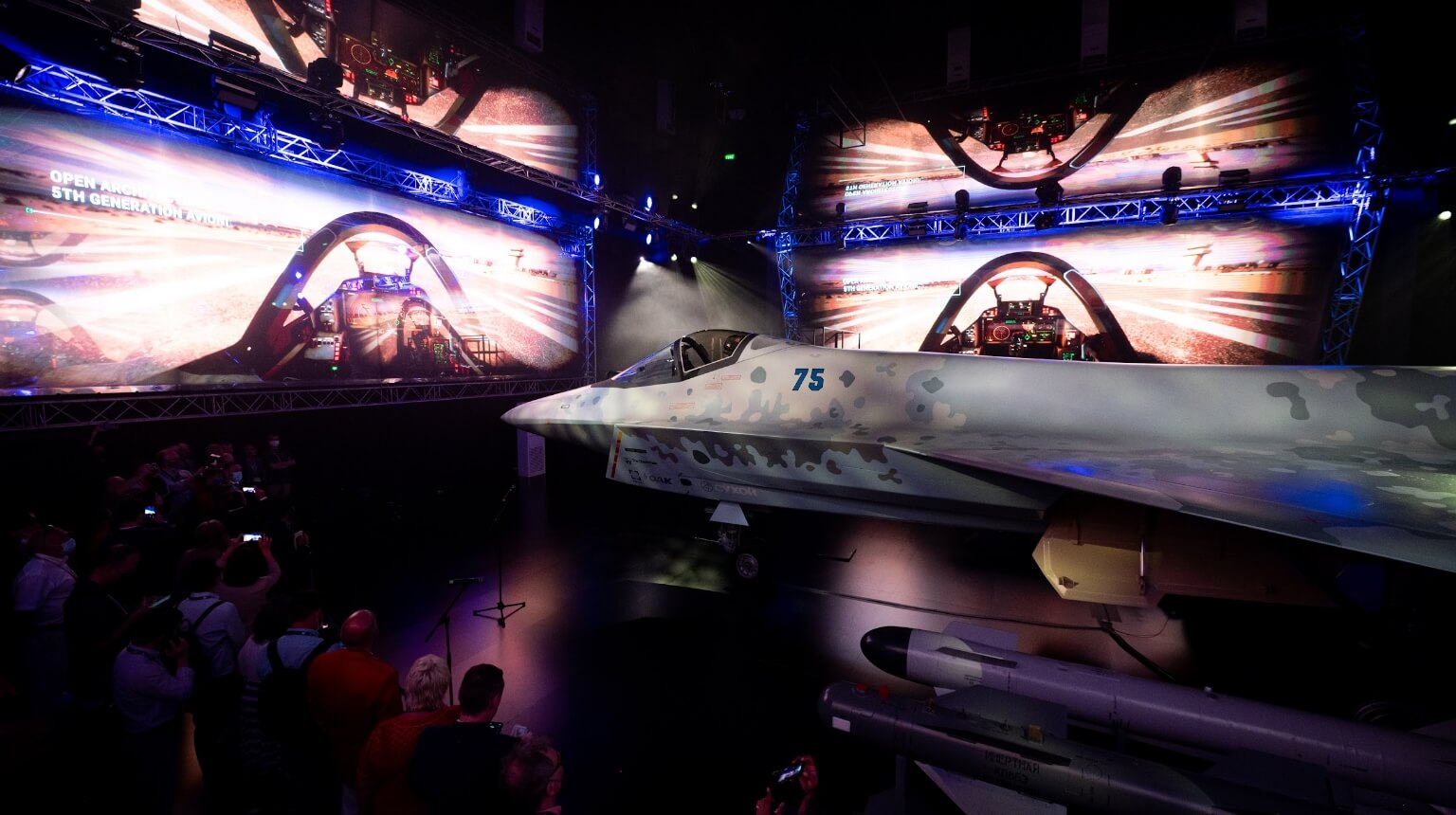
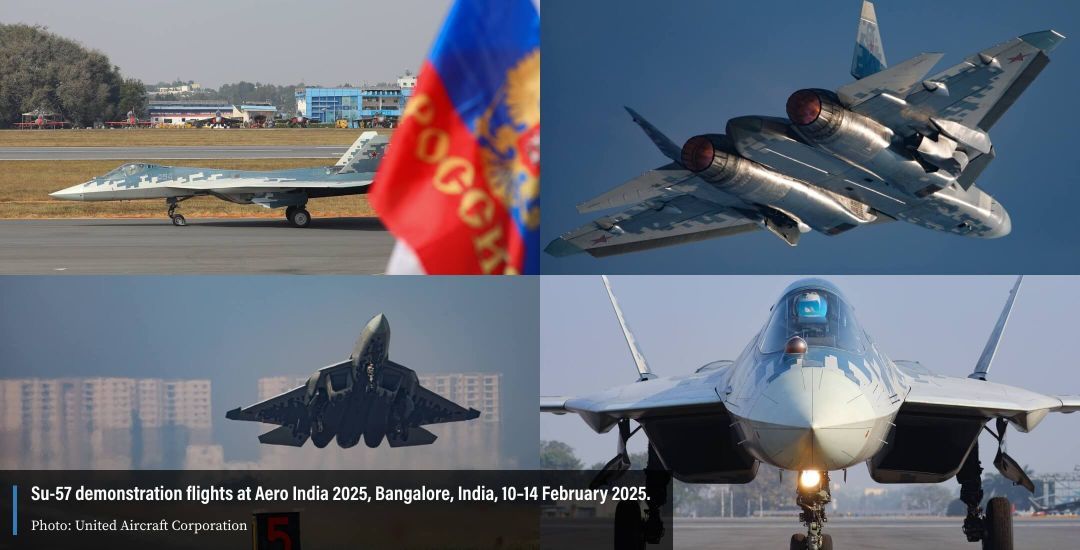
The United Aircraft Corporation-manufactured multirole fighter, code-named “Felon” by NATO designation, has already completed trade show rounds to the 15th China International Aviation and Aerospace Exhibition in Zhuhai during November 2024 (its first display abroad) and, more recently, to Aero India 2025 in Bangalore during February this year.
Sukhoi Design Bureau test pilot Sergey Bogdan has spent much of this year showcasing the aircraft overseas, with its appearance at Aero India 2025 capturing headlines before returning to Russia via a stopover in Iran.
In a value-adding announcement, Russian state intermediary exporter Rosoboronexport has declared that the aircraft is available for licensed production overseas.
Although the Algerian Air Force is expected to be the first active foreign customer of the fifth-generation Russian fighter, as it attempts to retire its ageing MIG-25 fighters, other potential customers include Vietnam, Iran and, most importantly, India.
“For the Indian market, the Su-57 aircraft is, in my opinion, simply essential as the next step in evolution, in the furtherance of joint progress between our countries and between our aerospace companies and our aviation industry,” says United Aircraft Corporation director general Vadim Badeha, speaking during Aero India 2025 earlier this year.
“We propose that consideration be given to manufacturing this aircraft here in India, in the same manner that the Su-30MKI aircraft is currently produced.
“No other vendor can offer such a proposition. And we are confident that the Su-57 will have a splendid, large and very bright future in the Indian market.”
Sukhoi began work on the next-generation fighter in 1983; however, significant delays plagued the design process until it was selected under Russia’s PAK FA program in 2002. Originally named the Sukhoi T-50, the aircraft, while under development, would only break cover in test flights undertaken in 2010.
It also reportedly flew combat testing in Syria in 2018 before entering service with Russian Aerospace Forces in 2020. While considered to be a super-manoeuvrable and Mach 2.0 capable aircraft, it has only flown limited sorties (Ukraine) and its combat potential is largely unknown.
Although unconfirmed, the aircraft is speculated to be able to achieve a supercruise speed at Mach 1.3, accomplish a range of 3,500 kilometres on internal fuel (4,500 kilometres with drop tanks), 6,6000 feet service ceiling, as well as carry weapons on six internal hard points and a further six hard points externally.
“The Su-57 is now the world’s only fifth-generation fighter that has proved effective in conditions of modern foreign air defence countermeasures such as Patriot, National Advanced Surface-to-Air Missile System and IRIS (air defence systems),” Rosteс State Corporation chief executive Sergey Chemezov says.
It is currently the world’s only aircraft system that has proved the title of a fifth-generation fighter.”
- Sergey Chemezov
“The aircraft successfully fulfils battlefield missions and can use the latest weapons, including the X-69 low-observable cruise missiles.
“The aircraft has a high export potential and is of great interest in the expert community and among foreign customers.
“Rostec’s aircraft manufacturers deliver aircraft to the field at a steady pace … The Su-57 fighter is the king of sky and the most perfect vehicle in the tactical aircraft family.
“It is currently the world’s only aircraft system that has proved the title of a fifth-generation fighter. It can effectively engage all types of targets using a wide range of high-precision weapons. Due to its stealth, it can kill the enemy even in conditions of modern foreign air defence countermeasures.”
In detriment to its potential export value, the Su-57 has already gained some unwanted attention regarding its radar cross-section (the measurement of how detectable an object is by radar). This conjecture was spurred by the aircraft’s visible lack of protective cover surface over its engines and the lack of radar absorbing engine intake S-ducts.
Documents publicly leaked online have reportedly stated the aircraft has a radar cross-section of 0.1 to one square metre, significantly larger than those of its competing US rivals in the F-35 Lightning (sub-0.0001 square metre) and F22 Raptor (0.0001 square metre).
In addition, there were questions about the aircraft during its Airshow China 2024 appearance due to photography showing the plane’s fuselage had exposed metal rivet heads and was potentially further detectable to radar.
Onboard, the Su-57 reportedly features an electronic warfare system and front-mounted infrared search and track system for the use of infrared guided missiles and to detect aircraft IR emissions without radar. Significantly, the aircraft allegedly does not contain an integrated targeting pod.
Looking into future upgrades for the aircraft, it has been speculated that it will be equipped with Russia’s OSNOD tactical communications, data exchange, navigation, encryption and identification system (a rival to the US Link 16 system). In addition, the aircraft is anticipated to continue receiving upgrades for greater teamed integration with the Sukhoi S-70 unmanned combat aerial vehicle.
Russian President Vladimir Putin, speaking in a defence meeting in May last year, has confirmed the country would purchase an addition 76 Su-57 aircraft for delivery to the Russian Air Force before 2028.
“The 2028 arms program stipulated the purchase of 16 such jets … In the nearest future we will sign a package contract to supply 76 such jets equipped with modern weapons of destruction and provided with the necessary land infrastructure,” Putin says.
“Multipurpose Su-35S and Su-57 fighter jets are in the final testing stages.”