

 iscover
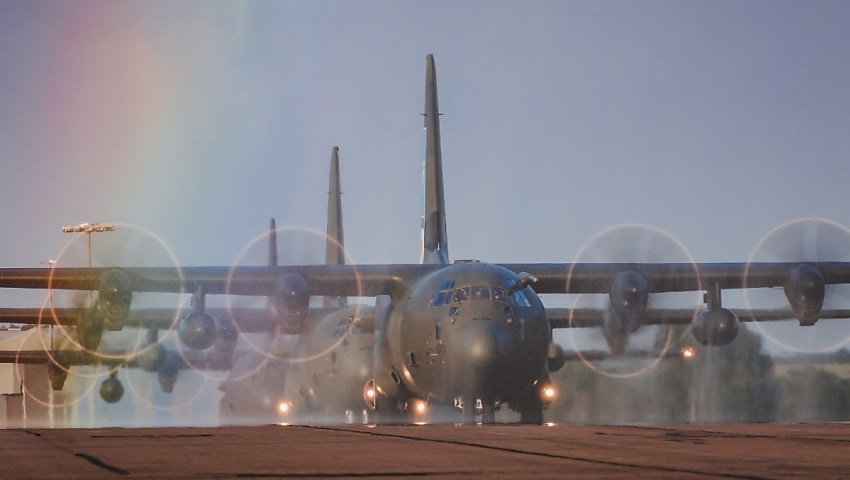
The United Kingdom’s Royal Air Force has farewelled its C-130J Super Hercules four-engine turboprop military transport aircraft with a historic flypast across the country.
The last operational Hercules flight took place on 4 June with No. 47 Squadron flying from RAF Akrotiri to RAF Brize Norton, ahead of the aircraft’s final retirement date on 30 June.
The aircraft has been in service with the RAF for 56 years. The platform remains in service with more than 20 nations across the world and the Royal Australian Air Force operates a fleet of 12 C-130J-30 Hercules from RAAF Base Richmond by No. 37 Squadron.
As part of the retirement of the C-130 Hercules in the UK, No. 47 Squadron has also been stood down and its standard laid up for a period at College Hall Officers’ Mess, RAFC Cranwell.
Wing Commander James Sjoberg, Officer Commanding No. 47 Squadron, said the C-130 fleet has been an integral part of air power for the RAF for nearly six decades, contributing to nearly every British conflict since it was brought into service in the 1960s.
“It is a great honour to command 47 Squadron at this historic moment. I am extremely proud of the people on my squadron and across the wider Hercules family; they have delivered time and again on operations,” he said.
“I wish to pay tribute to them, and their families, for their exceptional contribution to UK Defence. Whilst the retirement of the Hercules and the laying-up of the 47 Squadron standard is a sad moment for many of us, I have full confidence that the people of the RAF Air Mobility Force will continue to deliver excellence around the globe.”
The aircraft has previously been utilised for operations of air mobility fleet, supporting UK military and humanitarian relief.

Most recently, three aircraft were used in Sudan in April and May 2023 to evacuate more than 2,000 Embassy staff and British passport holders.
The aircraft has the ability to airdrop equipment and paratroopers and operate from natural surface landing zones. It’s able to conduct low-level flying and flying at night using night-vision goggles, as well as long-range capabilities enhanced with air-to-air refuelling or search and rescue missions using air survival rescue apparatus.
The Super Hercules aircraft are being replaced by new Airbus A400M transport aircraft, alongside Boeing C-17 Globemaster aircraft tasked with the heavy-lift, longer-range duties.

Want to see more stories from trusted news sources?
Make Defence Connect a preferred news source on Google.
Click here to add Defence Connect as a preferred news source.