

 iscover
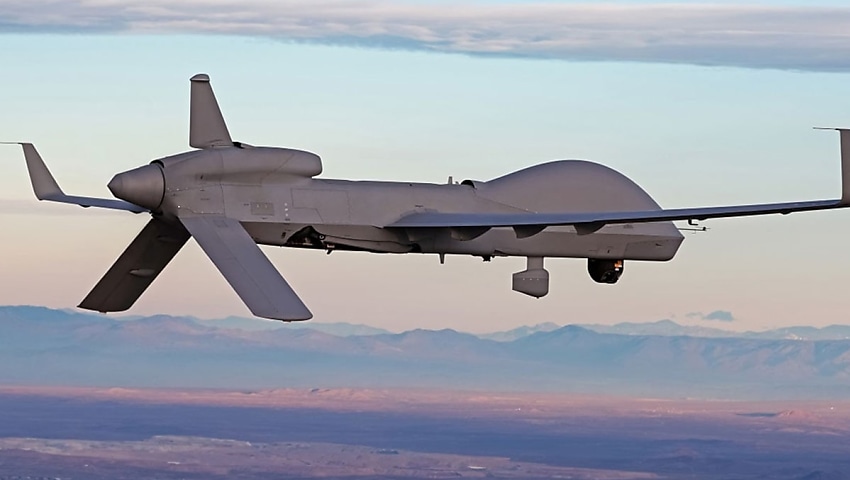
General Atomics Aeronautical Systems has successfully supported the US Army’s Project Convergence Capstone 5, a major military modernisation experiment held throughout March.
The exercise featured the MQ-1C Gray Eagle Extended Range (GE-ER) unmanned aircraft system, which operated seamlessly in contested electronic environments.
Throughout the exercise, which took place at Fort Irwin and nearby training areas, the GE-ER was fitted with commercially available, next-generation long-range sensors operated directly by Army soldiers.
Despite the presence of simulated electronic warfare threats, the aircraft remained unimpeded and effectively identified targets at ranges relevant to multi-domain operations, providing crucial intelligence for the 82nd Airborne Division and other participating units.
The aircraft demonstrated its advanced capabilities with a suite of integrated systems, including communications intelligence (COMINT), electronic intelligence (ELINT), synthetic aperture radar/moving target indicator (SAR/MTI), and mobile ad hoc network radios. These were enabled through the platform’s open-architecture C5ISR Modular Open Suite of Standards, allowing for flexible and rapid system integration.
Flying at altitudes and ranges that kept it safely beyond the reach of kinetic threats, the Gray Eagle used its long-range sensors to detect, identify and target enemy emitters and vehicles with precision.
A key feature demonstrated during Project Convergence Capstone 5 (PC-C5) was the Gray Eagle’s Expeditionary Ground Control System, a laptop-based control solution that significantly reduces operational footprint. This system allows missions to be conducted from tents, buildings or mobile shelters, enabling flexible deployment in remote or austere environments without heavy logistical demands.
The GE-ER operated in a multi-mission, multi-sensor role, carrying out persistent detect, identify, locate, and report tasks while simultaneously providing aerial mesh network support to ground units. This capability allowed soldiers and their assets to remain connected, even across terrain that would normally obstruct communications.

Employing its full range of advanced systems, including ELINT, COMINT, SAR, and Aerial Tier Network Expansion (ATNE), the MQ-1C supported the Combined Joint Task Force by sensing, tracking and targeting enemy positions in real time.
“The Gray Eagle is a true workhorse,” General Atomics Aeronautical Systems president David R Alexander said. “We rapidly integrated third-party systems, delivered user-friendly interfaces for soldiers, and ensured relevant data was available to meet long-range sensing and network expansion requirements. Its survivability and effectiveness in contested environments prove its value in modern warfare.”
Project Convergence Capstone 5 is the US Army’s flagship experimentation exercise, bringing together joint and multinational partners to test emerging capabilities in realistic, complex battlefield scenarios. The event aims to shape the future of warfare through technology integration and multi-domain operations.
Want to see more stories from trusted news sources?
Make Defence Connect a preferred news source on Google.
Click here to add Defence Connect as a preferred news source.