

 iscover
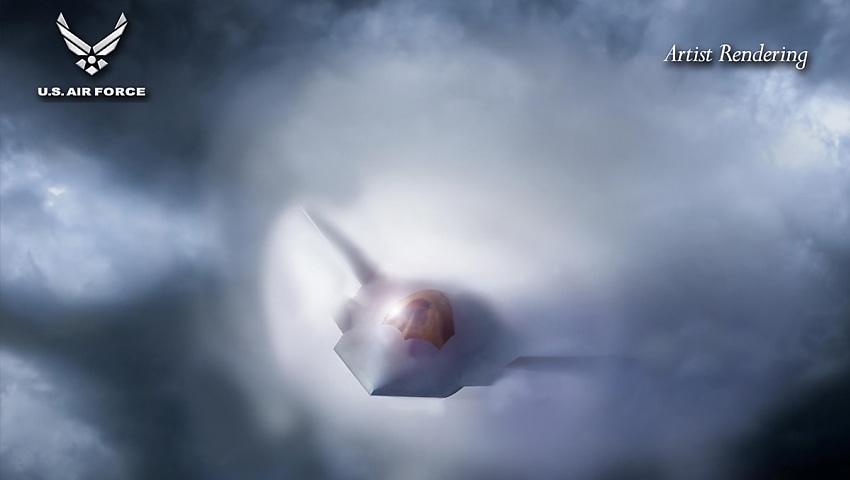
Chief of Staff for the US Air Force General David Allvin has released further details about the recently unveiled F-47 next-generation fighter aircraft and the supporting fleet of Collaborative Combat Aircraft (CCA) set to reshape the US Air Force.
The United States Air Force’s Next Generation Air Dominance (NGAD) program represents a significant leap in aerial combat capability, aimed at maintaining US air superiority well into the mid-21st century. Initiated in the mid-2010s, the NGAD program emerged as a response to the rapid advancements in military aviation by near-peer competitors, notably China and Russia.
Its development marks a shift away from traditional single-platform solutions, like the F-22 Raptor or F-35 Lightning II, towards a broader system-of-systems approach. This includes a manned sixth-generation fighter aircraft at the core, supported by an array of uncrewed systems and advanced networking technologies.
Early conceptual work for NGAD was conducted under the Defence Advanced Research Projects Agency (DARPA) and matured through classified research and development. By 2020, the program had already produced a demonstrator aircraft that had reportedly flown, signalling an accelerated pace rarely seen in modern fighter development.
The NGAD platform is expected to feature advanced stealth capabilities, artificial intelligence-assisted operations, modular weapons systems and enhanced range and survivability.
A key tenet of NGAD is its adaptability across different theatres of operation, with tailored variants for the Indo-Pacific and European regions – this flexibility is intended to counter evolving threats in contested environments.
The program also introduces the concept of CCA, uncrewed autonomous drones designed to operate in concert with the manned fighter, expanding combat effectiveness and survivability.
With full operational capability projected for the 2030s, the NGAD program stands as a cornerstone of future US air power, with the US Air Force aiming for the F-47 to not only replace the ageing F-22 fleet but also to redefine how air dominance is achieved and sustained in increasingly complex and contested battlespaces.

While shrouded in mystery, the US Air Force Chief of Staff, General David Allvin, has turned to social media to reveal some further details about the future of the US Air Force’s NGAD program, including some specifics about their aircraft.
General Allvin said in an X post, “Our @usairforce will continue to be the world’s best example of speed, agility, and lethality. Modernisation means fielding a collection of assets that provide unique dilemmas for adversaries – matching capabilities to threats – while keeping us on the right side of the cost curve.”
Further to this, General Allvin’s post highlighted that the F-47 would be expected to see some form of operational capability between 2025 and 2029, with a minimum number of aircraft of 185 airframes, or a one-for-one replacement for the F-22 Raptor fleet.
In addition to this, the information revealed by Gen Allvin stated that the aircraft will have a combat radius in excess of 1,000 nautical miles (1,852 kilometres), a major increase over the F-22 Raptor’s combat radius of just 590 nautical miles (1,092 kilometres) with a top speed in excess of Mach 2 and major enhancements to the stealth capabilities of the aircraft.
For reference, the F-35A Lightning II, operated by the US Air Force and the Royal Australian Air Force, has a combat radius of 670 nautical miles (1240 kilometres) with a top speed of Mach 1.6.
Shifting focus to the CCA, uncrewed autonomous drones, the General Atomics YFQ-42A and the Anduril YFQ-44A, each has an expected operational capability in line with the F-47, in excess of 1,000 airframes to be procured and a combat radius of 700+ nautical miles or 1,296 kilometres at a minimum.
This emphasis on range highlights the thinking and shift in priorities for the US as it pivots away from operating theatres in Europe and the Middle East to focus on the Indo-Pacific and to overcome the range limitations that confront the US and its allies in the region, Australia included.

Want to see more stories from trusted news sources?
Make Defence Connect a preferred news source on Google.
Click here to add Defence Connect as a preferred news source.