

 iscover
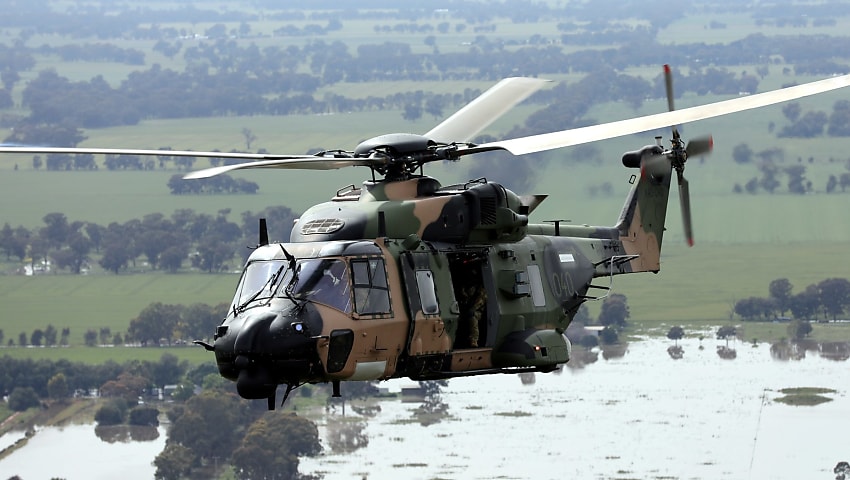
Unrecognised spatial disorientation has been found as the primary cause of a fatal MRH-90 Taipan helicopter crash in July 2023.
A recently released Aviation Safety Investigation Report, finished by the Defence Flight Safety Bureau (DFSB), investigated the details surrounding the incident which occurred during a night training activity at Exercise Talisman Sabre 2023 near Lindeman Island.
Captain Danniel Lyon, Lieutenant Maxwell Nugent, Warrant Officer Class 2 Joseph “Phillip” Laycock and Corporal Alexander Naggs lost their lives during the accident, which occurred on 28 July 2023.
The report detailed that the Taipan helicopter, callsign Bushman 83, had been flying third in a four-helicopter formation when it impacted ocean in the vicinity of the Whitsunday Islands.
The released aviation safety investigation is considered to be one of the most complex conducted by Defence in recent history. In addition, aviation safety investigations reportedly did not seek to apportion blame or liability on individuals or organisations.
The investigation concluded that the primary cause of the accident was an unrecognised loss of spatial orientation, commonly referred to as spatial disorientation (where a pilot is unaware of their actual orientation in relation to the surrounding environment).
“Overall, the investigation found that the primary cause of the accident was Type 1 (Unrecognised) SD, leading to controlled flight into terrain. The most fundamental lesson for Defence Aviation is to recognise that all aircrew are exposed to spatially disorienting effects due to the unique nature of military operations in degraded visual environments, low illumination levels or poor contrast conditions,” according to the report.
“Defence Aviation has placed a significant emphasis on training, competency and assessment to operate in such environments and conditions, and to apply UA techniques to react and recover from Type II (Recognised) SD events. However, the ASIT reached the conclusion that training, competency and assessment to promote awareness of Type I (Unrecognised) SD, such as the warning signs and indicators of decreasing SA and/or complete loss of spatial orientation, is a challenging and complex task.

“Defence Aviation has long had a culture of ‘can do’, with high-achieving and driven personnel working in challenging and complex environments. This accident has drawn attention to the fallibility of humans in complex systems and acts as a stark reminder of the importance of the systems and processes built to support effective performance and ensure safety in operating environments.
“It should also prompt organisational reflection on the enduring aspiration to build a ‘generative safety culture’ – the need to maintain a persistent state of vigilance, be receptive to learning, have a willingness to respond to opportunities, and a collective commitment to enhancing aviation safety.”
In a detailed account of the timing and events of the crash, the DFSB recounted that when visibility ahead of BSMN 83’s flight path was likely degraded and without a discernible horizon, the aircraft began to climb from 224 feet to a height of 362 feet, further reducing the aircraft’s visibility to assess position within the formation.
The report speculated that BSMN 83 made a roll to regain sight of the formation, unwittingly lowering its pitch altitude and increasing air speed. The pilots, seeking to avoid a potential collision with the formation, further unintentionally pitched the aircraft’s nose downward and entered a very high and unrecoverable rate of descent towards the water, according to the report.
“On the basis of evidence analysed by the ASIT, the most plausible cause of the accident was Type I (Unrecognised) SD leading to CFIT,” according to the report.
“As is the case with the majority of aircraft accidents, the investigation found that the accident was more than likely the result of a combination of contributing factors.”
The report also found it was more than likely that misleading sensory inputs contributed to the pilots of BSMN 83 losing spatial awareness of the departure from formation parameters, creating a widening gap between the perceived and actual situation.
In addition, it found that personnel on the aircraft had been awake for 15.5 hours and 14 hours at the time of the accident – increasing the likelihood of experiencing a level of fatigue considered sufficient to impede their fitness.
Report interviewees described the sleep environment of the crew as stretchers in tents of up to 18 people, located in an active civilian aerodrome. In addition, the accommodation was not air-conditioned and multiple interviewees reported interruptions to their sleep due to movements of other people in the tents who were on different sleep schedules, aircraft movements. The likely quality of restful sleep was assessed as “likely poor” and that “it is likely that the sleep environment contributed to BSMN 83’s AC and CP obtaining restricted sleep”.
The report also found that a decision was made to close the cabin doors of the Taipan (usually left open and able to contribute to aircraft visibility) due to anticipated rain showers and wind chill factor. Closure of the cabin doors likely impeded the ability of BSMN 83’s ACMN to contribute effectively to the situation awareness… but was permissible, according to the report.
The report identifies 196 findings, indirect findings and observations, which inform 46 recommendations across the Defence Aviation Safety Program. The Defence Aviation Authority has accepted and is actioning all of the report’s recommendations and has issued direction to assure these recommendations are completed, and the outcomes are assessed for the effectiveness of implementation.
Defence has provided the report to the Inspector-General of the Australian Defence Force and Comcare and is in the process of providing it to the Queensland Coroner.

Want to see more stories from trusted news sources?
Make Defence Connect a preferred news source on Google.
Click here to add Defence Connect as a preferred news source.