

 iscover
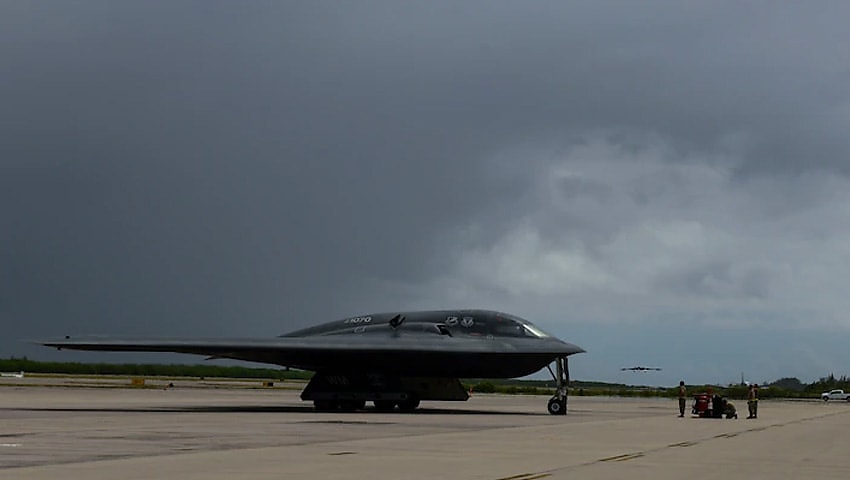
The success of the B-2 raids on Iran has sharpened the case for a jointly developed AUKUS loyal wingman UCAV, giving allies a cost-effective, sovereign long-range strike option to bolster deterrence, survivability and reach in contested environments.
The recent success of American B-2 stealth bomber strikes against Iranian military infrastructure has reaffirmed the value of long-range, low-observable strike platforms in modern warfare.
The proliferation of advanced air defence systems and precision long-range weapons by peer competitors – particularly those being developed and fielded at rapid pace by China – continues to erode the technological and quantitative edge held by the aggregated forces of Australia, the US, Japan and other partners in the region, making the case for a next-generation, trilaterally developed AUKUS unmanned combat aerial vehicle (UCAV) an often overlooked avenue for greater allied mass.
As AUKUS Pillar II focuses on advanced capabilities and emerging technologies, Australia, the United Kingdom, and the United States have a unique opportunity to redefine strategic deterrence by jointly developing a stealth UCAV designed to operate both alongside and independently of the US Air Force’s next-generation B-21 Raider bomber.
This proposed UCAV would be built with intercontinental range (over 9,300 kilometres), advanced stealth shaping and carry approximately 75 per cent of the B-21’s 13,600-kilogram weapons payload, and through leveraging the existing doctrine and thinking around the concepts of collaborative combat aircraft or loyal wingmen to build a loyal wingman to the B-21, the aircraft would expand the bomber’s combat mass and survivability.
For Australia and the UK, both unlikely to acquire manned strategic bombers, it would serve as a sovereign, long-range strike platform able to operate autonomously in contested theatres. Crucially, the UCAV would inherit the B-21’s open systems architecture, enabling seamless integration into future multi-domain operations. It could execute strike missions, electronic warfare, ISR, decoy and kinetic tasks at high risk and low cost, reducing the burden on exquisite crewed assets.
At less than half the cost of a B-21, estimated between US$200–300 million (AU$308–462 million), the AUKUS UCAV offers unmatched cost-effectiveness for both mass and reach. Australia brings expertise from the MQ-28 Ghost Bat and its rapid prototyping ecosystem. The UK contributes from its Global Combat Air Programme (GCAP) and Taranis program, while the US offers propulsion, stealth and Collaborative Combat Aircraft (CCA) integration technologies from B-21 and Next Generation Air Dominance (NGAD) developments.
In today’s Indo-Pacific strategic environment characterised by China’s growing long-range strike arsenal, hypersonic missile development and layered anti-access/area denial (A2/AD) networks, the survivability of manned platforms is rapidly declining. A stealth UCAV matched to the B-21’s radar cross-section and range can offset this risk by acting as both an enabler and a force multiplier.

Its long reach allows operations from US mainland bases, northern Australia or Diego Garcia, striking deep into the South China Sea or the Korean Peninsula without relying on forward basing. For Australia, it represents a return to strategic air power capability not seen since the retirement of the F-111, meanwhile for the UK, it fills the gap left by the Tornado and aligns with their future air combat roadmap.
By leveraging proven technologies and established models for multinational collaboration, this effort presents substantial economic, operational and strategic benefits for AUKUS members while significantly accelerating development timelines.
Setting the standard
The Northrop Grumman B-21 Raider, developed under the United States Air Force’s Long Range Strike Bomber program, will form the core of America’s strategic strike capability through to the 2050s and realistically, well beyond that.
Engineered for deep penetration missions, the B-21 is designed to operate in highly contested environments, offering long-range global strike with both conventional and nuclear munitions. Its design allows for global reach from mainland US bases, negating the need for forward-deployed infrastructure that may be vulnerable in wartime.
Importantly, the B-21 is being built with open systems architecture and optional crewed configurations, positioning it as a true “digital bomber” that can seamlessly integrate with unmanned systems like the CCA.
A UCAV developed under AUKUS would capitalise on these attributes utilising the B-21’s advanced data fusion, secure communications and sensor-sharing capabilities to increase mission survivability, enhance lethality through distributed operations and function as a high-end strike node in its own right.
Many hands make light work – the joint development case and path to development
With a unit cost in excess of US$700 million (AU$1.07 billion), the B-21 is a critical but high-cost asset, making its deployment in high-volume strike missions inherently risky. While appropriate for US strategic needs, it remains financially and politically prohibitive for Australia and the UK to acquire.
However, a UCAV with roughly 75 per cent of the B-21’s payload capacity and intercontinental range – but at less than half the cost (estimated at US$200–300 million or AU$308–462 million), offers an attractive path to increase both firepower and survivability without prohibitive investment.
Each AUKUS nation brings complementary capabilities to this proposed joint development:
- Australia contributes cutting-edge experience in digital design, prototyping and unmanned systems through its Boeing MQ-28 Ghost Bat program, in addition to extensive test ranges and secure airspace.
- The United Kingdom brings deep expertise in advanced avionics, power systems and autonomous mission software through its Taranis demonstrator and participation in the GCAP.
- The United States contributes propulsion, low-observable materials and secure communications systems developed through the B-21, CCA and NGAD programs.
A shared program would reduce research and development overheads, streamline supply chains and drive production scale benefits while fostering a sovereign industrial base particularly in Australia and the UK. Such collaboration also offers the potential to reduce reliance on the US foreign military sales system and deepen allied strategic autonomy.
With mounting concerns about looming capability gaps and the potential for direct kinetic conflict, even in a limited but enduring capacity in our part of the world and on the European continent, accelerating the development and delivery of such a platform needs to be achievable in a timely manner.
Doing so requires an effective division of labour, as previously mentioned and critically, a clear timeline and co-development precedents already in existence, along the lines of:
- Ghost Bat rapid prototyping (Australia): Built in just three years using digital twin technology, the MQ-28 offers a mature foundation that could be scaled for increased range and payload.
- United States Air Force CCA: The US aims to field loyal wingmen by 2030. A strike-optimised B-21 variant could be adapted within the same programmatic umbrella.
- F-35-style co-development: While politically complex, lessons from the F-35 program on workshare, sustainment and training can inform a streamlined three-nation effort.
- Spiral development: Begin with a Block 1 strike/ISR configuration, then evolve to include advanced autonomy (Block 2) and hypersonic or space-link capabilities (Block 3).
- A dedicated AUKUS Joint Program Office: To manage security protocols, coordinate development and enable sovereign upgrade pathways across all partners.
The tactical case
The strategic landscape, especially in the Indo-Pacific, is becoming increasingly hostile to traditional crewed aircraft due to the rapid proliferation of long-range surveillance radars, integrated air defence systems and anti-ship and land-attack missiles.
In such environments, a stealth UCAV designed to mirror the B-21’s radar signature and flight profile could conduct high-risk missions with greater flexibility and lower political cost.
Tactically, through increased use of open systems architecture and increased modularity, the UCAV could perform multiple roles:
- Kinetic strike: Launching Joint Air-to-Surface Standoff Missile-Extreme Range (JASSM-XR), small diameter bombs, hypersonic glide vehicles and precision free-fall bombs either in concert with a B-21 or independently.
- Electronic warfare: Carrying jamming pods and electronic attack payloads to blind or confuse enemy sensors ahead of a manned strike.
- Sensor extension: Providing forward ISR, targeting support, and battle damage assessment via low probability of intercept/low probability of detection (LPI/LPD) datalinks.
- Decoy operations: Mimicking the B-21 to saturate enemy defences and divert fire from human-crewed assets.
Crucially, with unrefuelled intercontinental range, these platforms could be launched from northern Australia, Diego Garcia or even the US mainland, allowing them to reach high-value targets across the South China Sea, Taiwan Strait or North Korea without relying on vulnerable forward airbases.
For Australia, this UCAV could restore strategic strike capacity lost with the retirement of the F-111, fulfilling a long-standing capability gap without the political complexity of fielding a manned bomber. For the UK, it would reintroduce long-range strike options absent since the retirement of the Tornado and enable deeper integration with US and AUKUS partners.
Strategic logic
Given its nuclear role, the B-21 is highly unlikely to be exported or permanently forward-deployed. A conventionally armed AUKUS UCAV, however, enables burden-sharing and strategic integration under a common doctrine while reinforcing national sovereignty.
For the US, it means higher sortie generation, distributed lethality and enhanced survivability of its bomber fleet. For Australia, it offers a potent strategic deterrent aligned with the Defence Strategic Review’s emphasis on long-range precision fires. For the UK, it supports global force projection and industrial renewal, while reinforcing its role in Indo-Pacific security.
The UCAV would also serve as a tangible demonstration that AUKUS is not solely about nuclear submarines but a framework for integrated deterrence across multiple domains – air, sea, space, cyber and beyond.
Final thoughts
A UCAV with the B-21’s range and 75 per cent of its payload developed trilaterally by AUKUS partners would represent a quantum leap in allied strike capability. It allows the US to augment its exquisite bomber fleet while giving Australia and the UK credible, sovereign and scalable strike power in an increasingly contested global environment.
In the wake of the B-2’s operational success over Iran and amid the growing challenge posed by China’s expanding strike and anti-access/area denial architecture, this program would transform AUKUS from an aspirational partnership into a practical engine for integrated deterrence and technological dominance ensuring the allies stay decisively ahead of the curve.
Get involved with the discussion and let us know your thoughts on Australia’s future role and position in the Indo-Pacific region and what you would like to see from Australia’s political leaders in terms of partisan and bipartisan agenda setting in the comments section below, or get in touch at

Want to see more stories from trusted news sources?
Make Defence Connect a preferred news source on Google.
Click here to add Defence Connect as a preferred news source.