

 iscover
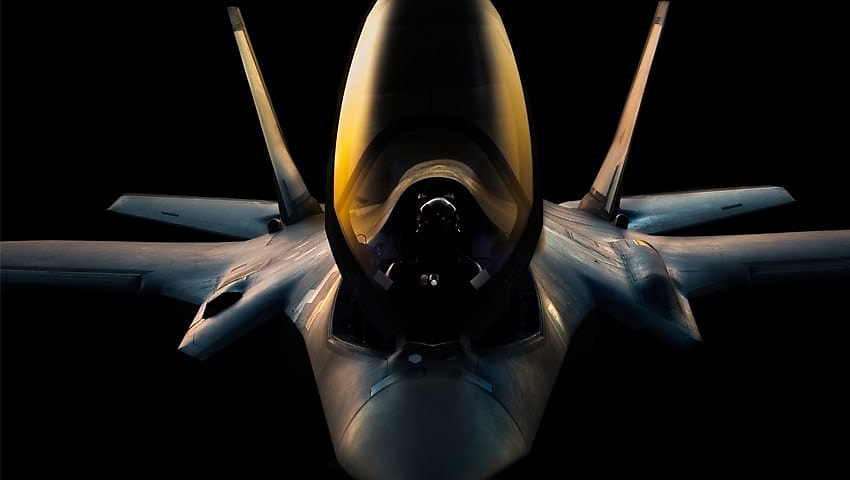
The president and CEO of global aerospace leader Lockheed Martin, Jim Taiclet, has set tongues wagging following the company’s second quarter financial results revealing a US$1.6 billion (AU$2.45 billion) pre-tax loss, but also revealing a “magical” next-generation aircraft for US and international customers.
These revelations come following what has been described as one of the company’s worst quarters to date, which saw the company report second quarter 2025 sales of US$18.2 billion (AU$27.93 billion), broadly in line with the US$18.1 billion (AU$27.75 billion) recorded for the same period in 2024.
However, the company posted significantly lower net earnings of US$342 million (US$1.46 per share), impacted by US$1.6 billion (AU$2.45 billion) in program losses and US$169 million (AU$259.2 million) in other charges, compared to US$1.6 billion (US$6.85 per share) in Q2 2024.
The company also saw operating cash flow fall sharply to US$201 million (AU$308.29 million), down from US$1.9 billion (AU$2.91 billion) a year earlier, while free cash flow turned negative at US$150 million (AU$230.1 million), compared to US$1.5 billion (AU$2.3 billion) in Q2 2024.
Lockheed Martin chairman, president and CEO Jim Taiclet said, “Over the course of the past few months, Lockheed Martin systems and platforms once again proved highly effective in combat operations and in deterring further aggression. Our F-35s, F-22s, PAC-3, THAAD, Aegis and many others, crewed by the soldiers, aircrews, sailors, marines and guardians of the US and its allies, and supported by our own dedicated teammates, performed extremely well in the most crucial and challenging situations.”
Taiclet added, “Overall, the company’s foundation remains solid and resilient. In the second quarter, sales of US$18 billion (AU$27.6 billion) grew sequentially, as we continued to drive supply chain improvements and ramp capacity on needed deterrent capabilities. In addition, we invested US$800 million (AU$1.2 billion) in infrastructure and innovation for growth and returned US$1.3 billion (AU$1.99 billion) to shareholders through dividends and share repurchases. We are maintaining full year 2025 guidance for sales, cash from operations, capital expense, free cash flow and share repurchases.”
“The program charges taken in the quarter – which resulted from our ongoing rigorous monitoring and review processes – are a necessary step as we continue to take action to improve program execution. We’re investing in emerging technologies, and as a proven mission integrator, we remain well positioned to support critical programs like the Golden Dome for America. Our relentless focus on operational performance, combined with our disciplined capital allocation strategy, will enable us to deliver value to our shareholders while providing the advanced solutions that America and its allies need to maintain peace through strength for decades to come,” he added further.
Progressing through the detailed investor relations call, Taiclet turned his attention to a classified aeronautics program which has faced ongoing challenges with design, integration, testing and overall performance on this program, with issues continuing into 2025 and having a greater-than-expected impact on both timelines and costs. In response, the company undertook a full review of its program management and execution, completed in the second quarter.

Following this review and after further discussions with the customer and suppliers, Aeronautics implemented major changes to its processes and testing approach. These changes led to significant revisions to the program’s schedule and cost projections. As a result, the company recorded additional pre-tax losses of US$950 million (AU$1.45 billion) on the program during the second quarter of 2025.
However, by far the most important part of this Skunk Works program is shared by Taiclet: “This particular program team discovered new insights in the quarter that required us to adjust our expected future costs on that program and then recognised the charge for doing so. I acknowledge the losses on this classified program are significant. Again, we are taking these charges very seriously and have initiated changes in program team management and assigned experts across the company to approve the performance and oversight of this program under a comprehensive risk identification and corrective action plan.”
Taiclet further detailed the company’s long-term vision for this experimental program, adding, “This is a highly classified program that can only be described as game-changing capability for our joint US and international customers and therefore it is critical that it be successfully fielded. With our enhanced oversight of this program and rapid incorporation of lessons learned, we expect to continue to reduce risk over the next few years as we move through the key milestones of this very advanced system.”
This isn’t without its challenges, with Taiclet indicating that the program is placing significant financial burdens on the company, something that the US defence customer is increasingly aware of and would hopefully, according to the president and CEO, be “open to figuring out ways to make it more reasonable”.
Taiclet later went on to describe the capability and its long-term implications for the business, saying, “But that’s the nature of something of this magical status, I would call it. We probably won’t be able to talk about what that is for many years to come, but I can assure you that it’s going to be in high demand for a very long time, well beyond the fixed price commitments, I would expect, let’s say. So I’ll stop there.”
These exciting and cryptic revelations come despite the company’s failure to secure the lucrative contract for the US Air Force’s F-22 Raptor replacement program, the F-47 Next Generation Air Dominance fighter aircraft, ultimately won by Boeing which saw the company record a US$66 million (AU$101.22 million) charge, mainly due to the write-off of fixed assets.
Finally, in addition, Taiclet reinforced his intentions and ambitions to maximise the company’s hard-earned research and development investments in the NGAD program by leveraging them into the F-35 and F-22 programs, respectively, effectively to develop a 5.5 generation fighter aircraft.
Taiclet, responding to questions about the future of F-35 and F-22 programs, added, “Because we did bid on NGAD, everyone knows that we weren’t selected, but the pivot that we made is one that we’re taking incredibly seriously, which is how do we create a best value bridge from today’s fifth generation to sixth generation. NGAD is Next Generation Air Dominance airplane and that may not be fielded for quite a few years, I’ll say a number of years.”
Taiclet added, “How do we bridge capability there? We’re going to port a lot of our own NGAD R&D over to the F-35 and potentially the F-22 as well and striving to get 80 per cent effectiveness of sixth generation, both in stealth and other aspects at 50 per cent of the cost per unit, all in with R&D and non-recurring. And that’s the best value option for the US government going forward. It’ll be the only one I’m aware of that can actually make that bridge over, you know, call it five plus, maybe even 10 years.”
The question now becomes, what is in the box?!

Want to see more stories from trusted news sources?
Make Defence Connect a preferred news source on Google.
Click here to add Defence Connect as a preferred news source.