

 iscover
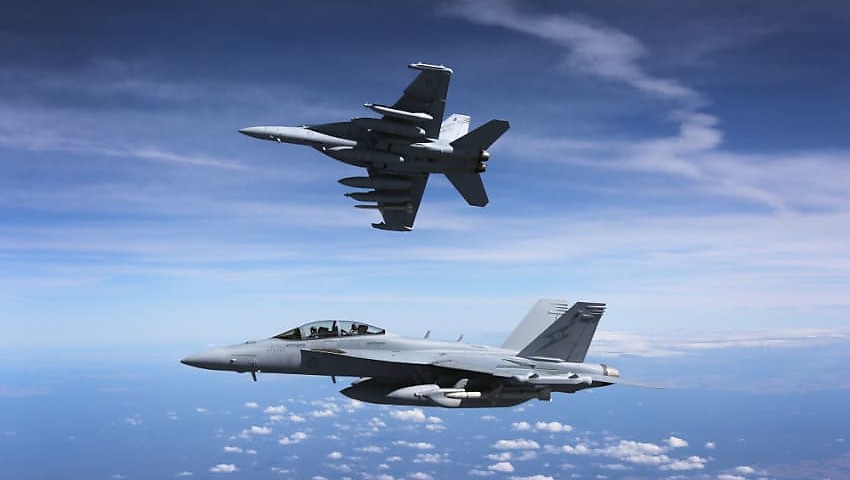
Raytheon Technologies has taken a major step forward in developing its next-generation electronic warfare suite for the United States Navy’s F/A-18E/F Super Hornet fleet, with the company’s Advanced Electronic Warfare prototype successfully passing a critical software and systems review.
The milestone confirms that the Advanced Electronic Warfare (ADVEW) prototype is progressing on schedule, with software integration, flight-representative hardware testing and alignment with US Navy reference architectures all validated.
The system is designed to replace the current AN/ALQ-214 Integrated Defensive Electronic Countermeasures system, which has formed the backbone of the Super Hornet’s self-protection capability for more than two decades.
According to Raytheon, ADVEW will offer faster threat detection, more agile countermeasures and increased survivability in contested environments dominated by advanced radar and missile systems.
Daniel Theisen, president of advanced products and solutions at Raytheon, said the system would significantly enhance the Super Hornet’s effectiveness against emerging electronic threats.
“Our ADVEW prototype continues to showcase significant progress in both hardware and software that will improve the aircraft’s ability to detect and counter electronic threats,” Theisen said.
Theisen added, “We are on track with our fast-paced schedule and will continue developing the system to meet all necessary requirements on the US Navy's accelerated fielding timeline.”
The announcement comes as the US Navy prepares to keep the Super Hornet in front-line service well into the 2040s, despite earlier plans to curtail production. For Australia, the development has direct implications.

The Royal Australian Air Force (RAAF) operates 24 F/A-18F Super Hornets from RAAF Base Amberley, acquired in 2010, as an interim strike capability before the arrival of the F-35A Lightning II.
In addition to its strike-fighter role, the Super Hornet is a key platform for electronic warfare integration with the RAAF’s fleet of 12 EA-18G Growlers, which carry dedicated jamming pods and sensors. If adopted by Canberra, ADVEW could help future-proof the RAAF’s Super Hornets and ensure seamless interoperability with US Navy counterparts in high-threat environments.
Raytheon has already conducted a test plan working group with the US Navy to refine in-flight evaluation processes and streamline certification. The next phase will see further demonstrations and the delivery of production-representative systems for government-run integration testing.
Defence observers noted that with Australia’s defence policy increasingly focused on countering advanced anti-access/area denial threats in the Indo-Pacific, investment in electronic warfare upgrades for the Super Hornet and Growler fleet could become a priority under the Integrated Investment Program.

Want to see more stories from trusted news sources?
Make Defence Connect a preferred news source on Google.
Click here to add Defence Connect as a preferred news source.