

 iscover
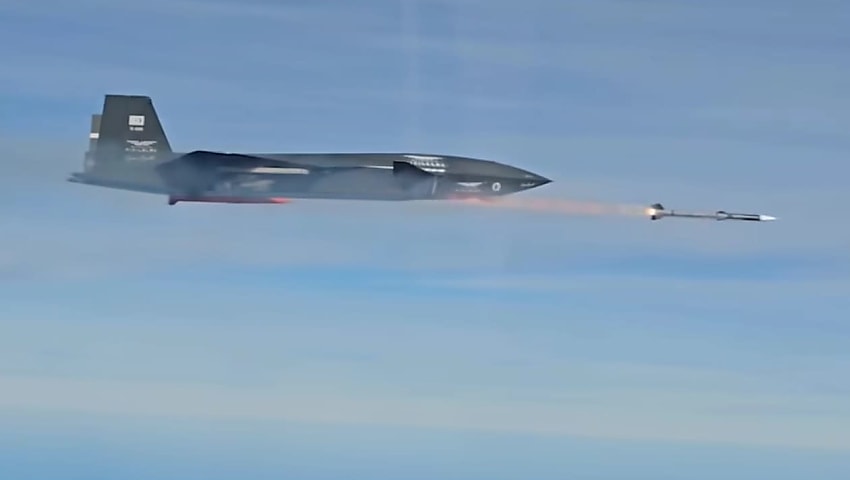
Turkiye’s unmanned fighter aircraft, the Bayraktar Kizilelma, has reportedly achieved a beyond-visual-range (BVR) air-to-air missile strike for the first time.
The uncrewed combat aircraft was reportedly able to utilise the country’s MURAD radar system and a Turkish Gokdogan air-to-air, fire and forget missile to track and destroy an aerial target, according to footage released by Turkish defence company Baykar.
The event was supported by the Turkish Armed Forces, the Turkish Defence Industry Agency, Baykar and other defence companies such as Aselsan and Tubitak Sage.
“We have opened the doors to a new era in aviation history. For the first time in the world, an unmanned combat aircraft fired an air-to-air missile with radar guidance and hit an aerial target with perfect accuracy,” according to a statement from the company.
“Our entirely indigenous and original Bayraktar Kizilelma successfully completed this historic mission.
“The first country in the world to achieve this. The Turkish Armed Forces have made history. The doors to next-generation aerial warfare have been opened.”
The uncrewed combat aircraft has previously conducted a simulated lock and fire test using the same air-to-air missile against a pair of F-16 fighter aircraft from the Turkish Armed Forces.
During that test, the combat aircraft reportedly detected the F-16 at a distance of 30 miles and transmitted real-time target, position and velocity data from its MURAD AESA radar to an air-to-air missile carried under its wing.

Late last month, on 17 November, the company also announced that it had fitted the unmanned fighter aircraft with a low-observable electro-optical targeting system for the first time.
“The system demonstrated outstanding performance during two separate flight tests conducted within the last week at the AKINCI Flight Training and Test Center,” the company said.
“The tests successfully validated stable image generation at various altitude and speed regimes, long-range tracking stability on moving targets and high-accuracy laser designation functions.
“It was confirmed that the system maintained seamless data exchange with Kizilelma’s integrated mission computer and preserved its performance even under demanding environmental conditions.
“This test marks the first time globally that ‘embedded EOTS’ technology has been implemented on an unmanned fighter aircraft. While platforms like the F-16 carry targeting systems as external pods, concealing this system inside Bayraktar Kizilelma’s airframe is critical for its low radar cross-section (low observability) capability.”

Want to see more stories from trusted news sources?
Make Defence Connect a preferred news source on Google.
Click here to add Defence Connect as a preferred news source.