

 iscover
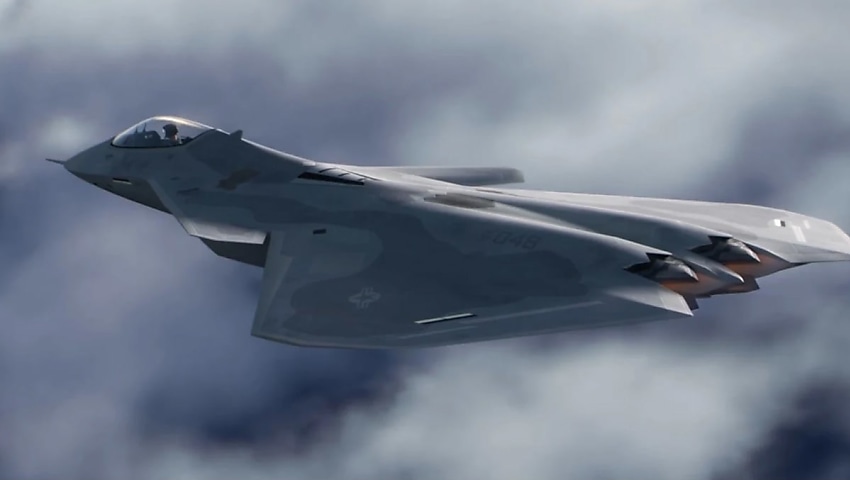
Global defence titan and owner of advanced jet propulsion manufacturer, Raytheon, has released a fresh look at the US Air Force’s Next Generation Air Dominance fighter, the F-47, in a video, revealing further details about this exciting new capability.
While still highly secretive, the United States Air Force’s Next Generation Air Dominance (NGAD) program represents a significant leap in aerial combat capability, aimed at maintaining US air superiority well into the mid-21st century.
Initiated in the mid-2010s, the NGAD program has emerged as a response to the rapid advancements in military aviation by near-peer competitors, notably China and Russia, who are actively accelerating their own efforts to develop and field a fleet of sixth-generation fighter aircraft.
The US development marks a shift away from traditional single-platform solutions, like the F-22 Raptor or F-35 Lightning II, towards a broader family-of-systems approach. Which will include a manned sixth-generation fighter aircraft at the core, supported by an array of uncrewed systems, namely aircraft developed under the Collaborative Combat Aircraft program and enabled by advanced networking technologies.
A key tenet of NGAD is its adaptability across different theatres of operation, with an expectation that the US Air Force could field tailored variants for the Indo-Pacific and European regions, providing the US Air Force with the flexibility intended to counter evolving threats in contested environments.
With full operational capability projected for the 2030s, the NGAD program stands as a cornerstone of future US air power, with the US Air Force aiming for the F-47 to not only replace the ageing F-22 fleet but also to redefine how air dominance is achieved and sustained in increasingly complex and contested battlespaces.
However, little detail remains about the aircraft to date, this comes despite the formal announcement that Boeing would be responsible for the delivery of a fleet of “at least 185” F-47 Next Generation Air Dominance aircraft, beating out Lockheed Martin in mid-March 2025.
Former US Air Force chief of staff General David Allvin said at the announcement, “With this F-47 as the crown jewel in the Next Generation Air Dominance Family of Systems, we believe that this provides more lethality. It provides more capability, more modernised capability, in a way that is built to adapt, along with our Collaborative Combat Aircraft.”

That is at least until now.
While Boeing, has to date, remained tight-lipped about the exact specifics of the airframe and the capabilities developed, one of the world’s largest defence contractors and owner of Pratt & Whitney – responsible for the development of the next-generation propulsion system under the Next-Generation Adaptive Propulsion (NGAP) program – has released some new, albeit computer-generated footage of the new F-47.
As part of the revelation, Raytheon provided updated information about the NGAP engines and the role it will play in delivering a next-generation air combat capability, with Alex Johnson, who leads Pratt & Whitney’s NGAP program, saying, “The United States is not interested in parity in any fights around the world.”
“You’re really looking to create air superiority and air dominance – and you do that by staying at least several years and preferably decades ahead of any potential adversaries,” Johnson added.
This sentiment is echoed by GEN (Ret’d) Allvin at the formal announcement of Boeing’s selection, where he said, “Air dominance is not a birthright, but it’s become synonymous with American airpower, but our dominance needs to be earned every single day.”
Raytheon and Pratt & Whitney’s work on the NGAP program builds on the breakthroughs the company made through the development and through-life support for the F119 engine developed for the F-22 Raptor, something Johnson detailed, saying, “They [the US Air Force] wanted that experience again not only from the performance of the engine but from the interaction with our team.”
“We’re creating perhaps the most complicated machines on the face of the planet, and yet they are some of the most reliable machines on the planet. That’s important because our team is committed to making sure the warfighter has what they need to complete their mission and come home safely. You want to make sure that it’s going to work, and you want to make sure that it’s going to get done on time – Pratt & Whitney is the place that you can get that dependable engine,” Johnson added.
So what does the image appear to confirm about the new aircraft?
Well, first things first. We see that there is front canards depicted just aft of the cockpit and a clear lack of vertical fin stabilisers, giving the aircraft a clear flying wing appearance, with integrated trailing edges responsible for pitch and yaw, similar to that of the Northrop Grumman B-2 Spirit and B-21 Raider bombers, respectively.
The overall blended wing design indicates an emphasis on sustainably high-speeds, increased range and full-spectrum low observability, as opposed to the superior low observability from specific angles and relatively short ranges and even shorter sprint speeds of fifth-generation aircraft like the Raptor and F-35.
While some experts have raised concerns about the use of canards into the aircraft, citing concerns about the aircraft’s low observability profile, however, the inclusion of the canards in the design (as was indicated in both publicly revealed images of the F-47 from the official announcement and since then) indicates a significant shift in thinking from the US Air Force.
We also see a bubble cockpit, positioned high to the forward of the aircraft denoting a clear priority on pilot visibility and ensuing situational awareness, critical to air dominance and air supremacy missions.
Shifting towards the rear, we see an F-22/F-35A-style dorsal mounted, stealth air-to-air refuelling port before getting to twin, supercruise-capable NGAP engines with what appears to be F-22 Raptor-style thrust vectoring nozzles, hinting at the same or better levels of maneouvrability to its predecessor, the Lockheed Martin F-22 Raptor.
Perhaps, most significantly, sans a central engine, this depiction of the F-47 looks conspicuously like the Chinese People’s Liberation Army Air Force’s own J-50 sixth-generation fighter aircraft.
So let’s see what comes it.

Want to see more stories from trusted news sources?
Make Defence Connect a preferred news source on Google.
Click here to add Defence Connect as a preferred news source.