

 iscover
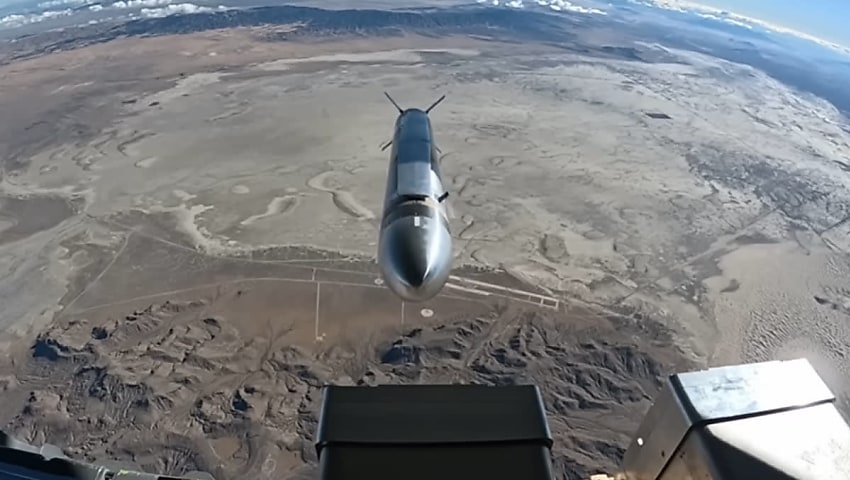
The US Air Force has formally designated a new long-range strike weapon developed by Leidos as the AGM-190A, marking a significant step forward in efforts to field more affordable and adaptable precision strike systems.
The weapon, previously known as the Small Cruise Missile (SCM), has been developed to meet a growing demand within the US military for lower-cost stand-off strike capabilities that can be produced at scale and adapted rapidly to evolving battlefield conditions.
According to the company, the AGM-190A is a 200-pound-class cruise missile designed to deliver precision effects at long range while remaining significantly cheaper and more flexible than traditional cruise missile systems.
During recent flight tests conducted from a Lockheed Martin C-130 Hercules transport aircraft, the AGM-190A demonstrated a stand-off range exceeding 400 nautical miles (approximately 740 kilometres). The tests highlight the missile’s ability to be launched from aircraft that are not traditionally used as strike platforms, expanding the number of assets capable of delivering precision attacks.
Military planners increasingly view this kind of distributed strike capability as essential for modern warfare, particularly in highly contested environments where traditional fighter and bomber operations may be constrained by advanced air defence systems.
A key feature of the AGM-190A is its modular architecture, which allows the missile’s hardware and software to be adapted quickly for different mission requirements.
The weapon incorporates an open-systems software framework, enabling upgrades such as new sensors, targeting modes, electronic warfare packages, or alternative payloads to be integrated without redesigning the entire system.
This approach reflects a broader shift across the US military towards rapidly upgradeable weapons that can evolve as threats change, rather than remaining fixed designs for decades.

Cost and scalability are central to the AGM-190A concept. Modern high-end cruise missiles such as the AGM-158 JASSM can cost over a million dollars per round, limiting the number that can be stockpiled for major conflicts.
By contrast, smaller modular weapons like the AGM-190A are intended to be produced in large quantities, enabling the US military to conduct saturation strikes or sustain operations during prolonged conflicts.
Such capabilities are increasingly viewed as critical in potential high-intensity wars where large numbers of precision weapons may be required.
Cindy Gruensfelder, president of the defence sector at Leidos, said the official designation reflects confidence in the system’s potential. “This capability will provide warfighters with the operational flexibility they need for today’s missions and help them counter emerging threats in the future,” she said.
She added that the AGM-190A aligns with the company’s NorthStar 2030 strategic initiative, which focuses on developing innovative and scalable defence technologies.
The introduction of the AGM-190A comes as the US Air Force and wider US Department of Defense accelerate efforts to expand their arsenal of long-range precision strike weapons.
New stand-off missiles are considered essential to maintaining military advantage in contested regions such as the Indo-Pacific, where adversaries have invested heavily in layered air defence networks and anti-access/area-denial capabilities.
By combining long-range, modular design and lower cost, the AGM-190A is intended to give commanders more options for delivering precision effects while preserving expensive platforms and high-end munitions for the most demanding missions.

Want to see more stories from trusted news sources?
Make Defence Connect a preferred news source on Google.
Click here to add Defence Connect as a preferred news source.