

 iscover

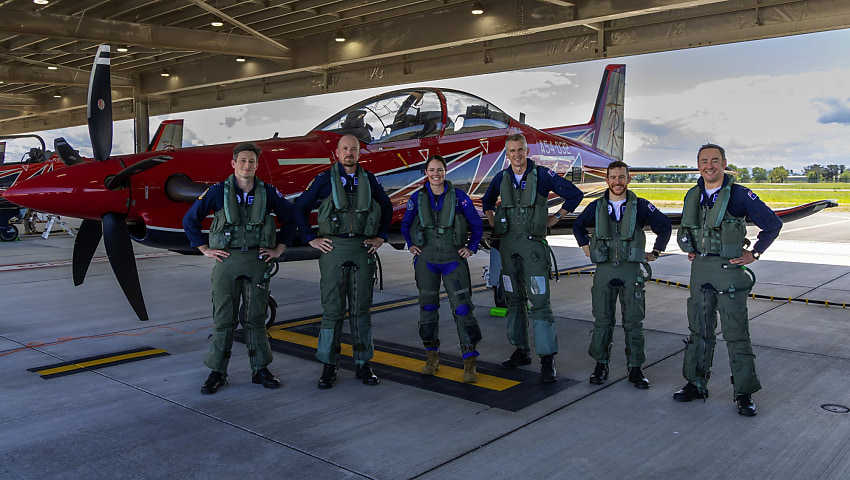
Astronaut and Australian of the Year Group Captain Katherine Bennell-Pegg has teamed up with the RAAF Roulettes to promote STEM careers.
Bennell-Pegg, who is hoping to become the first formal Australian representative to fly to space, flew with Roulette Three, Flight Lieutenant Kendall “Nugget” Dransfield, on a flight day at RAAF Base East Sale late last month ahead of National STEM Day on Sunday, 8 November.
“STEM has been absolutely critical to my journey to become an astronaut. At school, science and maths give you the tools that you need to be empowered to solve problems you care about, to make discoveries that excite you and to be at the forefront of human performance,” she said.
“STEM is for everybody. STEM is not something that is elite, it is something that enables you to participate in solving the problem.
“No one goes to space alone and no one goes into the air alone. Just like space, aviation is the ultimate team sport.”
According to Bennell-Pegg, a STEM career “enables you to participate in solving the problems facing us and grasping the opportunities of the future”.
“For me, I wanted to be an astronaut. Ever since I was very young, I was drawn into it for the curiosity and the adventure. That same drive you get when you want to look under a rock to see if there’s a bug or climb a tree to see if you can,” she said.
“As I became a teenager, I realised how unlikely it would be to be an astronaut. But I also learned that to be an astronaut, you can’t just finish school and get on a rocket. You need to have a first career in STEM. You can be a scientist of any kind, an engineer of any kind, a medical doctor, or a pilot. Ideally, a test pilot.

“And one of the things that I really enjoyed when I was a teenager was learning to fly, doing aerobatics, and that helped me to see my physics classes at school as a way to be able to do better roller coasters in the sky, it made it real for me.
“And so, while I’m not a professional pilot, it was certainly an important foundation and really stoked my love for STEM and my motivation to pursue a space engineering career and ultimately become an astronaut.”
FLTLT Dransfield said it was an “honour and a privilege” to fly with Bennell-Pegg, saying she “brings so much to Defence and the Air Force”.
“Specifically her education and what she contributes in terms of STEM is really important, and then that has a lot of similarities in terms of the Air Force and flying. But what she also showcases is her reliance on the team and the bigger team that enables her to go flying,” he said.
“It’s really important, as part of Defence organisation, that although we are at the tip of the iceberg, and we are what people see, underneath there’s the whole body of work, and we are supported by maintainers, doctors, engineers, and so many other different trades that help us to go flying.
“So, the key ingredient to being an astronaut or being a roulette is hard work and dedication, particularly in the STEM field.
“Being a Roulette or being an astronaut is a long pathway. So, for anybody aspiring to do something like that, you can have a big goal and have commitment, hard work over a long period of time. Just keep chipping away, and you can achieve anything.”
The Albanese government last month sent a counter-offer to the European Space Agency in efforts to send Bennell-Pegg on a historic spaceflight to the International Space Station, having struggled to secure widespread support from multiple state governments (apart from South Australia) to fund the original ESA proposal, reportedly worth $100 million and received earlier this year.
A response to the counter-offer is reportedly expected before the end of the year, according to information obtained by the ABC.
This article originally appeared on Australian Aviation.
Want to see more stories from trusted news sources?
Make Defence Connect a preferred news source on Google.
Click here to add Defence Connect as a preferred news source.