

 iscover



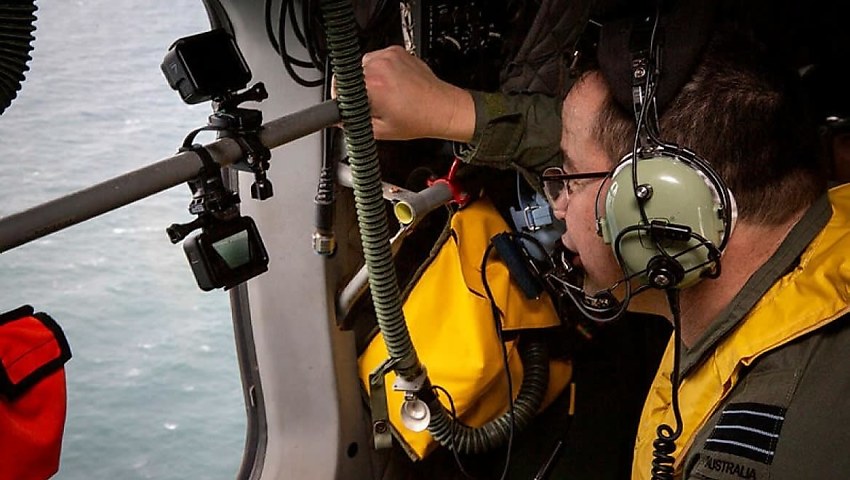
Defence has announced that AI-Search, an artificial intelligence project aimed at assisting personnel in offshore search-and-rescue missions, has entered the “second phase of development”. The announcement also provides further details of a wet run that took place off of Brisbane’s Stradbroke Island, as reported by Defence Connect in early April.
The cutting-edge AI project is a collaborative effort, marrying the skills of Warfare Innovation Navy Branch, Plan Jericho, RAAF Air Mobility Group’s No. 35 Squadron and the University of Tasmania’s Australian Maritime College.
At the time, it was hoped that the sea trials would prove the feasibility of the technology – and maybe even highlight its applicability to other ADF airborne platforms. Plan Jericho's AI lead, Wing Commander Michael Gan, said that for the next step in development the teams would assess strengths and areas for potential improvement in order to develop a more streamlined iteration of the prototype.
“The next phase will involve testing different sensor and processor combinations, in a range of environmental conditions, with the potential of testing on a range of aircraft – including UAS,” said WGCDR Gan.
According to Defence, the recent sortie from RAAF Base Amberley (off the coast of Stradbroke Island) was carried out with the assistance of the Australian Volunteer Coast Guard. Over the course of the trial, the AI-Search sensor and processor were deployed from an Alenia C-27J Spartan.
The technology was able to recognise a life raft and other waterborne vessels in pressing conditions.
“This sortie was pretty challenging as the life raft was upside down, making it harder to see for both the human eye and the AI-Search sensors," said Lieutenant Harry Hubbert of Warfare Innovation Navy Branch.
“The sensors are trained to detect an orange top rather than a black top, but the AI-Search still had a 70 per cent detection rate compared to the human detection rate of around 50 per cent.
“The 30 per cent AI-Search non-detections happened when there was low contrast between dark water and the black underside of the life raft. The good news is that we had no false positives.”
Flying Officer Katherine Mitchell, who piloted the aircraft as part of a search-and-rescue training exercise, said it was hard to see the upside-down life raft.
“We barely saw it 50 per cent of the time,” FLGOFF Mitchell said.
“AI-Search is already picking up more than what we are seeing. It’s incredible and it doesn’t get fatigued.”
Want to see more stories from trusted news sources?
Make Defence Connect a preferred news source on Google.
Click here to add Defence Connect as a preferred news source.