

 iscover
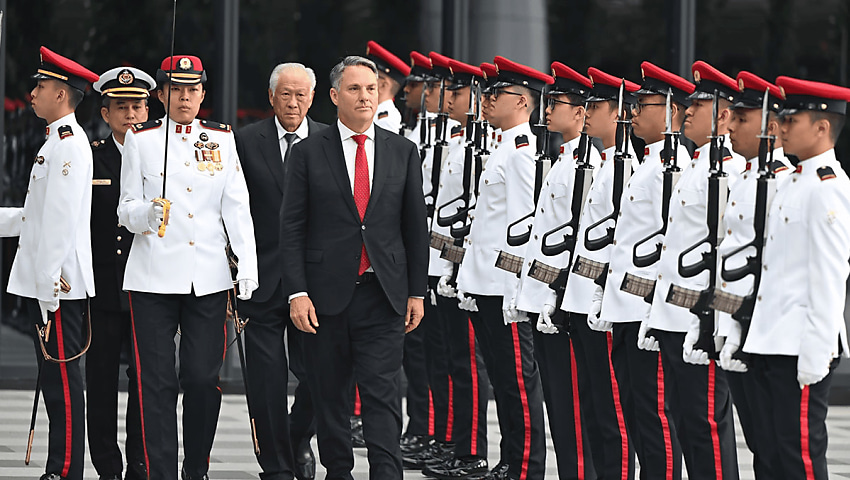
Singapore is stepping up military “big-ticket items”, such as infantry fighting vehicles, submarines, aircraft and artificial intelligence systems, to strengthen the country during turbulent times.
Singaporean Minister for Defence Dr Ng Eng Hen made the comments while attending the ASEAN Defence Ministers’ Meeting (ADMM) Retreat in Penang, Malaysia, earlier this month.
During the speech, Dr Ng announced a number of “big-ticket items” for the defence of Singapore, during the speech.
The first being that the Singapore Armed Forces would acquire additional German submarines to attain a fleet of six Invincible Class submarines. The Singaporean Navy would launch its first multi-role combat vessel (with significant unmanned capabilities) later this year to replace its ageing Victory Class corvettes.
He also announced that the military’s Fokker-50 maritime patrol aircraft would be replaced with an appropriate solution from either the Boeing P-8A or Airbus C295 aircraft.
“We are living in turbulent times, (that) is plainly evident. Some of my colleagues who have filed their cuts have said so. Mr Vikram Nair said that collective security and the rules-based world order appeared to be fraying. Mr Desmond Choo said the world is now a far more dangerous and uncertain place. Mr Shawn Huang said the war in Ukraine highlights the vulnerability of smaller states to larger powers and how we need to be prepared. I agree with all these sentiments,” Dr Ng said.
“How do we prepare Singapore and our people for a disruptive future? Even a disrupted one. For leaders everywhere, that surely must be the overriding concern as the global order changes before our very eyes. From a liberal world order, which was characterised by inclusion, which was characterised by rules for large and small states, which was characterised by protection of the global commons, we have now moved from that liberal world order to a world order based on size and influence, based on power.
“History teaches us that the fate of nations, particularly weak ones, and I use the word nations in the broadest sense, can change without their choice.

“Change can be inflicted through open aggression, brute force. ‘I do not like this situation. I am going to deal with you, sheer force, whether you like it or not, whether you can withstand it or not, never mind the suffering.’
“No one can predict the future precisely, but the feel of change is in the air… What is in store for Asia? That, to me, is the quintessential question for our time.
“The answer to that question is going to occupy us for at least a decade. It is going to decide the fate of Singapore and Singaporeans for this generation … Whatever comes, we must face our future resolutely. Singapore has thrived since our independence because we took the world as it is, and not what we wished it to be.
“We responded to daunting challenges as one nation, with grit, perseverance, sacrifice and hard realism. We must now do the same as we enter into uncharted waters.
“Now, as an independent and sovereign nation, we Singaporeans have agency, and can decide and do all we can to secure our future together. And certainly, building our own defences to protect our own interests must take priority. We count on no one else to protect Singapore, but ourselves.”
In addition, Dr Ng confirmed that the country would acquire eight more F-35A aircraft (announced in December 2024 following the announcement of acquisition of 12 F-35B aircraft).
He also announced that the Army would acquire new wheeled Titan infantry fighting vehicles, armed with 30mm cannon remote weapon systems and equipped with counter-unmanned aerial systems capabilities.
The Singaporean High Mobility Artillery Rocket Systems (HIMARS) would also be upgraded with more capable rockets, according to Dr Ng.
“The SAF has already progressed in the use of unmanned platforms – they are already deployed for operations. For example, in the Singapore Straits, the unmanned surface vessels conduct patrols now. They are equipped with electro-optic devices, radars, and a 12.7mm weapon system. These unmanned systems can issue audio and visual warnings using lights, sirens and long-range acoustics devices, and when justified, they can fire shots with their remote gun system,” Dr Ng said.
“Unmanned aerial vehicles are now becoming part and parcel of the soldier’s arsenal in the Army, very much like how scouts use binoculars, and but with far greater range and precision. Commanders can tap into a common picture from these various drones, inputs from the unmanned platforms to fight more effectively and smarter.
“But it is in the Air Force that the pace and scale of drones have grown exponentially. So much so that the Air Force has found it necessary to reorganise to establish a new Unmanned Aerial Systems Warfare and Tactics Centre. This new centre will drive the development of UAS warfare and its integration with other SAF forces and work with industries and tech agencies. The Army will also establish the Drone Accelerator for Rapid Equipping, or DARE, a similar centre to scale up operations for UAVs and ground vehicles for its units across the Army.
“The SAF will build new counter-UAS capabilities – a suite of sensors, jammers and weapon solutions to detect and neutralise smaller UASs, to add to our existing Island Air Defence capabilities. A newly established SAF Counter-UAS Development and Operations group will be responsible to guard against this threat in collaboration with other government agencies.”
Dr Ng also confirmed the SAF will focus on use of artificial intelligence, training in urban ops and homeland security.
“(Defence) financial expenditure is projected to be around S$23.4 billion. It is a 12.4 per cent increase from last year … The last three years, we have been playing catch-up. But going forward, we expect smaller increases year-on-year.
“Even so, over the past decade, defence spending has stayed within the range of 3 per cent of our GDP … I expect the growth in defence spending to taper down from FY26 and keep within this 3 per cent of GDP range over the next decade, barring any major conflicts or severe economic uncertainty.
“Given the rapid changes in our external environment, I think we will have to continue to monitor the situation closely, and if the need arises, we must be prepared to invest more to further strengthen our capabilities.”

Want to see more stories from trusted news sources?
Make Defence Connect a preferred news source on Google.
Click here to add Defence Connect as a preferred news source.