

 iscover
When it was officially launched in May 2009, the Defending Australia in the Asia-Pacific Century: Force 2030 white paper was met with varying degrees of criticism – much of which centred on it as “overly ambitious” – that we now know was misguided. So, how did we miss the point so completely?
While much of the nation’s public consciousness regarding the Australian Defence Force and our military responsibilities was focused on the ongoing conflict against radical Islamic extremists in the Middle East and Central Asia, the 2009 Australian defence white paper marked a significant recalibration of Australia’s strategic outlook, reflecting the evolving nature of global and regional security challenges.
At its core, the document recognised that the contemporary security environment was shifting away from traditional state-based threats to encompass a broader spectrum of risks, including terrorism, cyber warfare, and asymmetric challenges. This new paradigm required a reformed approach to defence planning, with an emphasis on agility, technological innovation and greater interoperability among the services.
A key theme of the paper was the importance of maintaining a modern and responsive military force, capable of operating effectively across a range of environments – from the vast maritime expanse of the Indo-Pacific to urban centres where unconventional threats may arise.
The white paper underscored the necessity for substantial investment in new capabilities and highlighted the value of integrating advanced technologies to ensure that the Australian Defence Force remained at the forefront of innovation. Such advancements were seen as critical not only for deterrence but also for effective response to emerging security challenges.
Equally significant was the emphasis on strengthening strategic partnerships and alliances, particularly with long-standing allies such as the United States. This was deemed essential for regional stability and for leveraging collective security arrangements in an increasingly interconnected world. The paper also addressed the importance of reforming the defence structure itself, advocating for enhanced joint operations and more streamlined command and control systems. These measures were intended to improve operational effectiveness and ensure that the military could adapt swiftly to unpredictable crises.
The 2009 Australian defence white paper laid the groundwork for a modernised defence strategy that balanced the imperatives of technological progress, resource optimisation and international collaboration. It also provided a comprehensive blueprint for adapting Australia’s defence capabilities to the dynamic security landscape expected of the 21st century, setting the stage for future strategic developments and reinforcing the nation’s commitment to protecting its national interests.
At its core, the 2009 Australian defence white paper established a jumping-off force, from which we could expand if the threat environment dictated it, yet once again, Australia’s strategic discourse has devolved into debate about where our “warning time” disappeared to, rather than the position we would be in, if successive Australian governments had followed through.

Highlighting this is lead author of the Defending Australia in the Asia-Pacific Century: Force 2030 white paper and former secretary of the Department of Home Affairs Mike Pezzullo, in a piece for the Australian Strategic Policy Institute titled The untold story of the 2009 defence white paper, in which he unpacked the core and often overlooked central pillars of the 2009 white paper.
Establishing a ‘baseline’ force
One of, if not the most important pillar of the 2009 defence white paper is the expansion of the Australian Defence Force as a whole and the formation of what Pezzullo described as a “baseline force” that is designed to be expanded upon and scaled up (or down) as dictated by the strategic requirements of the day.
At its core. the 2009 defence white paper is the basis for all the subsequent defence white papers, defence strategic updates, force structure plans, integrated investment programs and defence strategic reviews since, with the force structure and force posture outlined in the paper pulling through and, in many ways, shaping the Australian Defence Force we have today.
Before the comments erupt in calls for pitchfork and torches in a throwback to the villagers of Mary Shelly’s Frankenstein, it is important to articulate and understand that the 2009 defence white paper is a product of its time and place, and is, as Pezzullo described, the basis for a “baseline force”.
But what exactly does this mean? Well, Army, Navy and Air Force were all set for significant expansion based on existing and emerging platforms and capabilities and the planned long-term introduction of platforms and capabilities beginning in the 2020, provided that Australia got started ... yesterday.
Pezzullo articulated this harsh reality, saying, “The plan was premised on the critical importance of getting started. Force expansion could occur progressively, once a start had been made. The plan was predicated on a decade (2010–20) of aggressive force development, tendering and capability acquisition.
“By 2020, production lines, supply chains and procurement agreements would have been in place, especially in the crucial area of naval shipbuilding. Continuous construction, avoiding the start-stop syndrome that often afflicts naval shipbuilding, would have supported rapid construction. It would also have reduced ships’ unit prices over time, as a result of continuity and scale,” he added.
This growth would see the Navy expand from six Collins Class submarines to a fleet of 12 “son-of-Collins” conventionally powered submarines, paving the way for Australia to transition to a fleet of nuclear-powered submarines beginning in the 2030s and the Navy’s workhorse, the eight Anzac Class frigates replaced by a fleet of nine advanced, anti-submarine warfare frigates, now the Hunter Class frigates of which Australia will be (at least at this stage) acquiring six.
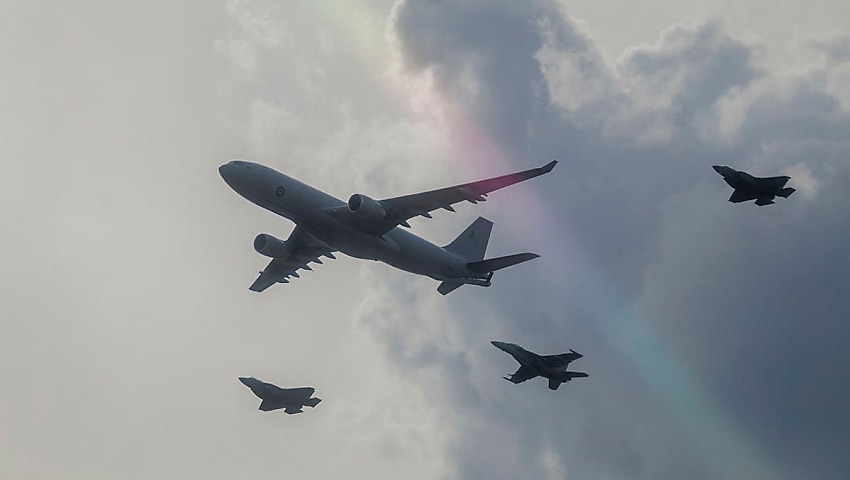
Air Force would see the acquisition of 100 F-35A Lightning IIs, supported by the 24 Super Hornets and dozen Growlers, along with a host of other existing but key enabling platforms like the E-7 Wedgetail, MQ-4C Tritons, KC-30A aerial refuelling tankers and other platforms that are not fielded in their planned numbers.
Meanwhile, Army would have been expected to grow to a three-division force, up from the existing two-division force, with far more balance across the three branches providing Australia’s policymakers with a significant increase in the flexibility, scalability and depth in capability that would provide the nation with the capacity to truly “shape, deter, respond” to the myriad of evolving threats across our area of primary responsibility and interest.
Pezzullo provided critical background context, explaining, “The white paper took the view that China was no ordinary emerging great power and that it was likely to take a different path. This proved to be prescient. China disliked the language of the document and protested stridently when briefed ahead of the launch of the document. The Rudd government did not buckle, and the offending text was not amended, as Beijing demanded.”
However, early momentum was not to be maintained, as Pezzullo detailed, saying, “The plan got off to a promising start in 2009 and 2010 but was effectively dismantled after Rudd’s removal from office in June 2010. Funding was cut. This stalled the momentum that should have be built over the decade 2010 to 2020, which was when the platform for force expansion was supposed to have been laid. As a result, the ADF is smaller and less powerful today than it would have been under the plan; Force 2030 is unachievable; and the further force expansion that should have occurred cannot be realised by the mid-2030s.”
What is and what could have been
I don’t think anyone needs to be reminded of the current state of the Australian Defence Force and, in many ways, most, if not all of the senior leadership of the Australian military is a victim of the inertia of successive governments and the decisions made.
Pezzullo, in some ways, touched on this, saying, “Had force expansion occurred, a plausible alternative history might now read as follows. Defence funding could have been progressively increased over the series of five-yearly planning cycles, with real growth (assuming annual price rises of 2.5 per cent) increasing from 3 per cent in the 2009–14 cycle to 5 per cent in 2014–19, 7 per cent in 2019–24, 9 per cent in 2024–29 and 9 per cent in 2029–34.”
So off the back of such spending, what direction of travel did the 2009 defence white paper set before us?
Well, Pezzullo articulated this perfectly, saying, “A larger ADF would have been available today, with the following force being realised fully during the 2029–34 cycle. The RAN would have had a battle fleet of at least 12 submarines (a mix of Collins and Super Collins boats), with a pathway to acquiring Virginia Class nuclear-powered submarines; six destroyers; 14 frigates; 20 corvettes; six missile arsenal ships, each with 100 vertical launch cells; and two light aircraft carriers (repurposed LHD assault ships) able to carry F-35B fighters, helicopters and autonomous aircraft and other uncrewed vehicles.”
Going further, Pezzullo added, “The Royal Australian Air Force would have been building to 100 F-35A Lightning fighters 24 F/A-18F Super Hornet fighters, 12 EA-18G Growler electromagnetic attack aircraft, 10 B-1B Lancer bombers (with B-21 Raiders in prospect), 20 P-8A Poseidon maritime patrollers, 10 MQ-4C Triton uncrewed surveillance aircraft, 10 E-7A Wedgetail air-surveillance aircraft and 10 A330 MRTT tankers (called KC-30As locally).”
Unpacking a hypothetical Australian Army, Pezzullo detailed, “The Australian Army would have been a three-division force, with the 1st Division optimised for littoral, amphibious and missile warfare, the 2nd Division for continental defence, and the 3rd Division for training and reinforcement. This would have required 18 battalion groups, as compared with the 10 battalion groups in Force 2030.”
Finally, it is the connective tissue and “key enablers” in the form of infrastructure, industrial capability, command and control facilities and critical consumables stockpiles that provides critical depth and “asymmetric” capability to middle powers like Australia, something Pezzullo articulated exceptionally well, saying, “The ADF would have been equipped with more Tomahawk cruise missiles, launchable from land as well as sea. A land-based, intermediate range ballistic missile force would have also been in prospect. Missile-defence batteries would have been available, including SM-3 and THAAD systems. Autonomous technologies and asymmetric capabilities would have been widely deployed across the force.
Going further he added, “Crucial enablers, such as command centres, communications systems, hardened bases, and fuel and logistics networks, would have been remediated and expanded. All of this would have required a complete enterprise-level reform of Defence – to make it lean, focused and driven.”
Final thoughts
Pezzullo detailed the impact this steady evolution of Australia’s military would have had, and, it is particularly depressing, “With such a force, Australia could have defended itself against a major power adversary by being able to extract a high cost from the attacker while we rallied support from the United States and others. A plan to hold out, as Britain did in 1940, would require Force 2030 and then some. The 2009 white paper was that plan.”
While it is too late to put the genie back in the bottle, it is becoming clearer by the day that Australia needs to take its own security, sovereignty and interests far more seriously, because if we don’t, we can’t expect that others will.
Equally, it is now important for Australia’s policymakers and the public to grapple with the fact that we blew our shot to do things “on the cheap”, our favourite past time; now, starting from an abysmally low level, we will be forced to spend far more than we would have otherwise.
Or as I have said a number of times before, our attempts to buy an Aston Martin on a Toyota Camry budget is going to bite us, and bite us at a time when the national budget is in a state of borderline bankruptcy conflicting with the rapid deterioration of our strategic environment.
Yet at the same time, despite our unbridled economic, political and strategic potential, we refuse to embrace it, all the while, the Indo-Pacific is rapidly becoming the world’s most contested region. Rising powers like China, India, Vietnam and Indonesia, alongside the re-emerging influence of Japan and South Korea, are reshaping the strategic landscape.
For too long, Australian policymakers have chased short-term economic wins and reactive measures instead of investing in a forward-looking strategy. This approach needs a complete overhaul. The pressing issue is not if challenges exist, but rather when Australia will step up to craft a clear, decisive response. When will our leaders lay out a cohesive plan that ensures the nation stays competitive and resilient amid escalating great power rivalries?
The choices made today will ultimately decide whether Australia flourishes or simply gets carried along by the currents of history.
Get involved with the discussion and let us know your thoughts on Australia’s future role and position in the Indo-Pacific region and what you would like to see from Australia’s political leaders in terms of partisan and bipartisan agenda setting in the comments section below, or get in touch at

Want to see more stories from trusted news sources?
Make Defence Connect a preferred news source on Google.
Click here to add Defence Connect as a preferred news source.