

 iscover
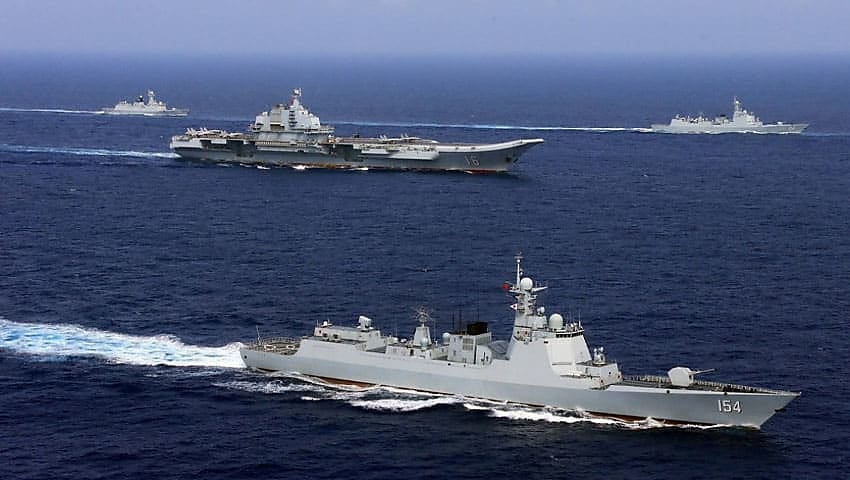
Beijing is stepping up its attempts to wear down Taiwan with expansive military exercises to surround the island. Meanwhile, closer to home, we have seen the latest attempts of the rising superpower to subtly coerce Australia, with one thing for certain, this is the new normal.
Widely regarded as the closest the world has come to nuclear Armageddon, the Cuban Missile Crisis still echoes in today’s geopolitics. This stand-off between President John F Kennedy and Soviet Premier Nikita Khrushchev had its roots in earlier disputes over nuclear weapons in Europe and Turkey, reaching a climax during the 1961 Berlin Crisis.
Soviet advisers viewed Kennedy as “too young, too intellectual, and lacking the backbone for crisis decision making”, a sentiment Khrushchev himself openly expressed, a sentiment that would ultimately come to embarrass the Soviet Premier at home and abroad.
This perception emboldened the Soviets to counter US Titan missile systems in Turkey by positioning nuclear weapons near the US mainland. In the aftermath of the disastrous Bay of Pigs Invasion, the Soviets disguised a military build-up in Cuba as humanitarian aid. They deployed around 40,000 troops posing as machine operators, agricultural experts and irrigation specialists – a prelude to introducing MiG-21 fighters, Il-28 bombers, SA-2 surface-to-air missiles, and R-12 and R-14 ballistic missiles.
Cuban President Osvaldo Torrado made it clear in 1962 at the United Nations that Cuba would not tolerate another US invasion, declaring, “If we are attacked, we will defend ourselves … We have the inevitable weapons, though we’d rather not have to use them.”
But how does all of this relate to Taiwan, let alone Australia, I hear you ask?
Much like Cuba, Taiwan is an island nation caught in the crosshairs of superpower rivalry. While Cuba symbolised Cold War communist defiance against US influence, Taiwan represents a democratic bulwark against China’s autocratic ambitions. Chinese President Xi Jinping has repeatedly stated that the reunification of Taiwan with mainland China is non-negotiable, insisting on peaceful means while reserving the option of force if necessary.
At least at this stage, Washington remains steadfast in its support for Taiwan’s right to self-determination, bolstering the island’s defences against any forced takeover. In essence, the legacy of Cold War brinkmanship is alive today, its lessons and tensions vividly reflected in the strategic dynamics of the Taiwan Strait.

While Australia does have some stark differences when compared to Taiwan, its similarities, including its status as an island nation with a robust democracy, firmly entrenched in the US-led post-Second World War economic, political and strategic order, are the primary focal points that have increasingly placed both nations firmly in the crosshairs of Beijing.
Yet this hasn’t deterred Beijing from ramping up its efforts to isolate and coerce the island democracy, and, concerningly for Australia, a number of recent Chinese naval operations, including the circumnavigation of the continent by a powerful surface action group, and in recent days, the surveying of our maritime economic exclusive zone by the survey/“spy” ship the Tan Suo Yi Hao.
A clear increase in provocation
Over the past two years (at least), Beijing has steadily increased the scale, scope and frequency of their joint operations in and around the waters and airways of Taiwan, combined with rapidly increasing the capability of the People’s Liberation Army and its various branches to achieve the objective of reclaiming Taiwan by 2027, as identified by President Xi.
In recent days, the Chinese government has accelerated its attempts to coerce and intimidate Taiwan, launching a series of large-scale military exercises, announced by the People’s Liberation Army Eastern Theatre Command spokesperson, Senior Colonel Shi Yi, who said: “Starting from April 1, the Eastern Theater Command of the People’s Liberation Army organised the army, navy, air force, rocket force and other forces to organise ships and aircraft to approach Taiwan Island from multiple directions around the island, focusing on exercises in sea and air combat readiness patrols, seizing comprehensive control, sea and land strikes, and blocking key areas and roads, to test the actual combat capabilities of the theatre’s troops in joint operations.”
Colonel Yi added, “This is a serious warning and powerful containment of the ‘Taiwan independence’ separatist forces, and is a legitimate and necessary action to defend national sovereignty and maintain national unity.”
As part of this exercise, the People’s Liberation Army-Navy (PLAN) has deployed 21 warships, including the Shandong carrier battlegroup, along with an additional 13 vessels of the PLAN, supported by four vessels from the Chinese Coast Guard, with the People’s Liberation Army-Air Force (PLAAF) providing a number of combat, aerial refuelling and command and control aircraft, conducting 71 sorties, 36 of which penetrated Taiwan’s Air Defence Identification Zone (ADIZ) according to Taiwan’s Ministry of National Defense.
This latest exercise follows on from what proved to be a busy March 2025 for the small island nation, with the Ministry of National Defense detecting 431 PLAAF aircraft around the island, along with 228 naval and coast guard vessels operating in and around Taiwan’s territorial waters over the course of the month.
Shifting focus to Australia, we have seen an increase in Beijing’s attempts to steadily increase pressure on Australia, with the recent deployment of a PLAN naval task group providing a very tangible and visible example of Beijing’s campaign of coercion and intimidation against the nation, which really ramped up during COVID-19 when several of the nation’s key exports were targeted for us daring to question the origins of the pandemic.
Yet true to form, Australia’s Defence Department issued a moderately worded statement, saying, “For decades, the ADF has undertaken maritime surveillance activities in the region and does so in accordance with international law, exercising the right to freedom of navigation and overflight in international waters and airspace.”
“This was an unsafe and unprofessional manoeuvre that posed a risk to the aircraft and personnel. Australia expects all countries, including China, to operate their militaries in a safe and professional manner,” the Defence statement added.
Bringing us to the revelations that a (comparatively) small PLAN surface action group – made up of a Renhai Class (Type 055) guided missile cruiser, a Jiangkai II Class (Type 054A) guided missile frigate and a Fuchi Class (Type 903) replenishment vessel – was operating to the “north-east of Australia” and elements of which had travelled through waters to the “north of Australia”.
Recognising this uncomfortable reality, we must accept one crucial fact: Australia is starkly outgunned. We’re investing in platforms and capabilities that, when taken together, will always be outclassed by a force that’s rapidly becoming both qualitatively and quantitatively superior–unless we change course now.
What does this mean in practice?
Take the current PLAN naval task group operating in the Coral Sea. Its flagship, the Renhai Class guided missile cruiser Zunyi, is just one ship. The PLAN has eight active vessels, is building four more, and plans an additional four. To counter the firepower of a single Zunyi, it would take at least 2.5 of our “Tier One” Hobart Class destroyers.
Looking at our planned “Tier One” Hunter Class frigates, we’d need roughly 3.5 of them to match the same threat. The same shortfall applies to whichever ship wins the multibillion-dollar “Tier Two” SEA 3000 general purpose frigate contract and our large optionally crewed surface vessels – none of which will be fielded en masse for some time.
And if we consider our venerable Anzac Class frigates, the picture is even bleaker. All eight (or is it seven now?) combined would deliver only 57 per cent of the firepower of a single Zunyi.
So what can we expect from all of this? Well, if we follow the evolution of events that Taiwan has experienced, Australia can expect to see an escalation of deployments in scale, scope and frequency, posing significant challenges to Australia’s enduring security, prosperity and stability.
Final thoughts
Despite the grand political rhetoric, many Australians face a less promising reality. While our nation is blessed with vast natural resources and strategic advantages, we’re not fully capitalising on our potential. Economic opportunities are dwindling, geopolitical tensions are rising, and everyday life is becoming ever more politicised, leaving many feeling disconnected and powerless.
Modern Australia has largely been spared the hardships of conflict – few have experienced food, energy or medical rationing. Yet, as global instability grows, we must face the fact that our national security and prosperity could be fundamentally redefined.
To secure our future, Australia must evolve into an independent power, bolstering its economic, diplomatic, and military capabilities to meet great power expectations. This shift would not only reinforce our national sovereignty but also position us as a key player in regional security. Shaking off the “it’s all too difficult” mindset could unlock new economic and strategic opportunities while reducing our vulnerability to external pressures.
The Indo-Pacific is fast becoming the world’s most contested region, with rising powers such as China, India, Vietnam and Indonesia – alongside the re-emerging influence of Japan and South Korea – reshaping the strategic landscape.
It is also important to note that figures like Maude, along with many in the establishment, continue to fall into a reductionist view: that Australia must have the US alliance, or nothing at all, and that we cannot forge an identity beyond this partnership. For too long, our policymakers have prioritised immediate economic gains and reactive measures over long-term strategy. That must change. The critical question is not if challenges exist, but when Australia will develop a clear, decisive response. When will our leaders articulate a coherent plan to ensure we remain competitive and resilient amid intensifying great power rivalry?
The choices we make today will determine whether Australia thrives or is swept along by the tide of history.
Get involved with the discussion and let us know your thoughts on Australia’s future role and position in the Indo-Pacific region and what you would like to see from Australia’s political leaders in terms of partisan and bipartisan agenda setting in the comments section below, or get in touch at

Want to see more stories from trusted news sources?
Make Defence Connect a preferred news source on Google.
Click here to add Defence Connect as a preferred news source.