

 iscover
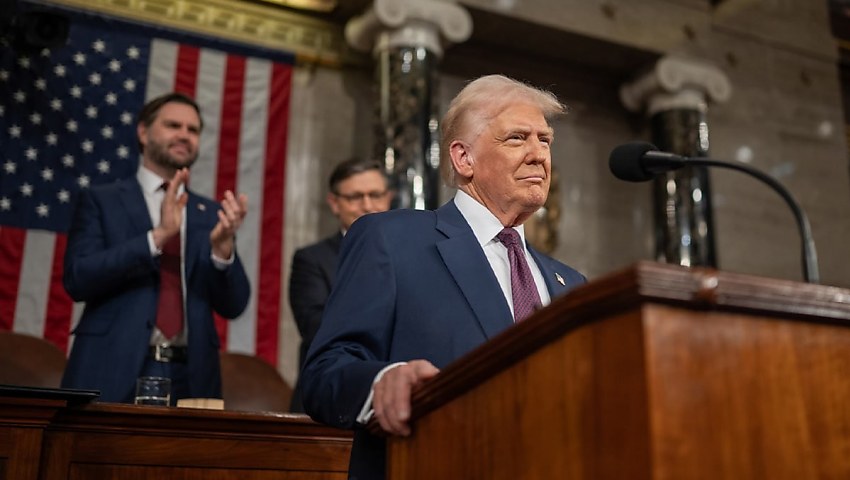
Now that the hyperventilating and hysteria have stopped (hopefully), perhaps it is time to look at the Trump tariffs with clear eyes and start viewing them as an opportunity for Australia to achieve its true potential.
Firebrand American President Donald Trump has been true to form and nothing if not consistent with his disruptive ways, announcing “Liberation Day” as part of his “Make America Wealthy Again” launch in the Rose Garden of the White House, throwing nearly a century of global economic orthodoxy into the trash heap of history.
Launching a wave of tariffs across the globe, friend and foe alike were in his crosshairs with none spared the wrath of the US President who told reporters, “April 2nd, 2025, will forever be remembered as the day American industry was reborn, the day America’s destiny was reclaimed, and the day that we began to make America wealthy again...
“For decades, our country has been looted, pillaged, raped and plundered by nations near and far, both friend and foe alike. American steelworkers, auto workers, farmers and skilled craftsmen. They really suffered gravely. They watched in anguish as foreign leaders have stolen our jobs, foreign cheaters have ransacked our factories, and foreign scavengers have torn apart our once beautiful American dream.
Setting the scene and using China as an example, President Trump told reporters, “So, if you look at that, China, first row, China 67 per cent. That’s tariffs charged to the USA, including currency manipulation and trade barriers.”
By comparison, at least at the high level, Australia seems to have avoided the worst of the President’s wrath, “enjoying” a 10 per cent blanket tariff (the lowest rate on offer) while managing to dodge a total ban on Australian beef imports to the United States, exemptions for pharmaceuticals and gold, and no specific mention of the nation’s steel and aluminium industries, or the Pharmaceutical Benefit Scheme or the social media age verification legislation at this point.
Yet for all the rhetoric from Australia’s political, media, academic and the broader commentariat, one would be forgiven for thinking that Australia had been hit with the highest level of tariffs and that the sky was falling in, with calls for Australia to abandon its relationship with the United States, scrap AUKUS and look to a host of new strategic partnerships to offset our “special relationship”.
Meanwhile, others, including the British Prime Minister, Sir Keir Starmer ,have heralded this as the “end of globalisation” and the post-Second World War economic order, which has, despite the rhetoric and reassurances of successive leaders around the world that globalisation and the unrestricted liberalisation of economic opportunities would put an end to conflict between great powers and explosive wealth and prosperity for Western nations.

But what if the tariffs imposed by President Trump and the ensuing end and “failures” of globalisation as proposed by both President Trump and his British counterpart provide Australia with far more opportunity than they do challenges? A controversial question and opinion, I know.
Levelling the playing field and creating competitive tension
Trump’s “reset” of the global economic order has two central pillars, the first being best summarised as a case of “build it and they will come” or best explained as a policy that states if companies, and by extension, countries seek to avoid the tariffs, they need to “reshore” industry and manufacturing to the United States.
The second pillar of Trump’s effort to “reset” the post-Second World War, and more acutely, the post-Cold War economic order, is a broader effort to rebalance the economic and industrial ledger by turning restrictionist and protectionist policies from countries, particularly nations designated as “emerging developing nations” or “upper middle-income” nations by multilateral organs like the International Monetary Fund and World Bank, including the People’s Republic of China, India, Thailand, Vietnam, Indonesia, Mexico, and Brazil.
What may come as a shock to many is the recognition that, in many ways, this doctrine is a modernisation and an expansion of the policies first implemented under the Reagan administration in the 1980s, when Japan was rapidly ascending the global economic power hierarchy, and America, much like it has been enduring over the past three decades, was a shadow of its former industrial and economic might.
Spearheading the charge in the 1980s was Robert Lighthizer, who, as deputy trade representative for President Reagan and then as trade representative to President Trump (2017–21), led the efforts against Japan and other nations, with transactional tariffs and an emphasis on, as he deemed it, trade relationships that “strike a balance among economic security, economic efficiency and the needs of working people”.
Hardly a contentious point and most Australians, who, when asked, quite fondly reminisce about Australia’s own “developed” and industrialised past, would find no issue with and one that makes it hard to materially argue with the core pillars of Trump’s Make America Wealthy Again and Make America Great Again policy platforms.
Yet for whatever reason, Trump’s efforts to rebuild and reshore American industry has been met with derision, economic catastrophism, claims that the sky is falling and bullyboy tactics, particularly from Australia’s own political leaders and economic pundits who are failing to see what the leaders of other nations have recognised and rapidly embraced: there is a deal to be made.
Reshoring and Australia’s opportunities in this ‘new world’
An important component to recognise is that while there is a deal to be made, one where Australia has an important role to play, America has come to the realisation that it can no longer unilaterally compete against a world of rapidly developing economic, political and strategic powers, particularly in the Indo-Pacific.
Importantly, there are examples for Australia to follow and, through deft diplomacy, a deal to be made to the mutual benefit of both the United States and Australia.
Arthur Herman, the noted historian and Senior Fellow at the Hudson Institute, sketches four possible futures for Pax Americana – from a reclusive US, which would embolden revisionist powers like China and Russia to dismantle the post-World War II order, to a renewed Cold War 2.0. His most compelling vision, however, is his fourth scenario, outlined in Toward a New Pax Americana – essentially flipping the old formula on its head.
Rather than the US solely exporting its might, this new model calls for a balanced partnership between American interests and those of its democratic allies. It hinges on collaborative efforts to reshore and restore the allied manufacturing base, and harnessing US tech – AI, cyber, uncrewed and autonomous systems, space – as a spearhead for collective defence.
Herman also advocates for a more transactional approach: instead of vague metrics like defence budgets as a percentage of gross domestic product, the contribution of firms from Germany, France, Italy and Japan should serve as a tangible measure of commitment to global security.
While his proposal centres on US revival, it leaves ample room for allies. This is where Australia can step in. Canberra has the opportunity to integrate with US reshoring initiatives by co-investing in critical industries – from defence technology and cyber security to AI and strategic minerals. By doing so, Australia can become a key pillar in a distributed Pax Americana – ensuring peace, prosperity, security and upholding a rules-based order across our region.
Critically, for all the rhetoric, this isn’t a zero-sum game, nor does it mean that Australia has to “sell the farm” or “its soul” to get the best deal, but it requires us to be ambitious, to be hungry and to have a considered plan for our future. It is a chance for Australia to build comparative advantage (and yes, it can certainly be built, just ask Taiwan and South Korea), bolster our own economic complexity, strategic industries, and support a more balanced, collaborative global order.
Final thoughts
As Australians, we stand at a pivotal moment in our history – a time when the challenges ahead demand our courage and our vision. Our world is rapidly shifting into a multipolar stage, with the Indo-Pacific emerging as the fiercest arena of competition. Nations like China, India, Pakistan, Thailand, Vietnam and the resurgent forces of South Korea and Japan are reshaping our region, and these changes are happening right on our doorstep.
We must confront an uncomfortable truth: without bold, strategic reform and investment, the promise of our future may be undermined, leaving generations of Australians less prosperous and more vulnerable in a rapidly evolving world. But this is not a call to despair – it is a rallying cry for us to rise together and seize our destiny.
Now is the time for us to cast aside the narrow, short-term thinking of the past. We have the chance to rewrite our story by playing the long game, embracing a visionary strategy that positions Australia at the heart of the Indo-Pacific’s transformation. The question before us is urgent and clear: Will we remain a secondary power, or will we step boldly into a future where our nation is a key, independent player in the global arena of great power competition?
Our future depends on it. Let us forge a narrative and strategy that empower our industries, inspire our communities and secure a vibrant, resilient Australia for all.
Get involved with the discussion and let us know your thoughts on Australia’s future role and position in the Indo-Pacific region and what you would like to see from Australia’s political leaders in terms of partisan and bipartisan agenda setting in the comments section below, or get in touch at

Want to see more stories from trusted news sources?
Make Defence Connect a preferred news source on Google.
Click here to add Defence Connect as a preferred news source.