

 iscover
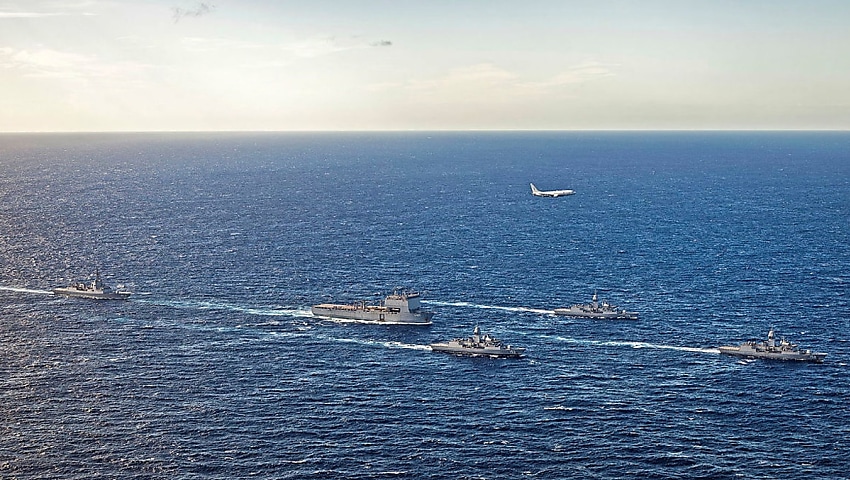
As America’s attention and increasingly limited resources are being pulled into multiple directions, its enduring commitment to acting as the security benefactor has come into question, raising an important question: How can Australia build the capability individually and in concert with our neighbours to secure the region?
In the overlapping world of biology and ecology, “keystone species” are described as a species that has a “disproportionately large impact on its environment when compared to its abundance”, they often play a central role in maintaining the structure and function of its ecosystem, where the removal can cause significant, cascading changes, or the collapse of the ecosystem.
On the geopolitical environment, there are “keystone nations”, which in many ways mimic the characteristics of how a “keystone species” interact with and shape the ecosystem they inhabit. The most visible contemporary example being the United States, which is itself now being challenged across the globe by a number of rapidly emerging rivals across the globe.
As a “keystone nation”, the economic, political, cultural and strategic weight of the United States has served as the foundation for the post-Second World War order and period of relative peace and prosperity, in effect shaping the global “ecosystem” in a disproportionate manner when compared to the aggregate “mass” of the broader global “ecosystem” of nations.
Now in the face of mounting global and domestic challenges, America’s once seemingly limitless economic, political and strategic will and capability is being called into question as the flashpoints in the Middle East, eastern Europe and the western Pacific are pulling the global superpower into multiple directions, undermining the capacity of the United States to continue its role a “keystone nation”.
In the Indo-Pacific, this reality is running head on into the rise of the People’s Republic of China that is becoming increasingly emboldened by the relative decline of America’s strategic umbrella, placing increasing pressure on American allies and other nations, with certain nations, Australia included, firmly in Beijing’s cross hairs for coercion, isolation and intimidation.
Highlighting this uncomfortable reality is Lowy Institute research fellow Dr Abdul Rahman Yaacob, in a piece titled Asia without America? History shows Australia can be confident shaping regional security where he draws upon Australia’s history of building lasting multilateral organs, systems and norms to subtly position Australia as a potential “keystone nation” in a “post-America” Asia.
Yaacob establishes Australia’s potential for such a role, stating, “Australia, rather than endlessly debate the US commitment to the region, should recognise that it is a country with the resources, expertise and geographic advantage to shape a region favourable to its interests. It has done so before.”

Luckily enough, Australia has the precedent to build upon.
Building on established precedent
A central pillar of Australia’s post-Second World War policy and posture of “Forward Defence”, which is often overlooked by its critics, is the nation’s engagement and nurturing of multilateral organisations while balancing with a national defence capability that emphasised long-range power projection and a degree of strategic-level capabilities separate to those provided by the nation’s traditional “great and powerful friends” like the United States or the British Empire.
This can be seen through the nation’s pivotal role in restoring regional stability during the Konfrontasi and the primordial incarnation of the ASEAN and the Five Power Defence Arrangement (FPDA) and efforts to revitalise and expand these efforts during the waning years of the Cold War, something Yaacob highlighted, stating, “The FPDA was formed in 1971 and involves Australia, Malaysia, New Zealand, Singapore and the United Kingdom. The primary function of the arrangement is for members to consult each other in the event of an armed attack against Malaysia and Singapore.”
Going further, Yaacob added, “Declassified documents from the British archives show that Australia led efforts in the 1980s and 1990s to revitalise the FPDA into a structure that contributes to regional order. Vietnam’s invasion of Cambodia in December 1978, followed by the Soviet Union’s occupation of Afghanistan in 1979, set off alarms in Canberra and Southeast Asia. In response to the emerging threats from the Soviet Union and Vietnam, then-Australian Prime Minister Malcolm Fraser initiated a plan in 1980 to institutionalise further defence relations with Malaysia and Singapore and to strengthen their defence capabilities through FPDA.”
This has provided a foundation for Australia to build upon in the broader region and enhances the long-standing political, economic and strategic ties Australia enjoys with nations across the broader Asian region, including Japan and South Korea, that when combined in aggregate, provide significant weight when measured against the region’s rising powers.
However, given the rise of our region and a growing number of other potential “keystone nations” – think China, India, Indonesia – alongside other potential great powers like Vietnam, Thailand, the Philippines and Pakistan, Australia will require a significant uplift in it’s economic, political and strategic capability and competitiveness in order to firmly entrench itself in the position of “keystone nation”.
Final thoughts
As Australians, we stand at a pivotal moment in our history – a time when the challenges ahead demand our courage and our vision. Our world is rapidly shifting into a multipolar stage, with the Indo-Pacific emerging as the fiercest arena of competition. Nations like China, India, Pakistan, Thailand, Vietnam and the resurgent forces of South Korea and Japan are reshaping our region, and these changes are happening right on our doorstep.
We must confront an uncomfortable truth: without bold, strategic reform and investment, the promise of our future may be undermined, leaving generations of Australians less prosperous and more vulnerable in a rapidly evolving world. But this is not a call to despair – it is a rallying cry for us to rise together and seize our destiny.
Now is the time for us to cast aside the narrow, short-term thinking of the past. We have the chance to rewrite our story by playing the long game, embracing a visionary strategy that positions Australia at the heart of the Indo-Pacific’s transformation. The question before us is urgent and clear: Will we remain a secondary power, or will we step boldly into a future where our nation is a key, independent player in the global arena of great power competition?
Our future depends on it. Let us forge a narrative and strategy that empower our industries, inspire our communities and secure a vibrant, resilient Australia for all. Australia stands at a crossroads. The world is shifting fast – and the Indo-Pacific is now the fiercest theatre of global competition. On our doorstep, powers like China, India, Vietnam, Thailand, Pakistan, Japan and South Korea are redrawing the strategic map. The pace is relentless, the stakes high.
We can no longer afford to cling to short-term fixes or business-as-usual thinking. The hard truth is this: without bold reform and serious national investment, we risk a future where our prosperity fades and our security is left exposed.
But this isn’t a reason to retreat. It’s a call to lead.
We’ve got the resources. We’ve got the smarts. What we need now is the vision – and the guts – to act. The question is clear: will we accept a role on the sidelines, or will we seize the chance to become a truly independent force in a multipolar world?
This is about more than defence or diplomacy. It’s about building national resilience, backing our industries and giving Australians a future that’s secure, prosperous and proud.
The time to act is now. Let’s step up – and shape our own destiny.
Get involved with the discussion and let us know your thoughts on Australia’s future role and position in the Indo-Pacific region and what you would like to see from Australia’s political leaders in terms of partisan and bipartisan agenda setting in the comments section below, or get in touch at

Want to see more stories from trusted news sources?
Make Defence Connect a preferred news source on Google.
Click here to add Defence Connect as a preferred news source.