

 iscover
Acclaimed Australian historian Geoffrey Blainey has issued a pointed warning to Australia’s political leaders, that the nation was “better prepared” to face threats in 1914, begging the question: How did the Australian public let it get to this point?
Australia’s early 20th century strategy was shaped by its status as a British dominion. Before World War I, Canberra built up a militia and a fledgling navy, expressly to aid Britain against Germany (while also guarding against Japanese expansion).
When war broke out in 1914, the governor‑general – representing the UK Crown – immediately offered Australia’s small fleet and an expeditionary force “to be at the complete disposal [of the] home government,” with costs borne by Australia.
This pro‑empire policy had broad support, and many Australians initially greeted the war with enthusiastic patriotism. Yet domestic unity was fragile. Within two years, bitter conscription referendums exposed deep rifts: both 1916 and 1917 votes to compel service overseas were defeated by narrow margins. Public opinion swung wildly – from loyal enthusiasm to prejudice against those of “enemy” heritage – as politicians debated who should fight for Britain and on what terms.
In the late 1930s, Australia again looked to Britain first, but world events soon forced a shift. At the start of World War II in 1939, Prime Minister Robert Menzies declared that Australia was also at war with Germany yet warned that our armed forces were dangerously small – only about 3,000 regular soldiers and 5,400 Navy personnel.
Compulsory training for home defence was reintroduced that autumn, even as overseas conscription remained banned. Within a few years, the Japanese advance brought the war to Australia’s doorstep.
By early 1942, Darwin had been bombed and Singapore had fallen. The Curtin government rushed to expand the Army and RAAF for a “total war effort” at home, and in December 1941, Curtin famously declared that Australia “looks to America, free of any pangs … at our traditional links … with the United Kingdom”.
In practice, Australia withdrew forces from distant theatres and relied heavily on US reinforcements, reflecting a dramatic post‑1914 pivot in alliances. Throughout WWII, public sentiment coalesced around defence of the homeland and support for the war effort; the crisis absorbed earlier divisions as Australia mobilised for a Pacific conflict.

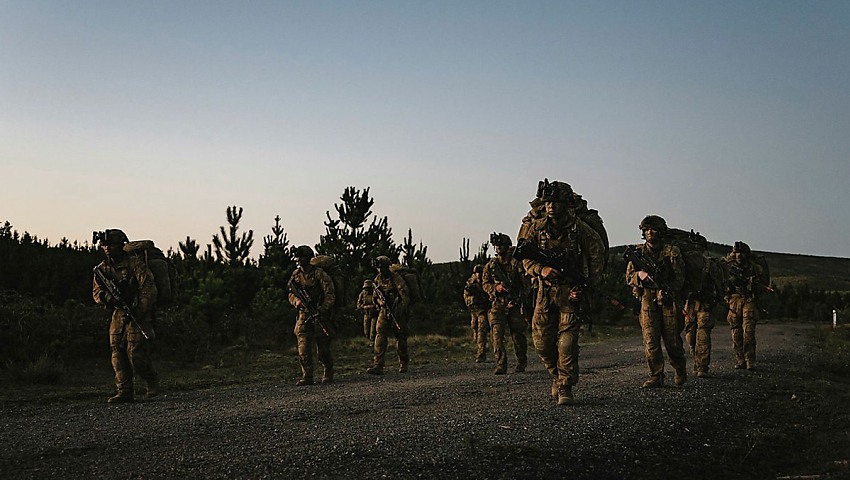
Today, Australia again faces strategic challenges from great‑power rivals, but in a very different context. Its policy still emphasises alliances – now with the US (ANZUS), the UK and other like‑minded partners – but also builds new regional ties. For example, Australia is a key member of the Quad (with the US, Japan and India) to bolster Indo‑Pacific security and the recent AUKUS pact will see Australian crews training side by side with US/UK forces (as in the photo above) for advanced submarines.
Public support for these alliances is high – a 2024 poll found 83 per cent of Australians view the US alliance as important to national security and official policy states the Australia–US alliance is “central to regional security”.
At the same time, Canberra is grappling with complex ties to authoritarian states. China remains our largest trading partner and governments engage it diplomatically without shying from criticism of its South China Sea claims or human rights record. But many Australians have grown wary: recent surveys show 53 per cent now see China more as a security threat than an economic partner. Russia’s war in Ukraine has also shaped opinion – Australians overwhelmingly back sanctions on Russia and aid for Ukraine.
In sum, Australia’s strategic posture today still relies on alliance building and robust defence, much as in the world wars. However, the scale and nature of threats have changed. Then the challenge was to mobilise a new nation for the clash of empires, balancing loyalty to Britain against emerging national interests. Now the focus is on multilateral Indo‑Pacific partnerships and high‑tech capabilities to deter any aggressive rise, while domestic debate centres less on conscription and more on trade, technology and values.
Although the context and adversaries differ, one continuity remains: Australians continue to weigh security needs against ideals, seeking strength through partnerships and public resolve in much the same way they did a century ago, but if you were to ask Australian historian Geoffrey Blainey, we are in an even more dangerous position than we were in 1914.
In two separate pieces for The Australian newspaper, titled We were better prepared for war in 1914 than we are now and Australia was ill-prepared for war in 1941. In 2025, we’re making the same grave mistake, Blainey articulated the precarious position Australia now finds itself in.
1914 v 2025
In his Weekend Australian column, historian Geoffrey Blainey argued that on the eve of World War I in 1914, Australia was far better prepared for conflict than it is today, drawing on the comparatively small Royal Australian Navy, a series of extensive but comparatively old coastal fortifications and the growing citizen militia that would come to form the basis of the first Australian Imperial Force.
Blainey articulated the stark difference in attitudes between 1914 and today, saying, “In 1914 our nation held just under 5 million people, and if their leaders miraculously were alive today they would be astonished that we – with more than five times as many people – field armed forces so inadequate.”
Going further, Blainey added, “In 1914 a mass of Australian boys and young men had already received some military training: such training was compulsory. In contrast our armed forces today have trouble in recruiting volunteers. The percentage of the male population with any kind of military training is tiny compared with the situation in 1914. At that time most citizens and the major political parties emphasised the need for a strong army and navy.”
When comparing to contemporary vulnerabilities, Blainey highlighted that the Port of Darwin – a crucial northern harbour – was leased for 99 years to a Chinese-owned company in 2015, effectively handing a strategic asset to a foreign power. Both major parties now promise to return the port to Australian ownership, underscoring bipartisan alarm over this loss of defence infrastructure. He used the Darwin lease as an example of how Australia has neglected its northern approaches and ceded key assets.
Blainey also sought to draw comparison to the nation’s industrial base, particularly the decline of the Australian industrial base over the past three decades, something he highlighted, saying, “Australia in other ways was more prepared in the era of iron and steel than it is today. On the eve of World War I our first steelworks were busy at the NSW town of Lithgow, while nearby stood the small-arms factory that manufactured rifles, pistols, bayonets and ammunition.”
“It was to employ 6,000 people – mostly women – in World War II: today, however, a modern version of Lithgow, ready to supply our war machine, does not even exist,” he added.
Blainey also criticised bloated bureaucracy and misplaced priorities in defence planning. He noted a “boom in well-paid Australian generals” even as core combat capabilities are cut back. For instance, the Army expanded its armoured fleet on paper (from 59 to 75 tanks) but then allowed crews for 18 of those tanks to be “let go” for lack of personnel.
These mismatches illustrate broader waste and inefficiency. In fact, a recent strategic review warned of “waste, inefficiency and rework” in Defence caused by duplicate processes and a change-resistant bureaucracy. It also noted that basic logistics improvements – from fuel storage to supply chains and missile production – remain unimplemented, leaving critical capabilities underfunded.
Taken together, Blainey argued, these deficiencies weaken Australia’s national resilience. He emphasised that defence readiness depends on a strong industrial base, secure supply chains and a well-trained workforce as much as on hardware. He calls for clear strategic guidance and stronger alliances to rebuild capability.
In particular, Blainey endorses deeper engagement through the AUKUS partnership with the US and the UK. As the US Department of Defense explained, AUKUS is meant to “strengthen the ability of each government to support security and defence interests” by integrating technology and industrial bases. Blainey implied that by fully committing to AUKUS – for example, building advanced submarines domestically – Australia can recover the strategic depth and deterrence it once possessed.
But Blainey’s historic comparisons don’t stop there.
A repeat of the interwar years?
During the interwar years, Australia, like many nations, and in many ways similar to the decades following the end of the Cold War, embraced a “peace dividend” and a reluctance for nations to want to commit to open war following the horrors of the First World War. This culture would only be further entrenched following the Wall Street collapse of 1929 and the ensuing Great Depression which placed further strain on budgets around the world.
Blainey warned that Australia risks repeating its 1941 mistake of being caught unprepared for war. He bluntly stated that “Australia is not prepared for a war or a half-war near its shores” and called this “a failure of leadership” as political leaders ignore looming regional crises.
Blainey urged Australians to learn from the World War II crisis – when events moved from distant battlefields to our doorstep – and not remain complacent. He noted that even as Europe fell to Nazi conquest, life in Australia “went on as normal”, and only modest steps (like BHP’s Essington Lewis establishing the Commonwealth Aircraft Corporation to build basic Wirraway trainers) had been taken by 1940.
He stated, “In some activities Australia was adventurous in preparing for a war that might approach its unguarded coastline. Essington Lewis, the head of BHP, after touring Japan in 1934, decided its industries were quietly preparing for a major war. Eventually he set up the Commonwealth Aircraft Corporation at Port Melbourne where a simple flying machine called the Wirraway was mass-produced. A training aircraft of Californian design, it was the first step in plans to build a faster plane, but the next step was taken only after the Japanese had entered the war.”
Blainey highlighted that by early 1941, Canberra knew Japan had produced the advanced Mitsubishi A6M Zero fighter (capable of ~300 mph), far outclassing Australia’s Wirraway trainer. Nevertheless, British officials reassured Australian leaders that the zero threat was minimal – confidently saying the Wirraway “would put up quite a good show” – an advice Blainey called “suicidal” when war arrived.
This reflects Australia’s lack of independent defence capability: it had no modern fighters or armour of its own and relied on Allied assurances, drawing clear parallels to Australia’s approach today.
Similarly, Australia trusted Britain’s Singapore naval base to deter Japan. General Thomas Blamey assumed Singapore was safe and even suggested Australian troops there be sent back to Europe. Then Prime Minister Menzies spent weeks in London urging Churchill to reinforce Singapore, but Churchill, focused on the European war and underestimating Japan’s ambitions, refused.
Blainey articulated this, saying, “Would Singapore, the British naval base, be equal to the task if war erupted? General Thomas Blamey, the experienced head of our army, decided that Singapore was not in danger of a major attack. A month before the devastating Japanese naval raid on Pearl Harbor, Blamey thought so poorly of the Japanese army that he recommended that all Australian soldiers then training in Singapore’s hinterland should join their comrades in North Africa and the Middle East.
“There, under the same commander, they could fight the powerful German forces. Fortunately his advice was not taken. Returning to Australia he so advised the government.”
By December 1941 the war exploded in Australia’s region. Japan struck Pearl Harbor and simultaneously invaded Malaya. Within days, Japanese dive-bombers sank the British battleships Repulse and Prince of Wales off Malaya, much to the shock of British and Australian leadership and public alike.
The bombing of Darwin in 1942 dramatically revealed Australia’s vulnerability. Blainey noted that this attack – and the fear that Japan could strike the Australian mainland – underscored how dangerously unprepared the nation had been. In response to these calamities, Prime Minister John Curtin famously appealed for American support, declaring that “Australia looks to America … free of any pangs as to our … kinship with the United Kingdom”.
It is here just weeks following the circumnavigation of the continent that we see Blainey draw yet more important parallels with contemporary Australian leadership, something he highlighted, saying, “We can now examine the hazardous version of history that tends to shape [Anthony] Albanese’s thinking. He believes he can weaken our nation’s defences but confidently summon the US to mend the defensive fence he himself has broken.”
He added, “In short, does he hope to walk in the footsteps of John Curtin, the new Labor PM who, it is widely believed, persuaded the US to rescue Australia from the Japanese at the end of 1941? This was seen as perhaps his finest achievement, though then he was less than four months in office.”
It is worth noting that this government is not solely to blame for the nation’s current predicament, rather it is just the latest compounding factor dating back to the Rudd–Gillard years and failing to adequately heed “frank and fearless” advice to government in the 2009 Defence white paper and supporting documents.
Blainey called on the Prime Minister and, should he be replaced, his successor, to avoid making the same mistakes that were made in the lead-up to the Pacific conflict, saying, “Albanese should realise that the lesson learnt and taught by Curtin was to defend and rely on ourselves as much as possible. Thousands of Australians died as Japanese prisoners of war or ‘on active service at sea’” because their own nation was not adequately prepared for war. Many are among our war heroes. The Prime Minister has yet to learn that vital truth.”
In these ways, Australia placed excessive faith in others rather than building its own defences. Sounds strangely familiar, right?
How did we get here?
Importantly, as mentioned, this is not solely the blame of the current government, with successive Australian governments failing to accept and respond to the challenges emerging across our region, specifically those posing a major challenge to the future economic, political, societal and strategic security of the nation.
This is something Blainey hinted at, posing an important question, “Are our ever-changing political leaders or the heads of our armed forces or the platoons of Canberra bureaucrats mostly to blame for our military weaknesses? Australia is one of the oldest continuous democracies in the world, and therefore we as citizens and voters have also to share the blame.”
That is something that will come as quite a shock to much of Australia’s citizenry, many of whom are, largely still enamoured by the comforting blanket that is the “end of history”, largely because successive governments have failed to communicate the emerging threats.
Blainey added, “For at least seven years, however, China has been provocative on sea and land, and one of its countless gestures of defiance was to send, early in 2025, war vessels far into Australian territorial seas without even notifying Canberra.”
Yet once again, we find Australia defaulting to Homer Simpson’s tried and true saying “Can’t someone else do it?”, which sees the nation’s default strategy of placing our security solely in the hands of someone else. “Albanese believes that if Australia is in peril he will summon the US for immediate help. Yet in some situations the US, with all the goodwill in the world, will be unable to help us at once or unable to help us at all. The case is almost overwhelming that Australia first has to help itself. Even talented scholars who believe we should not be the firm ally of even the US or China are convinced that we should vigorously re-arm.”
Final thoughts
For Australia to survive and thrive in this rapidly shifting era, both policymakers and the public must recognise that while the world is becoming increasingly multipolar, the Indo-Pacific is swiftly emerging as the most fiercely contested region globally.
This transformation is being driven by the rising economic, political and strategic influence of nations such as China, India, Pakistan, Thailand and Vietnam, alongside the established and resurgent strengths of South Korea and Japan. Together, these forces are creating a highly competitive environment right on Australia’s doorstep.
In facing these challenges and opportunities, Australia must break free from the narrow perspectives that have long shaped its diplomatic, strategic and economic policies since Federation.
To genuinely seize the opportunities emerging across the Indo-Pacific, Australia must embrace a long-term, forward-looking approach. The pressing questions now are: when will we see a thorough analysis and a decisive response to these challenges? When will a clear narrative and strategy be developed to help both industry and the public understand not only the risks, but also the exciting, untapped opportunities on the horizon?
As regional dynamics continue to evolve and China asserts its influence, Australia must determine whether it can afford to remain a secondary power, or whether it must step into a more independent and influential role amid an era of intensifying great power competition.
Above all, Australia’s leaders and citizens must resist the lure of short-term distractions and remain firmly committed to the nation’s enduring values and principles.
Get involved with the discussion and let us know your thoughts on Australia’s future role and position in the Indo-Pacific region and what you would like to see from Australia’s political leaders in terms of partisan and bipartisan agenda setting in the comments section below, or get in touch at

Want to see more stories from trusted news sources?
Make Defence Connect a preferred news source on Google.
Click here to add Defence Connect as a preferred news source.