

 iscover
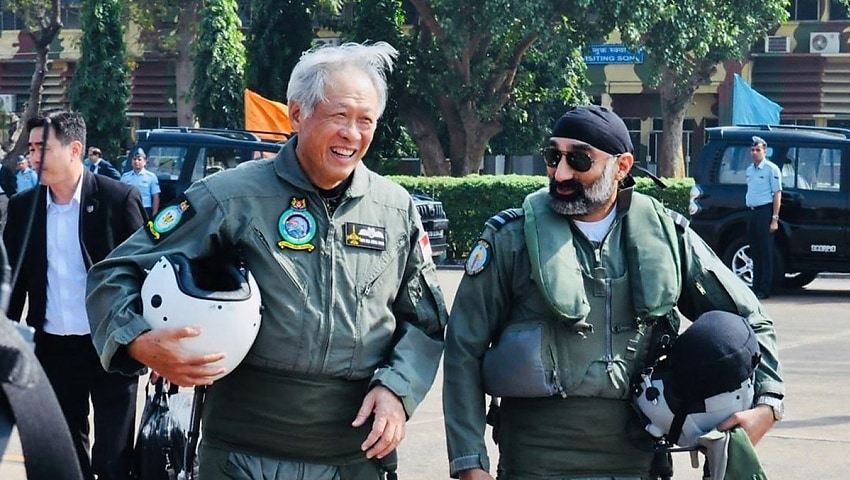
Defence strategy heavyweight and Singaporean Defence Minister Ng Eng Hen has announced his upcoming retirement from politics.
The five-term MP and Singaporean military strategy adviser will reportedly retire and not contest the next general election after more than two decades in cabinet.
Dr Ng’s political career included serving as MP for Singapore’s Toa Payoh Central ward and other political appointments as Minister of State for Education and Manpower, Minister for Manpower, Second Minister for Defence.
Crucially, he served as Minister for Defence from 2011 to 2024, Deputy Leader of the House from 2007 to 2011 and Leader of the House from 2011 to 2015.
“I had informed (Prime Minister Lawrence Wong) some months back that it was time for me to continue that virtuous tradition to make room for renewal and regeneration of the PAP slate,” said Dr Ng, speaking at a press conference.
“I will not be contesting the next general election,” he said, thanking residents in the constituency for their trust over 24 years.
“It’s been an honour and privilege to serve my residents and Singaporeans at large.”
Dr Ng led two long-term modernisations of the Singapore Armed Forces such as the SAF 2030 initiative (revealed in 2014) and the updated SAF 2040 initiative in 2024. He also led the opening of a new training facility for urban warfare and presided over the creation of Singapore’s Digital and Intelligence Service branch.

In addition, Dr Ng has been a significant personality in the Indo-Pacific defence landscape with significant experience in negotiation with the People’s Republic of China, the United States of America and other major international players.
“How do we prepare Singapore and our people for a disruptive future? Even a disrupted one. For leaders everywhere, that surely must be the overriding concern as the global order changes before our very eyes,” he said earlier this year while attending the ASEAN Defence Ministers’ Meeting retreat in Penang, Malaysia.
“From a liberal world order, which was characterised by inclusion, which was characterised by rules for large and small states, which was characterised by protection of the global commons, we have now moved from that liberal world order to a world order based on size and influence, based on power.
“History teaches us that the fate of nations, particularly weak ones, and I use the word nations in the broadest sense, can change without their choice.
“Change can be inflicted through open aggression, brute force. ‘I do not like this situation. I am going to deal with you, sheer force, whether you like it or not, whether you can withstand it or not, never mind the suffering.’
“No one can predict the future precisely, but the feel of change is in the air… What is in store for Asia? That, to me, is the quintessential question for our time.
“Now, as an independent and sovereign nation, we Singaporeans have agency, and can decide and do all we can to secure our future together. And certainly, building our own defences to protect our own interests must take priority. We count on no one else to protect Singapore, but ourselves.”

Want to see more stories from trusted news sources?
Make Defence Connect a preferred news source on Google.
Click here to add Defence Connect as a preferred news source.