

 iscover
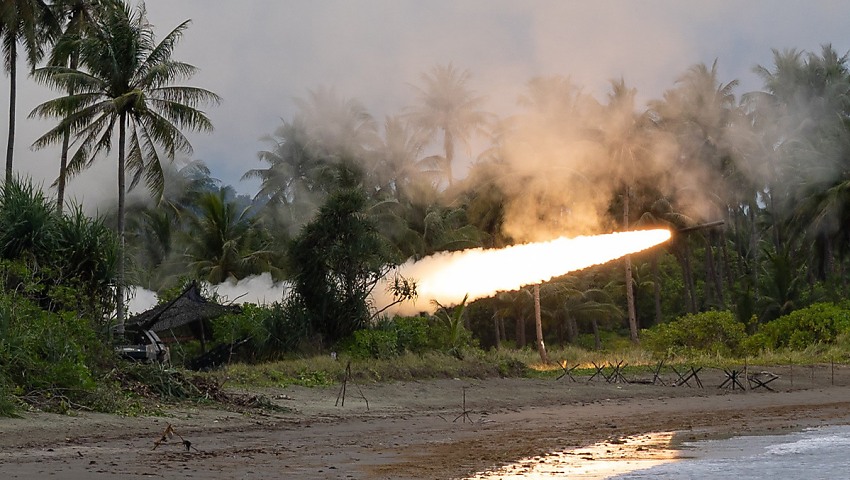
Military personnel from Australia, the United States, and the Philippines have conducted counter-landing live fire exercises in the Indo-Pacific.
Around 260 Australian Defence Force personnel attended Exercise Balikatan at Palawan in the Philippines alongside troops from the Armed Forces of the Philippines and the United States Armed Forces. More than 14,000 personnel participated in Balikatan 2025.
At the exercise, the United States Army 1st Multi-Domain Task Force fired High Mobility Artillery Rocket Systems (HIMARS) at pre-designated coordinates during the counter-landing live fire exercise at Campong Ulay.
In addition, Australian Army soldiers from the 5th/7th Battalion, the Royal Australian Regiment, fired a Javelin Weapon System to repel opposition landing operations.
Exercise Balikatan is designed to enhance military interoperability and readiness in support of the Mutual Defense Treaty between the United States and the Philippines.
“The Philippines is one of our closest partners and friends, and under our strategic partnership, our defence relationship continues to deepen,” said Chief of Joint Operations, Vice Admiral Justin Jones, AO, CSC, RAN.
“Balikatan 2025 highlights the United States and Philippines’ commitment to their bilateral partnership as well as interoperability with other partner nations.
“Australia’s participation demonstrates our commitment to security and stability, and engagement with the Indo-Pacific region.”

Australia’s participation provides a key training opportunity for deployed personnel, improving interoperability with partner nations and strengthening defence cooperation by building people-to-people links.
Participants and observers ranged from Japan, the United Kingdom, France, and Canada, and, this year, from the Czech Republic, Lithuania, Poland, and the Netherlands observing for the first time.
Australia’s contribution to Balikatan 2025 includes conventional and special forces from the Australian Army and Royal Australian Air Force, exercising integrated air and missile defence, counter-landing, sustainment, medical support, maritime strike, and multinational coordination, as well as delivering humanitarian civic assistance.

Want to see more stories from trusted news sources?
Make Defence Connect a preferred news source on Google.
Click here to add Defence Connect as a preferred news source.