

 iscover
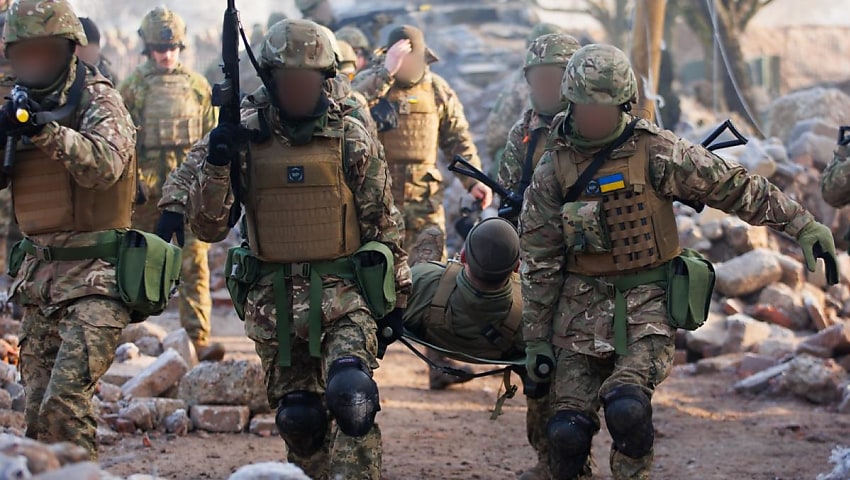
Nearly three and a half years since Russian forces rolled into Ukraine, the staying power of the much smaller nation has served as a powerful inspiration, but there are equally powerful lessons for Australia to embrace ahead of the looming storm.
The Russo-Ukrainian War, ignited by Russia’s full-scale invasion of Ukraine in February 2022, has emerged as a defining conflict of the 21st century to date and has shattered long-standing assumptions about European security, exposed the fragility of international norms and signalled a profound shift in global power dynamics.
What began as a regional crisis has evolved into a protracted war with global ramifications, challenging the post-Cold War order and testing the resilience of democratic alliances.
At the heart of this conflict lies a stark contest between authoritarian aggression and the sovereignty of smaller states. Russia’s actions have not only violated Ukraine’s territorial integrity but have also undermined the principles of the rules-based international order. The war has revealed the limitations of existing security frameworks and highlighted the need for a more robust and inclusive approach to global governance.
For Australia, the war offers critical lessons as it navigates an increasingly complex Indo-Pacific region. The parallels between Russia’s aggression in Ukraine and China’s assertive behaviour in the Indo-Pacific are increasingly striking.
Both scenarios involve challenges to the sovereignty of smaller nations and tests of international resolve. Australia must therefore reassess its strategic posture, enhance its defence capabilities and deepen its diplomatic engagements to safeguard its interests in a region marked by escalating tensions.
Moreover, the conflict underscores the importance of resilience and adaptability in the face of evolving threats. Ukraine’s effective use of asymmetric warfare, bolstered by international support, has demonstrated the potential of smaller states to resist larger adversaries.
Critically, Australia can draw valuable insights from Ukraine’s experience, particularly in enhancing its own defence preparedness and fostering regional partnerships.

As the post-Cold War global order continues to evolve, Australia’s response to the lessons of the Russo-Ukrainian War will be pivotal in shaping its future security and prosperity. By embracing a proactive and nuanced approach, Australia can contribute to a more stable and resilient Indo-Pacific region.
Highlighting this is Senior Fellow for Military Studies in the Lowy Institute’s International Security Program and Australian Army Major General (Ret’d) Mick Ryan in a piece for the Lowy Institute’s The Interpreter, titled, Political lessons for Australia from the war in Ukraine, in which he highlighted the mounting lessons Australia’s policymakers must increasingly prioritise on “sovereign resilience”.
Invaluable lessons for savvy leaders
Russia’s invasion of Ukraine marked for many Western nations the first time since the Second World War that they had been on the potential receiving end of a nation-state invasion, and in many ways radically shattered the paradigm of global peace and stability that had held true since the end of the war.
In many ways, this bucking of the post-war consensus formalised what some across the Western world had come to expect, that the good times, or as Francis Fukuyama would call it, the “End of History”, would come to an end and the heady days of the post-Soviet Pax Americana would go the way of the dodo.
Nevertheless, nations across the Western world, Australia included, would continue to conduct themselves in the belief that the world wasn’t changing around them, despite the evidence before their eyes, with the chickens now coming home to roost.
Highlighting this, MAJGEN Ryan stated, “Writing in the early days of the war, I described how no responsible military or political institution will be able to ignore the lessons that will emerge from Ukraine. Very few people anticipated the profound impacts this war would have on European and global political and security affairs.
“The insights from this conflict about the changing character of war extend from the technological to the industrial, the tactical to the political. With this as context, what might be the key insights that the past three years have provided for Australian politicians?”
However, Ryan isn’t all questions and no solutions, with a series of key focus points and lessons for Australian policymakers to glean from the ongoing conflict in Ukraine, beginning with the increasing importance of deterrence as a central pillar of the nation’s strategic posture in the Indo-Pacific.
This is a major departure from Australia’s defence and national security posture status quo, but in a more holistic manner. MAJGEN Ryan said, “A first lesson is the need to invest in deterrence. Deterrence is a national undertaking to discourage or restrain another nation-state or non-state entity from taking unwanted actions.
“It possesses a psychological dimension and aims to affect a potential aggressor’s decision-making process. One of the crucial responsibilities of national political leadership is to deter aggression against the nation they lead, and to resource their participation in multinational efforts to deter coercion, aggression and conflicts.”
Going further Ryan added, “The West now exists in an environment where predatory authoritarian regimes see democratic political weakness as provocative. While Australia has embraced deterrence in its most recent National Defence Strategy, it remains purely a military strawman.
“At heart, Australia needs a new theory of conventional deterrence for non-nuclear middle powers that is more sophisticated than possession of three submarines and a small stockpile of missiles. More elements of conventional deterrence, including civil defence, a capable sovereign defence industry, robust cyber defences, missile defence and plans for mobilisation of industry and people, are needed.”
Bringing us to his second key point, which is the need for Australia’s political decision makers and their support structures to accelerate their capacity for strategic planning, decision making and adapt in order to better respond to the challenges emerging across the spectrum posing a host of conventional and asymmetric threats to the nation’s security.
Ryan added, “The speed of planning, decision making, action and adaptation is increasing due to faster media cycles, the greater visibility of friendly and enemy systems from drones and open-source intelligence, the proliferation of different ballistic and hypersonic missiles and AI-enabled decision support.
“Political and military institutions must ensure that their people and institutions are able to intellectually and physically deal with this new environment through better use of time for improved decision making. In the 2024 Australian National Defence Strategy, the government proposed that defence’s procurement decision making does not pass the test of timely 21st century decision making. This is largely a result of a dwindling risk appetite by politicians and public servants in the modern era.”
He goes on to add, “This root cause is likely to have impacts in many other elements of the national security enterprise. For example, decision making about the provision of military assistance to Ukraine has been slower than required by battlefield and strategic realities ... Contemporary politicians need to improve their performance, however. The frequent debates in recent years about whether providing a few tanks or artillery systems to Ukraine would escalate the war not only demonstrated strategic immaturity and risk aversion but also resulted in Ukraine being unable to exploit battlefield opportunities at the end of 2022 and since.”
Third and finally is the societal aspect of “sovereign resilience” and the capacity and, indeed, willingness of a population to endure hardship and act in the national interest, something for our now atomised, disconnected and uninvested population will struggle to grapple with, often in stark contrast to nations that may challenge our national security, prosperity and stability.
MAJGEN Ryan unpacked this, saying, “A final lesson of the last three years for Australia’s political leaders, and indeed every citizen of our nation, is about will. The central insight from Ukraine must be that no one will help a nation that doesn’t demonstrate the will to defend itself. There are many dimensions to this demonstration of will.
“Ultimately, it is about building national resilience in all its forms. The concept of sovereign resilience, which includes the requirement to mobilise people, ideas and industry for large military and national challenges, must be implemented from the top of our nation’s political leadership,” he said.
Uniquely, this combination of factors presents the nation with an opportunity to act before our back is against the wall and, if actioned appropriately, can present a series of unprecedented opportunities for a nation grappling with a myriad of economic, financial, socio-political and other factors to overcome.
MAJGEN Ryan hinted at this, saying, “That opportunity, for our politicians, our government, business and community leaders and for every citizen of this country, has been underpinned by the courage, resilience and essential goodness of Ukrainian citizens and soldiers. They have demonstrated a form of overwhelming will and sacrifice not often seen in nations.
“And despite the horror we feel in watching the Russian barbarians seek to extinguish an entire people and its culture in the past three years, there is also a sense of privilege we might feel in having been able to observe the rare demonstration of uncommon valour by an entire nation.”
Final thoughts
Australia stands at a pivotal crossroads. The Indo-Pacific is rapidly becoming the epicentre of global strategic competition, with nations like China, India, Vietnam and Japan reshaping the regional order. This transformation is unfolding at an unrelenting pace and the stakes are exceptionally high.
In this dynamic environment, clinging to outdated habits and short-term thinking is no longer viable. Without bold reform and substantial national investment, Australia risks a future where it is weaker, less prosperous and increasingly vulnerable.
Yet this is not a moment for fear – it is a moment for decisive leadership. Australia possesses the talent, resources and resilience to navigate these challenges. What is required now is the courage and vision to act. The choice before us is clear: do we remain on the sidelines, or do we step up as a truly independent force in a multipolar world?
This challenge transcends defence and diplomacy; it encompasses the security of our industries, the inspiration of our communities and the construction of a nation resilient enough to thrive amid turbulence. The world will not wait and our future cannot afford delay. It is time for Australia to seize this moment and forge its own destiny.
Get involved with the discussion and let us know your thoughts on Australia’s future role and position in the Indo-Pacific region and what you would like to see from Australia’s political leaders in terms of partisan and bipartisan agenda setting in the comments section below, or get in touch at

Want to see more stories from trusted news sources?
Make Defence Connect a preferred news source on Google.
Click here to add Defence Connect as a preferred news source.