

 iscover
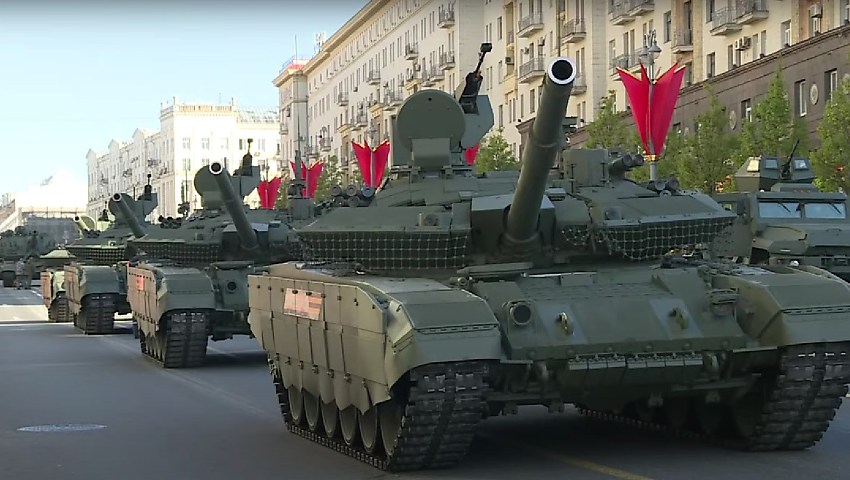
In a major return to form, Russia has once again rolled out its big guns, main battle tanks and missile launchers during the 80th anniversary commemorative Victory Day military parade on 9 May.
The celebration of victory against Nazi Germany in World War II is traditionally the nation’s largest and most public showcase of military might and usually features its most modern tanks, missile launchers and technology.
Representing a stark viewpoint into a Russian and Chinese-led world order, a number of international military personnel marched alongside Russian troops in the parade. These included personnel from Vietnam, Azerbaijan, Belarus, China, Egypt, Laos, Kazakhstan, Kyrgyzstan, Mongolia, Myanmar, Tajikistan, Turkmenistan, Uzbekistan and the People’s Republic of China.
Numerous foreign dignitaries were also listed as attending from Armenia, Azerbaijan, Belarus, Bosnia and Herzegovina, Brazil, Burkina Faso, China, Congo, Cuba, Egypt, Equatorial Guinea, Ethiopia, Guinea-Bissau, Kazakhstan, Kyrgyzstan, Laos, Mongolia, Myanmar, Palestine, Serbia, Slovakia, Tajikistan, Turkmenistan, Uzbekistan, Venezuela, Vietnam, North Korea and Zimbabwe, among other nations.
Chinese President Xi Jinping, who conducted a number of pre-parade agreements in Moscow, was welcomed personally by Russian President Vladimir Putin after all dignitaries had arrived, and the two leaders sat together to observe the parade. The arrangement a clear indication that China and Russia are lock-step in their international foreign policy goals.
In past commemorations, columns of Russian T-90A, T-14 Armata and Terminator tanks have rolled through Red Square, flanked by artillery and shadowed by MiG fighter jets and military helicopters flying overhead in previous years.
This year’s parade (80th anniversary) featured a return to form with the main stays such as T-72B3M, T-80BVM and T-90M main battle tanks alongside BMP-1AM, up-armoured BMP-3 and BMP-2M infantry fighting vehicles as well as wheeled artillery systems, tracked Msta-S 152mm artillery, Tornado-S multiple rocket launcher systems and Shahed-drone styled Geran-2 loitering munition carriers.
The vehicular part of the parade was once again led out by its historical grouping of World War II T-34 medium tanks; however, the much-touted T-14 Armata modern main battle tanks took a firm backseat. The T-14 is understood to have had limited, if any, combat deployment in Ukraine and pressure is likely mounting to shelve further manufacturing of the vehicle due to heavy cost, cheaper alternatives in the T-80/T-90 and reputational damage (if it were destroyed by drones or captured).

The parade also featured a number of personnel carriers and armoured car troops transports such as the 30mm armed BTR wheeled armoured personnel carriers, K-17 Bumerang infantry fighting vehicles, Titan specialised protected vehicles, Tigr-M all-terrain infantry vehicles, Typhoon mine-resistant troop transports and Linza 4x4 armoured medical vehicles.
Of note, is the inclusion of TOS-2 thermobaric launcher systems. Similar to the tracked TOS-1 thermobaric launchers, which have been used extensively by Russian forces in Ukraine, despite flamethrower-style systems being frowned upon by much of the international community, they are largely considered effective against fortifications, occupied structures, lightly armoured vehicles and personnel.
There was a strong presence at the parade again for Russia’s missile systems, this year including the RS-24 Yars intercontinental ballistic missile launcher, eight-wheeled Iskander-M ballistic missile launcher and S-400 surface to air missile launcher.
The last Victory Day parade held in Russia was comparatively solemn with a single T-34 medium tanks taking part alongside around 8,000 troops, several Tigr-M, 3-STS Akhmat, VPK-7829 Bumerang IFVs, VPK-Ural armoured cars, BTR-82A APCs, S-400 Triumf air defence systems, and a Yars intercontinental ballistic missile system with no aircraft flyover. International attendees at that time included those from Armenia, Belarus, Kazakhstan, Kyrgyzstan, Tajikistan, Turkmenistan and Uzbekistan.

Want to see more stories from trusted news sources?
Make Defence Connect a preferred news source on Google.
Click here to add Defence Connect as a preferred news source.