

 iscover
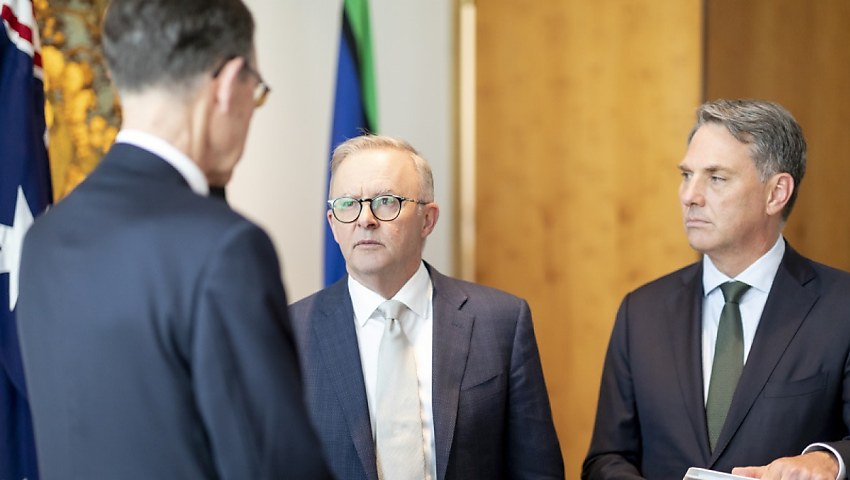
Prime Minister Anthony Albanese has resisted the Trump administration’s pressure to rapidly lift Australia’s defence spending to 3.5 per cent of GDP amid rising global tensions, clashing with warnings from ASPI and other experts – but at what cost to our own security?
Australia is a nation that prides itself on “never shirking its responsibility” and always being among the first (if not first) to step forward to defend democracy, the international rule of law and more recently, the post-Second World War economic, political and strategic order.
Yet in recent decades, particularly as a revisionist “world order” has emerged across the world – concentrated in Russia, the People’s Republic of China, Iran and to a lesser degree, other emerging powers across the world, including India, Brazil and Indonesia – Australia’s “commitment” to and “investment” in the global status quo has increasingly become one dominated by a culture of dependence.
This culture of dependence has steadily seen Australia’s investment in its defence and national security spending steadily trending down, driven in large part by the hubris and heady excitement of the post-Cold War world and the phenomenon known as the “peace dividend” that swept much of the Western World which continues to seduce many policymakers to this day.
In Australia’s context, the reality and costs of this culture of dependence has become increasingly apparent particularly as the mask began to slip from Beijing as it began to militarise reclaimed islands (against reassurances that it wouldn’t) in the South China Sea, increasing efforts to coerce neighbours all backed by the largest and most rapid modernisation and expansion of military capabilities since the inter-war years.
Adding further complexity to Australia’s policy dialogue is the second Trump administration which has established a new floor for allied defence spending, that being 3.5 per cent of gross domestic product (GDP) on defence spending, as the US begins to come to terms with the reality of its declining relative power and the emergence of an ecosystem of aforementioned major and great powers across the world that are eager to challenge the post-Second World War order.
As a result, Australia, like many US allies, has borne witness to mounting questions about the capacity of the United States to maintain the global order, with US President Donald Trump and his administration explicitly calling on allies to spend more on their own defence capabilities in order to depend less on the US and its military for their own security.
This push has seen what many would consider a rather lacklustre response from Australia since the release of the 2023 Defence Strategic Review and the supporting 2024 National Defence Strategy and Integrated Investment Program and a commitment by the Albanese government to reaching 2.33–2.4 per cent of GDP by 2033–34.

Pushing back in a rather robust manner, we saw Prime Minister Anthony Albanese responding to questions about Australia’s defence spending, saying, “What we’ll do is we’ll determine our defence policy, and we’ve invested just across the forwards, an additional $10 billion in defence. What we’ll do is continue to provide for investing in our capability but also investing in our relationships in the region.”
This comes days after the Prime Minister’s snippy response on ABC radio to criticism from the Australian Strategic Policy Institute (ASPI), where he said, “Well, that’s what they do, isn’t it? ASPI. I mean seriously, they need to, I think, have a look at themselves as well and the way that they conduct themselves in debates. We’ve had a Defence Strategic Review. We’ve got considerable additional investment going into defence, $10 billion.”
“We’re lifting up our defence expenditure up to 2.4 per cent of GDP. We’re investing in assets and our capability. We’re also investing in our relationships in the region that’s very important as well. ASPI regularly produce these sort of reports, you know, run by people who’ve been in a position to make a difference in the past as part of former governments. You know, like, I think it’s predictable, frankly. What we’re doing is getting on with the defence assets and providing the investment for those assets to be upgraded,” the Prime Minister added.
The prompt for these pointed responses is no doubt the “one, two” of the ASPI’s The cost of Defence report and comments made by US Secretary for Defense Pete Hegseth during meetings on the side of the Shangri-La Dialogue 2025 in Singapore with Australia’s Deputy Prime Minister and Defence Minister Richard Marles, in which Secretary Hegseth stressed that Australia needed to lift its defence spending to 3.5 per cent of gross domestic product as soon as possible.
Spearheaded by ASPI’s visiting senior fellow Marc Ablong PSM, outlining a number of key questions, namely, “This year’s Cost of Defence therefore asks some more fundamental and strategic questions and evaluates whether the government is paying enough attention to the traditional strategy calculation of ends, ways and means. Has it identified and articulated the objectives that meet Australia’s strategic intents, as set out in the 2023 Defence Strategic Review and the 2024 National Defence Strategy? Has it chosen the best plans for meeting those objectives? And has it allocated enough resources for those plans?
“Finally, this year’s Cost of Defence asks the hard questions about whether the government’s rhetoric about a once-in-a-generation investment in defence and about the criticality of Australia’s defence industry base, national economic base and resilience is being matched by resources ... We argue, as we did last year, that resourcing isn’t matching the rhetoric. We suggest that, in part, that’s because the implementation of strategy has been frustrated by bureaucratic, time-consuming and inefficient processes.”
Key findings – A mixed bag and a lot of confusion
Breaking with tradition, the report extended its analysis beyond the Department of Defence alone to assess whether government strategy, capability planning and resources match the growing threats identified in the 2023 Defence Strategic Review and the 2024 National Defence Strategy, particularly the nation’s requirement for a “whole-of-nation” and “whole-of-government” response to the emerging threats.
It reviewed recent budget outcomes and forward estimates, evaluated major capability projects and highlighted workforce and organisational challenges that affect Australia’s ability to prepare and respond. Overall, ASPI found that despite repeated calls for a “once-in-a-generation” uplift in defence investment, actual funding increases have been modest and may not keep pace with the nation’s strategic needs.
In particular, we see only modest budget growth, with Defence’s total planned funding (including departmental appropriations, prior year appropriations and equity injections) rising only slightly from about AU$53.5 billion in 2024–25 to roughly AU$56.1 billion in 2025–26 (excluding working-capital adjustments).
This marginal increase largely reflects routine indexation and some early spending on long-planned projects, not a large new funding surge, contrasting in large part with the rhetoric of the government over the past three years.
Bringing us to the forward spending, with ASPI identifying that the 2025–26 budget brings forward only AU$1 billion from 2028–29 into the 2026–28 period. In practical terms, this accelerates just a tiny fraction of the promised defence build-up, the bulk of the so-called “generational investment” remains scheduled beyond the current forward estimates, resulting in most of the significant force-modernisation spending is therefore still being delayed until after 2028–29.
To understand the implications of this spending, we also have to use the metric of defence spending when measured against GDP, the key metric for understanding contemporary defence spending. Highlighting this, the ASPI report stated that Defence spending remains around 2 per cent of Australia’s GDP and roughly 5–6 per cent of total federal government outlays.
There is no escaping that these figures have stayed relatively flat, or put more simply, the nation’s defence budget is not expanding its slice of the national pie even as strategic threats intensify. Observers noted that this share is low by international standards among like-minded allies and represents “business as usual” funding rather than a crisis-level response.
Each of these factors are exacerbated by a myriad of factors, namely, increasingly aggressive moves by authoritarian powers, especially China’s military assertiveness and expansion of critical technologies, threatening Australia’s interests in the Indo-Pacific. At the same time, global power shifts (including a more transactional US foreign policy) and regional rearmament (with several Indo-Pacific states expanding conventional and even nuclear forces) have created a highly uncertain security environment.
Beyond traditional warfare, Australia faces a range of new security challenges, including cyber and information-warfare attacks on government and infrastructure, foreign interference in politics, terrorism, and hybrid tactics that exploit society’s fault lines. Not to be outdone, domestic political polarisation and mistrust in institutions add to the nation’s vulnerability, with ASPI’s report noting that governments worldwide are seeing rising populism and conspiracy thinking, which can degrade social cohesion and complicate national defence efforts.
These challenges bleed into the current force, its readiness, resilience and capacity to contribute and “fight tonight”, issues long identified and described as a major hurdle for Australia’s capability to defend itself even for a limited period of time.
ASPI’s report articulated that the ADF’s modernisation timeline creates a capability gap in the late-2020s, with much of the emphasis on major purchases (e.g. nuclear submarines, advanced fighter jets, hypersonic missiles) which are slated for late 2020 to 2030s, the current years lacking substantial new combat power. ASPI warned that this delay raises the risk that the ADF could be “hollow” when confronted by an urgent crisis, emphasising the nation’s need to invest not just in future kit but also in the readiness and training of today’s forces to deter immediate threats.
Finally, ASPI’s report raised the issue of national industrial resilience and preparedness as a central pillar that requires significant emphasis by the government as a means of enhancing the preparedness and the capability of the existing force, while strengthening the national capacity to resist and endure crisis in our region.
The report stressed “preparedness and resilience” at the national level, including ensuring domestic industry capacity (a sovereign defence industrial base), secure supply chains and societal resilience (e.g. civilian readiness in emergencies). ASPI noted that while government rhetoric has highlighted the importance of a robust defence industry and national resilience, there are questions whether policies and funding are adequate to build them. Greater investment may be needed in civil defence planning, emergency stockpiles and infrastructure hardening.
Key questions not being asked
The research and analysis conducted by ASPI in its report highlighted a number of “known knowns”, articulating what many experts from across Australia and more broadly allied nations have already identified within themselves and in us, yet challenges that we have failed to address.
Central to this is the perennial question about successive Australian governments letting budget drive strategy, rather than strategy driving budget with little to no real, material change to the nation’s defence capabilities, force structure and force posture since at least the late 1970s.
This is apparent on every major metric, while when it comes to personnel, Australia continues to backslide as we face both recruiting and retention issues, with the nation falling short of recruitment targets, with Army recruitment down 8.6 per cent, Navy being slightly down, while Air Force has bucked the trend seeing growth of 7 per cent, as the ADF grapples with approximately 10 per cent of the force leaving annually.
But as stated, these are all very, very well “known knowns”. The major question no one seems to be asking is, what sort of military does Australia require to secure our own interests or as the government itself has stated, “deter any adversary” unilaterally, and how much does this differ from the sort of military Australia would require if the United States rapidly withdraws major elements of its power and presence from the Indo-Pacific?
The next major question becomes: what does that force then look like? With a final but arguably the most important question: what does the nation look like if it is going to support that?
Because one thing is for sure, as it stands, it would seem that we are FAR from being ready, willing or able to ask these questions, let alone answer or deliver what is required and that needs to change.
Final thoughts
As the world and indeed, our region continues to grow more competitive, it’s becoming abundantly clear that Australia can no longer afford to rely on our “business as usual” attitude of “she’ll be right, mate”.
While Australians have enjoyed the “easy” decades since the end of the Cold War and the resulting “peace dividend” that continues to shape the nation’s economic, political and strategic consensus, it’s hard not to think back to the justifiable anger and frustration felt by the public at the height of the COVID-19 pandemic, when the illusion of national preparedness was laid bare.
That same anger and frustration will only intensify if the nation, its interests, or our standard of living comes under direct threat, and the Australian Defence Force and broader national security apparatus are revealed to be woefully unprepared to independently confront such a crisis.
For too long, our leaders have prioritised short-term economic gains over long-term strategic vision. That has to change. The question isn’t whether we’ll face challenges, the question is when will Australia respond with clarity and conviction to the challenges we will face? When will our leaders put forward a bold, coherent plan to keep us competitive and resilient?
The decisions we make today will determine whether Australia thrives – or is simply swept along by the tide of history.
Get involved with the discussion and let us know your thoughts on Australia’s future role and position in the Indo-Pacific region and what you would like to see from Australia’s political leaders in terms of partisan and bipartisan agenda setting in the comments section below, or get in touch at

Want to see more stories from trusted news sources?
Make Defence Connect a preferred news source on Google.
Click here to add Defence Connect as a preferred news source.