

 iscover
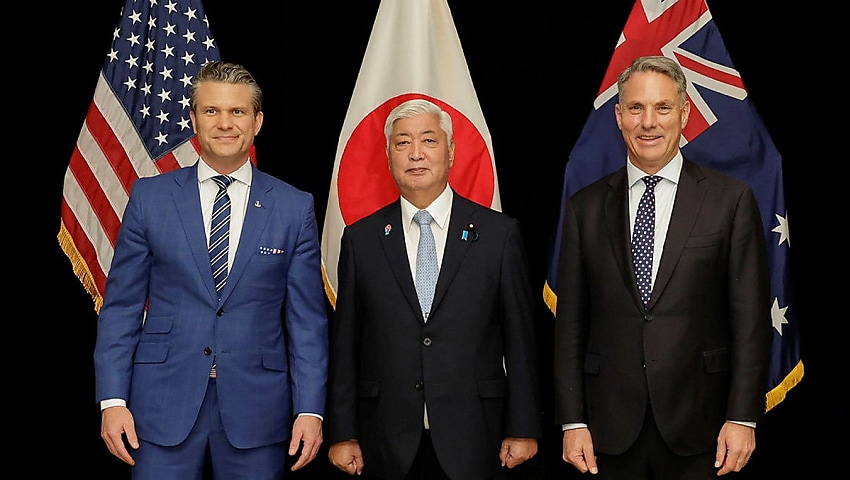
Australian Deputy Prime Minister and Defence Minister Richard Marles, Japan’s Minister of Defense Nakatani Gen, and US Secretary of Defense Pete Hegseth convened at the 15th Trilateral Defence Ministerial Meeting in Singapore.
This agreement occurred on the sidelines of the 22nd International Institute for Strategic Studies Asia Security Summit, better known as the Shangri-La Dialogue. This meeting also marked the inaugural session of the Trilateral Defence Consultations (TDC), launched in November last year.
The ministers reaffirmed the strong bonds between the three countries, underpinned by a shared commitment to collective deterrence and regional stability.
“We’ve made significant strides towards enhancing trilateral interoperability and operational coordination,” Minister Marles said. “This partnership is essential in preparing us to face the most pressing challenges in the Indo-Pacific.”
The ministers acknowledged the increasingly complex security environment in the region and emphasised the critical role of the Australia-Japan-US partnership in maintaining a free and open Indo-Pacific. They pledged to continue working with regional partners to bolster collective defence capabilities and demonstrate leadership in promoting peace and stability.
The three nations outlined concrete steps to enhance policy and operational alignment under the TDC framework. This includes expanding activities around Japan, increasing Japanese involvement in Australia–US force posture arrangements and aligning strategic communications. The ministers called for enhanced trilateral coordination through tabletop exercises addressing regional contingencies.
A key development was the establishment of Japan’s Joint Operations Command in March this year, which will improve operational coordination with the upgraded United States Forces Japan and Australia’s Headquarters Joint Operations Command. Reciprocal liaison officer exchanges will further strengthen ties.
The ministers committed to expanding joint capabilities through:

- Increased access for Australian Defence Force and partner forces to Japan for joint training with the Japan Self-Defense Forces (JSDF).
- The first trilateral F-35 exercise in Australia at Exercise Southern Cross in July 2026.
- Continued trilateral F-35 training, including at Exercise Cope North in February and Exercise Bushido Guardian in September 2025.
- Reciprocal deployments of air assets, including airlift and F-35s.
- The largest-ever JSDF participation in Australia–US Exercise Talisman Sabre in 2025, featuring amphibious training involving all three nations.
- Enhanced trilateral intelligence, surveillance and reconnaissance cooperation and reciprocal asset protection.
- Closer operational collaboration with the Philippines, including joint high-end exercises and maritime security activities in the South China Sea to uphold international law.
The ministers welcomed progress on trilateral cooperation in advanced defence capabilities, including long-range strike, stand-off defence, and networked air and missile defence systems. The three nations also confirmed that plans for live-fire exercises and information-sharing mechanisms were endorsed, with a live-fire drill slated for Exercise Talisman Sabre 2027.
Trilateral cooperation on research and development is also advancing, with joint work on composite aerospace materials set to commence by mid-2026. The completion of a trilateral concept for human-machine teaming in the air domain was hailed as a milestone in collaborative combat aircraft and autonomous systems development.
Australia and the US celebrated the success of DSEI Japan 2025 and reaffirmed their commitment to promoting multilateral defence industry cooperation in the Indo-Pacific. This includes efforts to strengthen production, sustainment and supply chain resilience, particularly through the Partnership for Indo-Pacific Industrial Resilience.
The ministers also highlighted the importance of a reliable supply of critical minerals for defence capabilities and pledged to support stable sourcing through public-private collaboration.
The meeting concluded with a renewed commitment to expanding cooperation with regional partners, including India, the Philippines and South Korea. The ministers welcomed Japan’s participation in Australia-led initiatives such as Exercise Puk Puk and Operation Render Safe in the Pacific in 2025, underscoring the trilateral commitment to regional stability and security.
Want to see more stories from trusted news sources?
Make Defence Connect a preferred news source on Google.
Click here to add Defence Connect as a preferred news source.