

 iscover
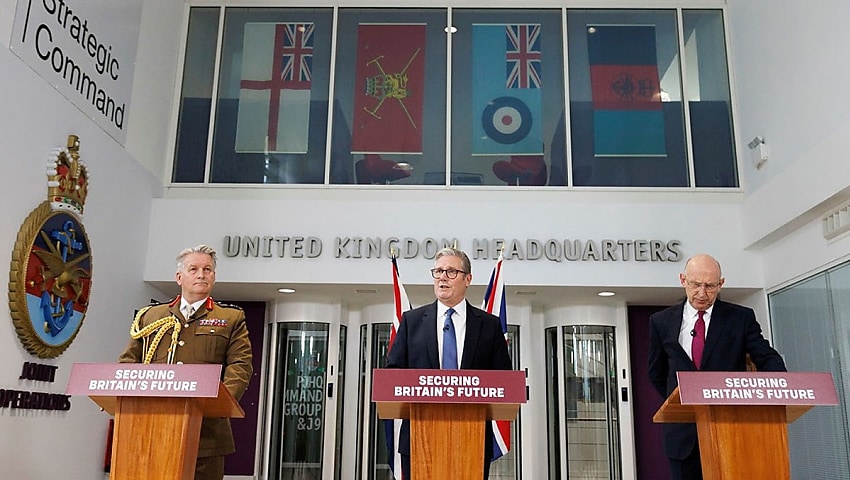
UK Prime Minister Sir Keir Starmer KC has formally unveiled the long-awaited Strategic Defence Review, promising a generational uplift, recalibration and modernisation of the UK’s Armed Forces and defence industrial base.
The British Prime Minister has declared that the United Kingdom is facing its most serious and complex security environment since the end of the Cold War, with multiple direct threats now challenging the country’s safety, prosperity and democratic institutions.
The world is entering an era of deep geopolitical instability, where the risk of major power conflict once considered almost unthinkable, is now a real and growing concern. The UK, together with its NATO allies, must be prepared not just to deter aggression, but to fight and win if necessary.
Defence experts warn that any future conflict involving advanced military forces is likely to be high-intensity, long-lasting and deeply costly in terms of resources, lives and national resilience. This sobering reality marks a major shift from the post-Cold War era, where large-scale state-on-state conflict seemed largely relegated to history.
Recognising this, the British government commissioned a Strategic Defence Review (SDR), promising that this “generational challenge” demands nothing less than a generational response, with Prime Minister Starmer saying, “We have already acted. Announcing the largest sustained increase in defence spending since the end of the Cold War.
“Raising it to 2.5 per cent of gross domestic product (GDP) by 2027. Setting the ambition to hit 3 per cent in the next Parliament ... Subject to economic and fiscal conditions.”
To meet this challenge, Britain’s Armed Forces must make a decisive shift towards full warfighting readiness, this includes not only expanding capabilities and industrial production but rethinking the very foundations of military power.
Defence strategy is now being shaped by the most dramatic transformation in warfare in over a century, driven by rapid technological innovation – traditional measures of military strength, like troop numbers and the size of equipment inventories are no longer sufficient on their own. In the modern battlespace, success is determined by agility, data dominance and technological edge.

Today’s military effectiveness relies on tightly integrated networks of manned, unmanned and autonomous systems that can make decisions at “machine speed” and operate seamlessly across land, sea, air, space and cyber domains. These systems harness artificial intelligence, real-time data processing and advanced sensor technology to deliver unprecedented levels of combat power or “lethality” with greater speed and precision than ever before.
These are the central challenges driving the UK government’s SDR, in many ways similar to Australia’s own 2023 Defence Strategic Review and the following 2024 National Defence Strategy and Integrated Investment Programs, respectively, which are designed to deliver what is described as a “generational” uplift in both nation’s respective military capabilities.
Prime Minister Starmer said, “This Strategic Defence Review will ensure the UK rises to the challenge and our Armed Forces have the equipment they need that keeps us safe at home while driving greater opportunity for our engineers, shipbuilders and technicians of the future.”
And the future is very much the central focus for the UK’s Strategic Defence Review, with each of the respective branches set for significant overhaul, modernisation and expansion of their capabilities and a strategic focus on delivering whole-of-nation “warfighting readiness”.
Rule Britannia, Britannia rules the waves
Front and centre of this is the “senior service”, more commonly known as the Royal Navy, which is expected to experience significant expansion, with the Prime Minister confirming an expansion of the nation’s nuclear-powered submarine fleet, up from the current seven Astute Class submarines to a dozen of the SSN-AUKUS submarines.
This will be supported by a move towards a “more powerful but cheaper and simpler fleet” focused on developing and delivering a “high-low” mix of capabilities, exploiting next-generation weapons systems, autonomy and digital integration.
The much questioned UK carrier capability will be at the forefront of this shift, establishing a “hybrid” carrier airwings, combining crewed combat aircraft, in this case the F-35B, coupled with autonomous collaborative platforms (think loyal wingman-style aircraft) in the air and expendable, single-use, “kamikaze”-style drones, and most interestingly, deck fired long-range missiles.
In addition to this, the Royal Navy’s surface fleet is set for continued growth through the continued delivery of the Type 26 City Class of anti-submarine warfare frigates, modernisation and eventual replacement of the Type 45 destroyers with the potential for a “minimally crewed”, if not uncrewed surface vessel, capable of contributing to carrier strike groups, along with broader integrated air and missile defence capabilities.
The Royal Navy will continue with the construction and fielding of the Type 31 general purpose frigates as a key mechanism for expanding the surface fleet, with the countermine and hydrographic capabilities to be provided by autonomous platforms. Finally, there is a commitment to delivering a “balanced” Royal Fleet Auxiliary, leveraging commercial and private sector relationships to “maximise the UK’s warfighting capabilities”.
A modern British Expeditionary Force
When it comes to the British Army, arguably the force most in need of modernisation, with wholesale efforts underway to replace and recapitalise much of the 1990s-era military equipment, including the delivery of “traditional” platforms – like the Challenger 3, Ajax and Boxer – with the SDR calling for a “tenfold increase in lethality by harnessing precision firepower, surveillance technology, autonomy, digital connectivity and data”.
Backing this, the British Army will see the formalisation of a “hybrid” personnel make-up, aiming to deliver a “minimum” of 100,000 soldiers, with 73 per cent of this figure to be regular soldiers with the introduction of autonomous and uncrewed in a “dynamic high-low” mix of capabilities to provide the Army with the adaptability and future-proofed force capable of defending the United Kingdom.
As part of this, the SDR calls for a “20-40-40” mix is likely to be necessary: 20 per cent crewed platforms to control, 40 per cent “reusable” platforms (such as drones that survive repeated
missions), and 40 per cent “consumables” such as rockets, shells, missiles and “one-way effector” drones “to provide the core of this mix”.
Additional “global crisis response” would be provided by the 16 Air Assault Brigade, with the venerable parachute regiment capabilities to remain focused on a single battalion group, further, to be supported globally by elements of the Royal Marines Commando force.
A cutting-edge Air Force
Much like the Royal Navy and British Army, the delicate balance between crewed and uncrewed capabilities is at the forefront of the government’s plans for the Royal Air Force, with a suite of capabilities to deliver combat power for the UK, including commitment to the next-generation Future Combat Air System (FCAS) under the Global Combat Air Programme (GCAP) being jointly developed with Italy and Japan as top priority.
Prior to the fielding of the FCAS, the Royal Air Force will see the upgrading of its existing Typhoon fleet along with the acquisition of additional F-35s over the next decade to support the existing two squadrons of F-35Bs, with the SDR hinting at a hybrid mix of F-35A and F-35B aircraft to be fielded “according to military requirements to provide greater value for money”.
Collaborative combat aircraft or autonomous collaborative platforms (ACPs), as identified in the SDR, are a critical component for expanding and enhancing the combat power of the Royal Air Force to work alongside the crewed aircraft of both the Royal Air Force and Royal Navy carrier strike groups, with the SDR spelling out, “The ACPs must be designed to operate in collaboration with the fourth-, fifth- and future generations of combat aircraft and to operate from the UK aircraft carriers.”
Additionally, the Royal Air Force’s commitment to the E-7 Wedgetail is reaffirmed with the SDR confirming that additional airframes should be procured when funding allows and could be expedited by a cost-sharing arrangement with NATO allies under the auspice of the existing NATO Airborne Early Warning and Control Force framework. This capability will be enhanced by the inclusion of maritime surveillance capability into the uncrewed Protector aircraft and the integration of the P-8 Poseidon aircraft.
Finally, on big ticket modernisations, this would be supported by increased investment in the “foundations” of the UK’s integrated air and missile defence capabilities, to be supported by the development and fielding of a “resilient” UK military space system to empower space control, decision advantage and capabilities that support the “Understand” and “Strike” functions identified by the UK government.
This would be delivered as part of the creation of a “digital web” designed to provide British decision makers with accurate intelligence, surveillance and reconnaissance streams as part of this push to deliver space control, decision advantage and kinetic capability overmatch.
The cyber and electromagnetic domain
Echoing the creation of the UK Space Command, the SDR calls for the standing up of a “cyber and electromagnetic” domain command tasked with coordinating and defending Britain from “daily attacks in the grey zone” from within the auspice of UK Strategic Command.
This is designed to emulate the model established by Space Command to provide a blueprint for domain coherence, while not “executing, military action across cyber space and the electromagnetic spectrum”, but rather the National Cyber force retaining the responsibility for executing offensive cyber operations.
Enhancing Britain’s defence industrial base
A central pillar of all of this shift is the emphasis on delivering an “always-on” defence industrial base, particularly of key consumables across the defence domain, with the British recognising that the defence industrial base is an “engine for growth” central to driving jobs and prosperity through a new partnership with industry, radical procurement reforms and backing UK businesses.
This includes a £15 billion (AU$31.4 billion) commitment which will secure the future of the Royal Navy’s Continuous At Sea Nuclear Deterrent by funding the sovereign nuclear warhead program in this parliamentary term. The investment will support over 9,000 jobs at the Atomic Weapons Establishment in Aldermaston and thousands more throughout the UK supply chain.
This marks the first time the UK has fully outlined the scale of its nuclear warhead investment, reaffirming its “triple lock” commitment: maintaining a continuous deterrent at sea, delivering the new fleet of Dreadnought submarines and funding all future upgrades.
Defence already supports more than 400,000 skilled jobs and is central to the government’s “Plan for Change”. With defence spending set to rise to 2.5 per cent of GDP by 2027 – and an ambition to reach 3 per cent in the next Parliament – the sector is also being used as a driver of economic growth.
To meet rising workforce demands, the government is working with industry to double apprentice and graduate intakes across the defence and civil nuclear sectors, targeting 30,000 apprenticeships and 14,000 graduate roles over the next decade.
An additional £1.5 billion (AU$3.13 billion) will fund at least six new munitions and energetics factories across the UK, creating over 1,000 skilled manufacturing jobs. These factories will produce essential components such as propellants, explosives and pyrotechnics.
Up to 7,000 UK-built long-range weapons will also be delivered to the Armed Forces, supporting around 800 jobs. This reflects key lessons from the conflict in Ukraine, which underscored the importance of long-range firepower and industrial readiness. Together, the investments form an “always-on” production approach that ensures a steady pipeline of munitions and weapons. This strategy will strengthen the UK’s defence industrial base, enhance its operational endurance and reinforce its role within NATO.
All of this combines to deliver a British Armed Forces designed to not only secure the United Kingdom in Europe and the Atlantic theatre, but ensure it continues to play a central role on the global stage in the era of great power competition and rising multipolarity, with some interesting and poignant lessons and ideas for Australian consideration and potentially, adaptation.

Want to see more stories from trusted news sources?
Make Defence Connect a preferred news source on Google.
Click here to add Defence Connect as a preferred news source.