

 iscover
Australian political leadership has been grilled on a possible communication breakdown with the nation’s closest ally, after the US struck Iran over the weekend.
Prime Minister Anthony Albanese and Minister for Foreign Affairs Senator Penny Wong were accused of being “out of the loop” in regard to the recent US strategic planning of strikes under Operation Midnight Hammer against three nuclear enrichment sites in Iran.
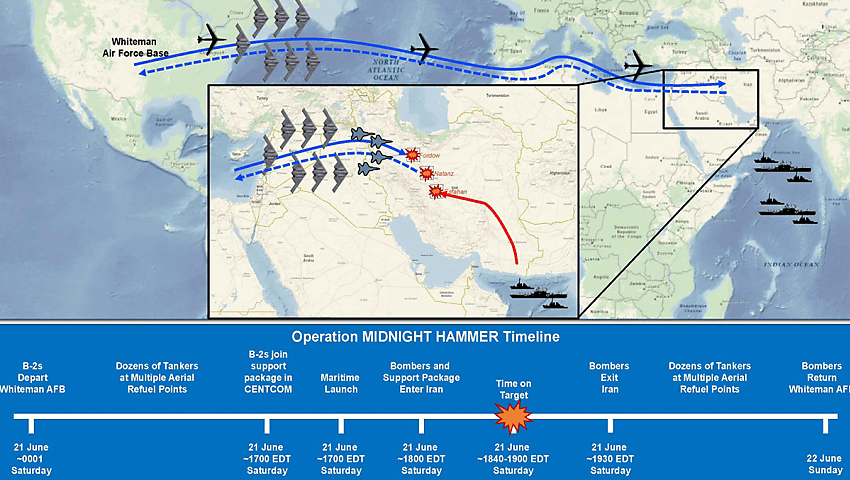
Under the US’ Operation Midnight Hammer, CENTCOM deployed multiple combined assets including B-2 Spirit stealth bombers with 30,000-pound GBU-57 Massive Ordnance Penetrator “bunker buster” bombs against Iranian fortified sites at Fordo, Natanz and Isfahan.
The initial mission package also included several decoy aircraft that flew west over the Pacific Ocean.
Journalists grilled Prime Minister Albanese regarding a 24-hour delay for Australia to express unequivocal support for the US’ military action and the lack of support for Israeli military efforts in Iran, during a press conference at Parliament House in Canberra on 23 June.
“This was unilateral action taken by the United States,” said Prime Minister Albanese, who could not confirm if any warning of the strikes on Iran had been given.
“We aren’t a central player in this conflict, that’s just a fact. And what we do is we run an orderly, stable government.
“The world has long agreed that Iran cannot be allowed to get a nuclear weapon. And we support action to prevent that. That is what this is. The US action was directed at specific sites central to Iran’s nuclear program. We don’t want escalation and a full-scale war. We continue to call for dialogue and for diplomacy.

“As I’ve said for many days now, we are deeply concerned about any escalation in the region and we want to see diplomacy, dialogue and de-escalation. We’ve been upfront about the challenge facing the international community; that is, dealing with the threat posed by any Iranian nuclear weapons program and dealing with the risk of regional escalation.
“And that’s why Australia called upon Iran to come to the table and abandon any nuclear weapons program. Iran didn’t come to the table, just as it has repeatedly failed to comply with its international obligations. We urge Iran not to take any further action that could destabilise the region.
“The information has been clear that Iran has sought to increase the grade (of uranium enrichment) … engaging in a program that wasn’t about civilian nuclear power. And that was clear. It was also very clear over a period of time and as early as a week ago, of course, at the G7, when President Trump left the G7, made it clear that Iran had an opportunity to comply. They chose not to. And there have been consequences of that. Thanks very much.”
Australian political leaders have recently called for a reduction or non-escalation of violence between Israeli, American and Iranian forces in the area.
US Secretary of State Marco Rubio has previously called for Australia and other allies to “not to forget who the real enemy is”, following the announcement of Australian sanctions against Israeli ministers Itamar Ben-Gvir and Bezalel Smotrich for inciting violence against Palestinians in the West Bank, in June.
“The United States condemns the sanctions imposed by the governments of United Kingdom, Canada, Norway, New Zealand, and Australia on two sitting members of the Israeli cabinet. These sanctions do not advance US-led efforts to achieve a ceasefire, bring all hostages home and end the war,” US Secretary Rubio said.
“We reject any notion of equivalence: Hamas is a terrorist organisation that committed unspeakable atrocities, continues to hold innocent civilians hostage and prevents the people of Gaza from living in peace.
“We remind our partners not to forget who the real enemy is. The United States urges the reversal of the sanctions and stands shoulder to shoulder with Israel.”

Want to see more stories from trusted news sources?
Make Defence Connect a preferred news source on Google.
Click here to add Defence Connect as a preferred news source.