

 iscover
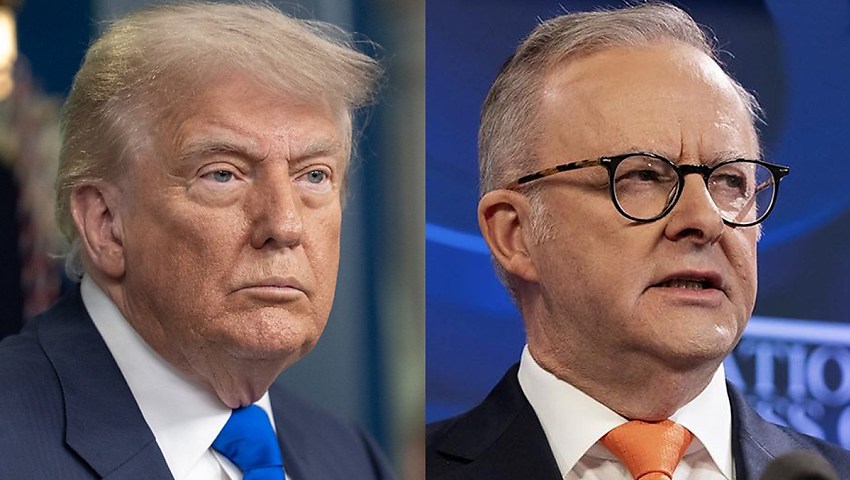
While Australia’s relationship with the United States has stood the test of time, Prime Minister Anthony Albanese appears to have put the alliance on notice, with his John Curtin Oration promoting a push for independence – but at what cost?
In an era of shifting alliances and growing strategic competition, clearly understanding how power is exercised – from dominant global players to emerging regional actors – has never been more important for Australia’s own enduring security, stability and prosperity.
Following the Second World War, the United States emerged as the world’s pre-eminent power, ushering in the era of Pax Americana through institutions like the World Bank and the International Monetary Fund (IMF), and alliances such as NATO.
Backed by immense economic strength and unmatched military reach, Washington took on – often at the encouragement or behest of others – the role of global policeman, containing communism, ending colonial conflicts and underpinning a stable, rules-based international order.
As a result of this foundational role, the United States quickly established itself as the central strategic and security pillar for many Western nations ravaged by the global conflict. Australia was no different, despite being largely unscathed by the conflict.
Formalised in the early 1950s, Australia’s alliance with the United States established the nation’s most important strategic relationship, in many ways replacing its strategic and security relationship with the British Empire and the United Kingdom, replacing the “old world” for the “new world”.
As the 21st century progresses, America’s post-Cold War period of unipolar dominance is weakening. The costs of global military engagement, deep domestic divisions and the rise of powerful rivals have steadily eroded America’s once-unquestioned primacy.
The rapid rise of China and India, alongside the growing influence of countries like Brazil, Indonesia, Poland, Saudi Arabia, Vietnam, and Thailand, signals a shift towards a multipolar world where power is spread across diverse economic and strategic centres.

For Australia, long shielded by its close alliance with the United States and comfortably positioned as a “middle power”, the slow unravelling of Pax Americana is a sharp wake-up call, or at least that is what should be happening.
Despite the shift in the global balance of power, particularly the upheaval currently transforming our own region, Prime Minister Anthony Albanese would have us believe, despite the mounting consensus, that Australia must do more to ensure its own security and Australia should begin to distance itself from the US alliance, in favour of a more “independent” security posture.
Prime Minister Albanese heralded this seismic shift in the nation’s strategic and security posture at a time when his government faces mounting pressure from the United States to lift defence spending to at least 3.5 per cent of gross domestic product (GDP), as well as tightening budgetary challenges as a result of the AUKUS program.
Drawing inspiration from a wartime leader
Speaking at the John Curtin Oration over the weekend (Saturday, 5 July 2025), Prime Minister Albanese drew inspiration from the nation’s wartime leader, Labor Prime Minister John Curtin, who led the nation through much of the Second World War in seeking to chart his vision for Australia’s future strategic posture and position within the Indo-Pacific.
The Prime Minister told the gathered party faithful, “Through 124 years of our Federation and 31 prime ministers of Australia, John Curtin stands apart. No leader of our nation has faced a sterner test. No-one has known a darker hour. And no prime minister has carried more on their shoulders, alone ...
“Within four months of being sworn in as prime minister, Curtin found himself leading the ‘Battle for Australia’. Singapore had fallen; Darwin had been bombed. And he was locked in a battle of wills with the British Prime Minister, Winston Churchill as well as the President of the United States, Franklin Roosevelt.
“John Curtin, a person so mindful of his flaws and limitations, pushing back against two of the most powerful men in the world and two of the most forceful personalities of 20th century politics,” Prime Minister Albanese said.
It is from this basis we see one part of the prime minister’s true objective, the first being to frame his reluctance to lift Australia’s defence spending beyond the planned 2.33 per cent of GDP by 2033–34 as outlined in the 2023 Defence Strategic Review and support 2024 National Defence Strategy and Integrated Investment Program in the face of mounting pressure from firebrand US President Donald Trump as similar to Curtin’s pushback against Churchill and Roosevelt.
Prime Minister Albanese said, “This moment is the core of the Curtin legend. Two divisions of the Australian Imperial Force, returning from the Middle East.
“Curtin wanted those troops for the defence of Australia. Churchill wanted them in Burma – and Roosevelt backed him ... Some historians downplay the military significance of that moment. They argue the threat of invasion was always exaggerated. But consider the counterfactual.
“If Churchill and FDR had got their way, Australian forces would have arrived in Burma barely a week before it fell to the Japanese. Hundreds if not thousands of Australians would have been killed or taken prisoner. It would have been a disaster every bit as crushing to national morale as the fall of Singapore,” Albanese said.
This framing has undoubtedly added fuel to the fire around concerns about the state of the Australia–US alliance, particularly as the White House’s own snap review of the trilateral AUKUS partnership raises questions about whether the US will provide Australia with nuclear-powered submarines as planned.
Adding to this, Prime Minister Albanese stated, “Even when the 7th Division docked safely in Adelaide, that pattern of mental and physical strain had been set. Today, at the safe distance of eight decades, the story of the Second World War is set in our memory.
“The Allied victory over tyranny has, in retrospect, taken on a feel of inevitability. Part of the debt we owe to Curtin, together with all the men and women who served Australia in that terrible conflict, is to remind ourselves how close history came to taking a different path,” he added.
And here lies the second part of Prime Minister Albanese’s framing, that by resisting the mounting pressure for lifting defence spending, in the way that Curtin resisted pressure from both Churchill and Roosevelt, he is in some way preventing Australia from falling to the ambitions of the People’s Republic of China.
If that is the case, one can’t help but ask, is that truly the sort of framing we want to be sending to our main strategic partner in the United States and to our main strategic challenge in the People’s Republic of China?
That presents significant challenges for Australia moving forward and it raises significant questions about the Prime Minister’s further statements.
Writing cheques his body will never have to cash
Bringing us conveniently to the next major point of Prime Minister Albanese’s John Curtin Oration speech, which is the efforts of the Curtin government to leverage the pressures of the Second World War to “remake” the Australian economy, with links to the Albanese government’s own ongoing efforts to remake the Australian economy.
The Prime Minister said, “Where the bravery of Australians had won them the right to build a good life for themselves and their families. With new opportunities in education. Secure, well-paid jobs in manufacturing. Affordable medicines through the Pharmaceutical Benefits Scheme. And a society where, to quote that government’s housing policy, a home was ‘not only the need but the right of every citizen’.”
Going further, he added, “While our nation has changed beyond the imagining of the Labor generations that have gone before us, respect for the aspirations of the Australian people still drives us. And the spirit of progressive patriotism still moves us ...
“That is why we are making the biggest ever investment in Medicare. So more Australians than ever before can see a doctor for free. It’s why we’ve made it clear that under our Labor government, the PBS is not up for negotiation. And it is why on Tuesday, we built on two great Labor reforms – and brought them together. We lifted superannuation to 12 per cent. We expanded paid parental leave by a further two weeks. And for the first time ever, we are adding superannuation to it,” Prime Minister Albanese said.
But what does this have to do with our nation’s defence and security posture and capabilities exactly? Well not a lot, beyond thinly veiled efforts to frame these areas of battlegrounds for our sovereignty with the United States as the Trump administration ramps up trade and diplomatic pressure on Australia.
In trying to thread this tenuous needle, the Prime Minister once again seeks to tie himself to the legacy of the Curtin government, saying, “The decision Curtin had made in 1941 that Australia would issue its own declaration of war with Japan. Speaking for ourselves, as a sovereign nation. That’s what Curtin recognised – this was a Pacific war. It was its own conflict which demanded its own strategy.
Going further Albanese added Curtin’s recognition that “Our security could not be outsourced to London or trusted to vague assurances from Britain. We needed an Australian foreign policy anchored in strategic reality, not bound by tradition. Dealing with the world as it is, not as we would like it to be.”
And it is the final point where we see the Albanese government fall dangerously short, despite their rhetoric, by every metric they continue to view the world as they would like it to be, not as it is.
Our world, particularly the economic, political and strategic challenges rewriting the fundamental balance of power on global and regional scales, means that the “great power peace” as guaranteed by the United States is, fundamentally at an end.
This reality is the world as it is, not as we would like it to be.
Yet for Prime Minister Albanese, we see he is still living in a world that no longer exists, when he reinforces Australia’s role in establishing, enhancing and maintaining the post-war order, saying, “For Australia and for Labor, that independence has never meant isolationism. Choosing our own way, doesn’t mean going it alone.
“It was the Curtin and Chifley governments that brought Australia into the United Nations, the World Bank and the IMF, at the outset. Australia did not just join the institutions which created the international rules-based order, we helped shape them.
“Because we did not want the future of our region to rest on what Doc Evatt called a ‘great power peace’. Then – and now – we championed the rights and the role of middle powers and smaller nations. Then – and now – we recognised that our region’s security depends on collective responsibility. Then – and now – we strive for a world where the sovereignty of every nation is respected and the dignity of every individual is upheld,” Prime Minister Albanese said.
Yet if the Prime Minister and his government were truly serious about securing our position, our sovereignty, our security and as the Prime Minister frames it, our independence we would be embarking on a truly transformative economic and industrial reawakening and a boom in defence spending commensurate with the “most dangerous strategic period since the Second World War”.
Equally, we wouldn’t be spitting in the face of our primary strategic benefactor. So I am left asking, at what cost is the Prime Minister’s insistence on ’independence’ worth it?
Final thoughts
If Australia is serious about truly developing and maintaining independence in the Indo-Pacific and is determined to prosper in a more contested, volatile world, we need to think bigger, act bolder and plan more strategically as a nation.
Defence spending alone won’t safeguard our future. In an era of geoeconomic competition and coercive statecraft, economic power is national power. To hold our own in this shifting global order, we must sharpen our economic edge, building resilience, expanding industrial capacity and turbocharging competitiveness.
The government’s core mission should be clear: grow the economy with purpose, create opportunity on our terms and forge an economic shield strong enough to deter coercion and withstand disruption.
This demands more than incremental reform. We need radical transparency, a culture that celebrates innovation and a new compact between government, business and citizens. Australians deserve a real stake in national strategy and a voice in shaping the choices that will define our future.
It also requires a hard look in the mirror. Are we content with the label of a “middle power”, always reacting to the moves of others? Or are we ready to lead? To earn our place at the top table and champion outcomes worthy of the next generation?
In an age of great-power rivalry and compounding shocks, we can’t afford short-termism or business as usual. Australia needs a bold, long-range vision, one that secures prosperity, hardens sovereignty and protects our freedom for decades to come.
Get involved with the discussion and let us know your thoughts on Australia’s future role and position in the Indo-Pacific region and what you would like to see from Australia’s political leaders in terms of partisan and bipartisan agenda setting in the comments section below, or get in touch at

Want to see more stories from trusted news sources?
Make Defence Connect a preferred news source on Google.
Click here to add Defence Connect as a preferred news source.