

 iscover
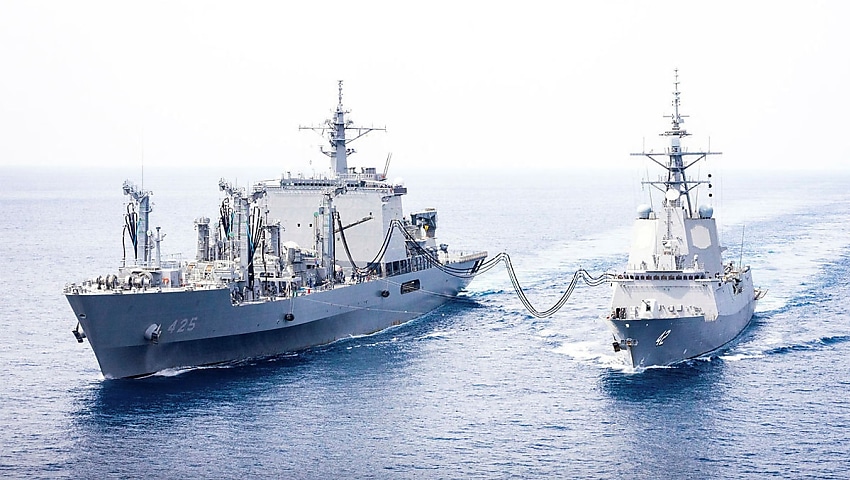
Senior naval officers from Australia, Japan and the United States have signed a new agreement to deepen maritime logistics cooperation, marking the first trilateral logistics arrangement under their long-standing strategic dialogue framework.
The agreement was signed aboard USS America (LHA-6) during its port visit to Brisbane, just ahead of the commencement of Exercise Talisman Sabre 2025. Participants included Vice Admiral Jeff Jablon (US Navy Deputy Chief of Naval Operations for Installations and Logistics), Rear Admiral Naoya Hoshi (Director General of Logistics for the Japan Maritime Self-Defense Force), and Commodore Catherine Rhodes (Director General Logistics, Royal Australian Navy).
The pact aims to improve logistics interoperability across the three navies, reinforcing their shared commitment to security and stability in the Indo-Pacific. It builds on existing bilateral arrangements and introduces more streamlined processes for information, technology and logistics sharing.
“Sustainment in depth is a key priority,” VADM Jablon said. “This trilateral framework enhances our ability to deliver critical support – whether in day-to-day operations or contingency scenarios – by ensuring that the right material and services are available when and where they’re needed.”
The agreement focuses on key logistics capabilities such as missile reloading and underway refuelling. Since 2019, the RAN and US Navy have supported each other’s missile reloading operations across the Indo-Pacific.
Work is also underway to expand this capability with prototype systems designed to transfer missile canisters between ships in elevated sea states. Demonstrations took place in 2024, with further trials scheduled for 2025 and 2026.
Refuelling operations are also central to the agreement. US, Australian and Japanese tankers regularly refuel each other’s vessels during joint exercises. Since 2011, the US Military Sealift Command has fitted leased commercial tankers with specialised consolidated tanking (CONSOL) systems, allowing them to refuel naval oilers at sea.
These efforts have been ramped up in partnership with Australia and Japan since 2022, and discussions are ongoing about equipping allied tankers with similar capabilities.

Rear Admiral Hoshi welcomed the agreement, saying, “Japan is excited to expand cooperation with our US and Australian partners. This arrangement will improve the efficiency and breadth of our interactions.”
In addition to technology and data sharing, incorporating realistic logistics operations into exercises remains a top priority. These include at-sea missile rearming, replenishment, aircraft and ship repair, airfield restoration, salvage operations and casualty evacuation.
CDRE Rhodes noted the practical value of the new arrangement during combined activities, saying, “During Talisman Sabre and beyond, we’ll have real opportunities to work trilaterally on logistics, enhancing our responsiveness across the spectrum of naval operations in the region.”
The agreement signals a new phase of practical cooperation among the three Indo-Pacific allies, reinforcing their ability to operate together in an increasingly contested strategic environment.
Want to see more stories from trusted news sources?
Make Defence Connect a preferred news source on Google.
Click here to add Defence Connect as a preferred news source.