

 iscover
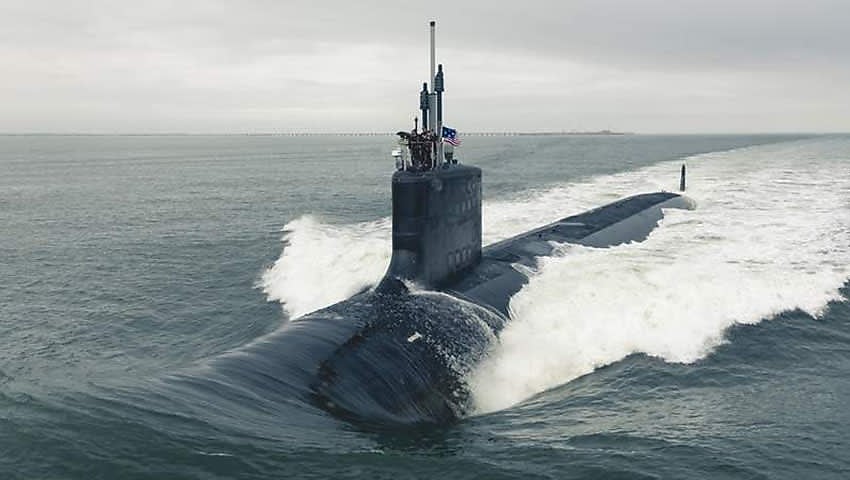
As the Trump administration reviews AUKUS, former DFAT chief Peter Varghese has revived calls for Australia to take more control of its defence – minus the advantage of nuclear submarines.
Since its announcement in September 2021, the AUKUS trilateral security partnership between Australia, the United Kingdom and the United States has been hailed as a once-in-a-generation strategic shift, one that promised to deliver nuclear-powered submarines (SSNs) to Australia and deepen collaboration across emerging technologies, including artificial intelligence, quantum and undersea warfare.
Much of the emphasis is firmly focused on Pillar I, which will see the Royal Australian Navy field a fleet of conventionally armed, nuclear-powered submarines beginning in the early 2030s.
The optimal pathway, unveiled in March 2023, outlined a staged transition involving US and UK submarine rotations through HMAS Stirling in Western Australia, followed by the purchase of three to five Virginia Class submarines from the United States, and culminating in the joint development and construction of the next-generation SSN-AUKUS submarine, to be built in both the UK and Adelaide.
The initiative was framed as essential to counter growing strategic uncertainty in the Indo-Pacific, particularly in response to China’s expanding military reach and ambitions towards the region. Alongside the submarine program, Pillar II promised a fast-moving tech partnership aimed at boosting collective defence innovation and deterrence in areas like cyber, hypersonics and electronic warfare.
However, by mid-2025, progress, particularly on the US side, has become entangled in American domestic politics, with influential defence strategist Elbridge Colby now tasked with reviewing the program under the new Trump administration. It has become clear that the future of AUKUS is again uncertain.
In large part, this is driven by concerns around US industrial capacity, particularly the ability of the US submarine industrial base to meet the requirements of the US Navy, along with technology transfer restrictions and budgetary pressures, have fuelled doubts over Washington’s long-term commitment to delivering Virginia Class submarines to Australia on time.
Nevertheless, Australia and the UK have continued to press ahead with their components of the program, but delays or a reduction in US support could significantly weaken the strategic logic of AUKUS.

As Colby’s review unfolds, the viability of AUKUS as originally envisioned is under renewed scrutiny, forcing Canberra to grapple with hard questions about sovereign capability, alliance dependence and future deterrence strategy.
In this climate, former Australian officials, including former Department of Foreign Affairs and Trade (DFAT) secretary Peter Varghese, have urged a reconsideration of Australia’s defence posture, raising the prospect of a more self-reliant approach, albeit one potentially without the advantage of nuclear-powered submarines.
Varghese in a piece for The Australian Financial Review, titled I ran DFAT. I hope Elbridge Colby sinks AUKUS for Australia, articulated, “The US might yet save us from ourselves by adding conditions to the nuclear submarine agreement that no Australian government could accept.”
Australia needs to do its due diligence
In the deeply reflective piece, Varghese called for a bold rethink of Australia’s strategic trajectory, beginning with a critical reassessment of the AUKUS pact. He argued that far from being a security guarantee, AUKUS, particularly its nuclear submarine component, risks distorting Australia’s defence priorities and weakening its long-term capacity for true self-reliance.
This narrative echoed the sentiments of former prime ministers Malcolm Turnbull and Paul Keating, as well as underpinning the central thesis behind the strategic planning proposed by Lowy Institute’s Sam Roggeveen, through his “Echidna Strategy”, and long-time Defence Department elder, Hugh White.
Varghese believes that Australia must move beyond the long-standing assumption that it cannot defend itself without direct US military support. Instead, he advocates for a defence policy rooted in self-reliance, taking advantage of the nation’s geography and alliance access to advanced technology and intelligence but not at the cost of sovereign decision making or strategic autonomy.
He stated, “The salad days of Australian foreign policy are over. In the eight decades since the Second World War, we have had the enormous benefit of an alliance with the global hegemon, the wisdom to pursue policies which opened up our economy and made us richer, and the luck of good timing to take advantage of the Chinese economic miracle. But we can no longer have our cake and eat it. When the facts change, so must policy.”
While Varghese is correct in asserting that Australia can no longer have our cake and eat it, he misses the mark completely, instead defaulting to the comforting reality of obsequious, myopic "continental defence” championed by the likes of Turnbull, Keating, Roggeveen and White who seem to completely and frequently underestimate the geographic factors that shape Australia’s defence.
He reinforced this, saying, “Our security will only be found through defence self-reliance, taking advantage of our continental geography and buttressed by the technology, intelligence and deterrent value of an alliance with the United States.”
If that doesn’t sound like having our cake and eating it, than I am not sure what does.
The other side of this push is what Varghese termed as “defence self-reliance”, something he does admit won’t come cheap or easily, but something that looks completely different without the tactical and strategic flexibility, adaptability and reach provided by conventionally armed, nuclear powered submarines.
Varghese said, “But defence self-reliance does not come cheap. It will require a significant uplift in our defence budget – not to meet some arbitrary percentage of gross domestic product but to fund the force structure that we need for the defence of Australia. Nuclear submarines distort both the cost and focus of that force structure. If walking away from AUKUS is a bridge too far for the Australian government, the US might yet save us from ourselves by adding conditions which no Australian government could accept.”
While he is correct in stating that that the pursuit of nuclear-powered submarines does indeed distort the defence budget (largely due to the obstinate nature of the current government to accept the rapidly deteriorating threat environment), the reality is, our geographic – along with the political, economic and security – realities of the Indo-Pacific necessitate such a capability for Australia.
Varghese added, “A properly funded defence budget is, however, only part of what we need.”
Avoid the ‘trap’ of Forward Defence
At the core of this push is a warning from Varghese against a return to Cold War-era “Forward Defence” thinking, where Australia acts as a junior partner in distant US-led conflicts, like Korea or Vietnam.
He argued rather, security must be grounded in a credible, regionally focused deterrent capability, one that will require significant investment and difficult budget choices. Nuclear-powered submarines, in his view, risk being an expensive distraction from more relevant capabilities.
A core component of this “rethink” is calls for Australia to be more “clear-eyed” about the rise of China and its ambitions for the Indo-Pacific, with Varghese adding, “We must also face up to the consequences of China’s ambition to become the hegemon of the region. China does not pose a direct military threat to Australia. It is not our enemy.”
This naive view is largely based on the same assumption made by all advocates of a “continental”-focused defence posture and strategy for Australia, that the only possible form of threat to the nation comes from a direct attack and/or occupation of part or all of the Australian mainland.
Something that is, at best, patently false, outrageously ludicrous and is a sign of a mind arrested in development around the time of the release of Patrick Swayze and Charlie Sheen’s 1984 action classic, Red Dawn and fails to take into account the myriad of direct and indirect means by which Beijing, or any other regional power for that matter, can take to kow Australia.
Not least of all is the rising challenge posed by Beijing’s ghost fleets, seen in action in the South China Sea and around Taiwan, or for that matter the growing prominence of cyber warfare, grey zone tactics including espionage, foreign interference and a host of other mechanisms all before coming to kinetic exchanges that could directly impact Australia’s exposed maritime trading economy across the Indo-Pacific.
Varghese went on to add, however, “But for as long as it retains its one-party authoritarian character, it is not in our interests to see it emerge as the predominant power in the region.”
So which is it? Well true to form and much like former prime minister Paul Keating, Varghese believes Australia will find its security “in Asia”, not “from Asia, rather defaulting to diplomatic efforts with other “like-minded” nations, including Japan, South Korea, India and others.
He detailed this, saying, “Australia should contribute to constructing this constraining balance of power. That requires acquiring a credible deterrent capability as well as working with like-minded countries who share our concerns about the emergence of a Chinese hegemony; not in an Asian NATO, which is unrealistic in a region where most countries simply do not want to choose between the US and China, but in a looser structure.”
Again, as if to disprove his own thinking about Australia’s inability to “have its cake, and eat it”, Varghese added, “The US will remain the keystone in such a balance, but its overarching objective should be to constrain China, not to save US primacy. This will need careful management with the US, which, notwithstanding all the talk about Trump’s attachment to spheres of influence, shows no sign of having given up the retention of global primacy as its animating strategic objective.”
Again, I am left asking, Mr Varghese, which is it?
Confronting a bipolar world
Varghese’s thesis then shifts to Australia’s need to embrace the reality of a bipolar world, largely torn between economic, political and strategic competition between the United States and China, with lower-tier powers like India, Japan, Indonesia, the European Union (as a bloc) and others rounding out the “multipolar world”.
He detailed this challenge, saying, “It is tantalising to think of this new balance of power as a precursor to a multipolar world. The reality however is that for the next several decades, we will be living in a largely bipolar world dominated by a competing US and China. The gap in economic size and strategic weight between the US and China on the one hand and the next tier of major powers, such as India or even the European Union, will be huge.”
However, the dominance of the United States and China, in particular, means Australia has its work cut out for it, with Varghese adding, “Navigating a bipolar world while holding on to both the US alliance and the Chinese market will test Australian policy as never before. Strengthening our relationships with key Asian partners such as Japan, Indonesia and India will give us more room to manoeuvre.”
Varghese is correct in assessing that Australia, in particular, needs to diversify its economic prospects and become more economically and industrially diverse and complex, as well as shying away from overdependence on any single market for our continued prosperity, as has happened with Beijing.
“So too will building up our economic resilience through the economic reforms we need to retain a high standard of living and fund our defence capability,” Varghese said.
He rounded out his assessment, summarising our unique conundrum, saying “The prime minister is right to tread carefully in such a world, focusing on Australia’s interests, careful about the prospects of rushing to a deal with a mercurial Trump administration and recognising that, however large our economic interests in China, our strategic interests are incompatible.”
Once again, I am left asking, which is it, Mr Varghese? Because if we want to be independent, it is undoubtedly going to cost us more and far more than what we expect, even though currently we need to increase defence spending, all before we thumb our nose at the US alliance.
Equally, both Australia and Australians need to be far more accepting that as a nation, we need to take our own security, prosperity and stability far more seriously, because if we don’t prioritise it ourselves, how can we expect others to do so?
Final thoughts
Regular readers of Defence Connect know I’ve long argued for a bold, forward-thinking strategy to lift Australia from a middling “Middle Power” to a truly consequential force in our region, one that can pursue its interests with confidence, and when needed, resolve.
The era of complacency is over. The old “she’ll be right” attitude no longer cuts it in a world that’s more competitive, volatile and openly hostile.
Whether we like it or not, power politics is back. The wars in Europe, the Middle East, and South Asia show that strength, not sentiment, shapes outcomes. And it’s not just military power that matters, but whole-of-nation resilience.
Australia is dangerously unprepared. Decades of peace and prosperity have bred comfort, and with it, a false sense of security. We’ve been insulated from the hard realities most of the world still lives with – conflict, rationing and instability.
It’s time to grow up. If we want to secure our future, we need to build serious economic, diplomatic and military clout. This isn’t just about defence; it’s about protecting our sovereignty, prosperity and our ability to shape, not just survive, the Indo-Pacific.
Change is hard. But doing nothing is riskier. A more ambitious Australia could unlock enormous potential by becoming a leader, not a bystander, in a region defined by strategic competition.
With China growing more assertive, we face a choice: stay small and vulnerable or step up. That means diversifying our economy, driving innovation and preparing for coercion so we’re not left exposed to foreign leverage.
Only a strong, diversified, dynamic and globally competitive economy can carry the weight of strategic ambition. Only then can we build a defence force that’s not just present, but powerful, ready for an era where security is earned, not assumed.
Get involved with the discussion and let us know your thoughts on Australia’s future role and position in the Indo-Pacific region and what you would like to see from Australia’s political leaders in terms of partisan and bipartisan agenda setting in the comments section below, or get in touch at

Want to see more stories from trusted news sources?
Make Defence Connect a preferred news source on Google.
Click here to add Defence Connect as a preferred news source.