

 iscover
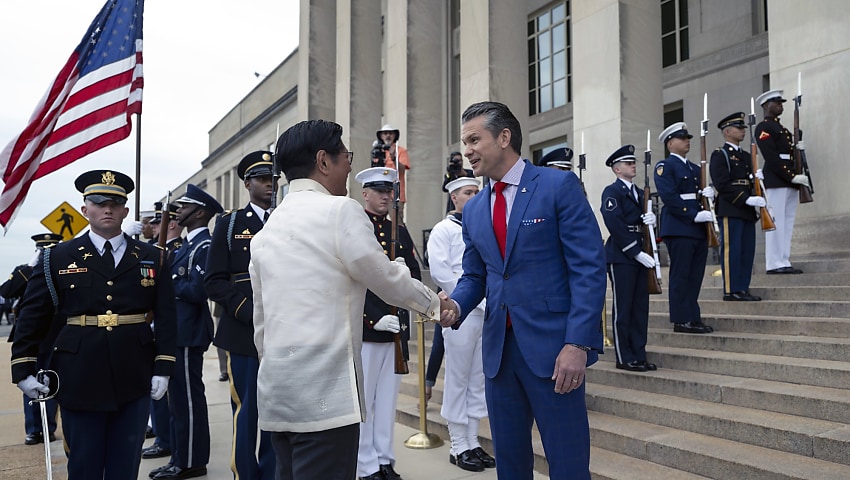
US Secretary of Defense Pete Hegseth has emphasised its mutual defence treaty and Coast Guard assets in the South China Sea, during a meeting with the Philippines.
Defense Secretary Hegseth hosted Philippine President Ferdinand Marcos Jr at the Pentagon to reaffirm the US-Philippines Mutual Defense Treaty and discuss shared security concerns in the Asia-Pacific region.
“Our storied alliance has never been stronger or more essential than it is today, and together, we remain committed to the Mutual Defense Treaty. And this pact extends to armed attacks on our armed forces, aircraft or public vessels, including our Coast Guard, anywhere in the Pacific, including the South China Sea,” he said.
“As I emphasised at Shangri-La, the Asia Pacific is our priority theatre, and the United States is committed to achieving peace through strength and willing to work with all nations who share this desire in the region.
“We do not seek confrontation, but we are and will be ready and resolute. We’re proud to support our mutual economic vitality, including your efforts to modernise your armed forces and collective defence.
“We’re also deploying new cutting-edge missiles and unnamed; excuse me, unmanned systems and revitalising our defence industrial bases. Together, we must forge a strong shield of real deterrence for peace, ensuring the long-term security and prosperity for our nations.”
Personnel from the US and Philippines recently attended the 40th iteration of Exercise Balikatan across the domains of air, land, sea, cyber, information and space.
“The United States is our only treaty partner, and the Mutual Defense Treaty continues to be the cornerstone of that relationship, especially when it comes to defence and security cooperation,” said Philippine President Ferdinand “Bongbong” Marcos Jr.

“We, again, have reaffirmed our mutual defence treaty and the importance that both countries, the United States and the Philippines regard that treaty and the joint exercises that we have had, they have been extremely useful, and I’m very, very happy to note that the feedback that we get from our own military has been very good.
“And when I see the officers who were involved and I speak to the men and women who were involved, they say it was extremely useful. And essentially, we’ve achieved our purpose because they say they have learned a lot about how to operate together, not only with American forces, but also with, as you’ve mentioned, forces around the Asia-Pacific and down to Australia and even to Canada and all of the other countries that have been involved.
“So it has been a good development, and I thank [you] and the United States government and President Trump for the continuing support that we feel and that we need in the face of the threats that we, our country, is facing.”

Want to see more stories from trusted news sources?
Make Defence Connect a preferred news source on Google.
Click here to add Defence Connect as a preferred news source.