

 iscover
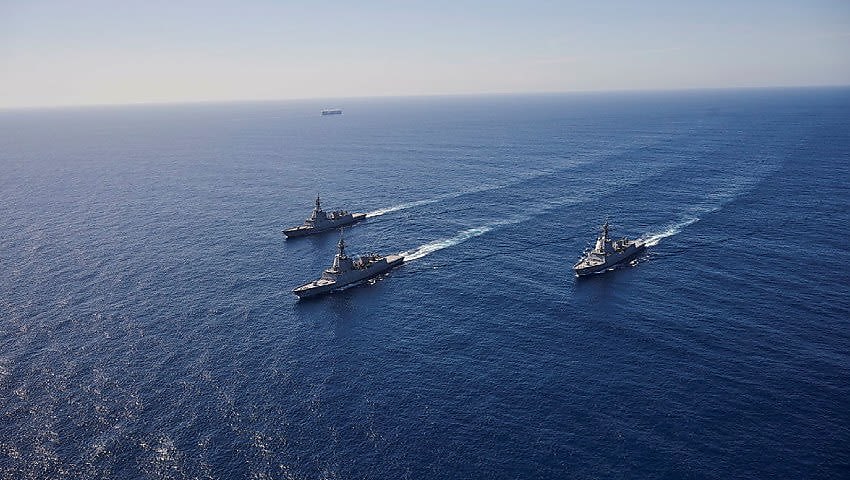
It appears as though sea control is once again in vogue, with calls for Australia to leverage planned acquisitions and developments to secure our vast maritime interests through a balanced strategy built on sea control.
As an island nation utterly dependent upon the unhindered flow of the global maritime commons, Australia’s economic, political and strategic stability and security is intrinsically and inescapably linked to the ocean.
At a high level, Australia’s economy depends on more than 29,000 international trading ship visits annually, which are responsible for over 99 per cent of our international trade, while Australian ports are responsible for handling over 1.6 billion tonnes of cargo annually.
This economic dependency is only further complicated by the vast expanse of the maritime domain Australia is responsible for, with a coastline in excess of 60,000 kilometres, overseas territories stretching across more than 12,000 islands, all of which are backed by the world’s third largest maritime exclusion zone of 8,148,250 square kilometres, with rights over an additional 2.5 million square kilometres (this doesn’t include the nearly 2 million square kilometres attached to Australia’s Antarctic interests).
Further complicating our relationship with the regional and global maritime commons is the increasing belligerence and assertiveness of our primary trading partner, the People’s Republic of China, culminating in the circumnavigation of the Australian continent earlier this year and recent efforts to coerce the Philippines in the South China Sea.
In response to the mounting number of challenges facing Australia’s maritime security, successive governments have sought to boost the nation’s independent capacity to secure our own maritime interests, with the Albanese government’s 2024 Independent analysis into Navy’s surface combatant fleet and its central findings the latest expression of this.
Central to the findings of the colloquially known Surface Fleet Review is the need for a larger, more robust and lethal surface combatant fleet to complement the strategic deterrence capabilities set to be delivered in the form of the conventionally armed, nuclear powered submarines as part of the tripartite AUKUS agreement.

The analysis found that Australia’s surface combatant fleet was not fit for purpose. In fact, it was the oldest the Navy had ever operated, lacking the capabilities needed for the intensifying strategic environment. To address these shortfalls, the panel recommended a significantly more lethal and better-balanced fleet. At its core, the future surface combatant force should include:
- Three upgraded Hobart Class air warfare destroyers capable of enhanced air defence and strike operations.
- Six Hunter Class frigates to bolster undersea warfare and strike capability.
- Seven to 11 general purpose frigates (to be based on the Japanese Maritime Self-Defense Force’s evolved Mogami Class frigates) as a “Tier 2” element, tasked with maritime and land strike, air defence and escort duties.
- Six Large Optionally Crewed Surface Vessels – essentially missile-armed boats with 32 vertical launch cells designed to project long-range strike.
- Retention of six remaining Anzac Class frigates, with the oldest pair to be retired in line with their service life.
In total, that shapes up as 26 major surface combatants, a significant expansion from the existing fleet. This analysis stressed that these surface assets must work in concert with the forthcoming conventionally armed, nuclear-powered submarines, providing a layered and resilient maritime defence posture.
However, questions still remain about the plans, funding and timeline for delivery, as well as the capacity of the proposed force to deliver true “sea control” in a contested and congested Indo-Pacific.
Highlighting this ongoing debate is retired naval officer and expert associate at the National Security College, Australian National University, Jennifer Parker, in a piece for the Lowy Institute’s The Interpreter, titled Sea control, not stockpiles, will secure Australia’s future, in which Parker argued for an accelerated effort to build Australian sea control capabilities.
Flawed arguments don’t change reality: Australia’s future depends on our ability to control the sea
The central driving force behind Parker’s piece is a response to a scathing analysis provided by the Lowy Institute’s Sam Roggeveen following the government’s announcement that the JMSDF’s evolved Mogami Class frigates had been selected as the successful winner of the multibillion-dollar SEA 3000 program to provide a fleet of “Tier 2” surface combatants.
At the core of Parker’s push-back is the reality, as she stated, “Maritime trade is Australia’s lifeline – in times of peace, crisis or conflict. Without ships bringing in the fuel, fertiliser, ammunition and other critical supplies that keep our economy running and our defence viable, Australia would quickly run out.”
Conversely, Roggeveen, a long-time advocate of the “Echidna Strategy” of pseudo-isolationism and neutrality to avoid offending Beijing or any other rising power in our region, articulated three key points, namely, “first, that the newly announced plan to acquire Mogami frigates from Japan would leave Australia with ships unacceptably vulnerable against a highly capable adversary; second, that trade routes themselves are too long to protect; and third, that the effort is not worth it”.
It is worth noting that Roggeveen’s third point is a frequent point made by him and other supporters of similar “Echidna” style strategies, namely Hugh White.
Pushing back against these naive points, Parker said, “Theorists have often argued that surface combatants such as frigates and destroyers are increasingly vulnerable to the proliferation of missiles and now uncrewed capabilities, including aerial vehicles and surface vessels. Most have never operated a warship combat system or fired a missile...
“While vessels operating closer to the coast are indeed exposed to a greater range of threats, lessons from recent naval warfare quickly debunk notions that frigates are now unacceptably vulnerable against a capable adversary. In both the Russia-Ukraine war in the Black Sea and the challenge of Houthi attacks on commercial shipping in the Red Sea, ships with well-prepared, well-trained crews, effective radars, modern combat systems and layered defences remain highly effective. Notably, despite firing hundreds of missiles and UAVs at US and European warships, the Houthis have yet to achieve a hit on a warship. This is why a wide range of nations, including China, continue to invest heavily in them.”
Roggeveen’s second point is regarding Australia’s traditional enemy, the “tyranny of distance”, and geographic isolation which results in a series of long, increasingly complex and contested sea lines of communication (SLOC) across both the Indian Ocean and through maritime Southeast Asia and the Western Pacific
Once again, Parker is quick to point out that Roggeveen’s narrow, naive and somewhat siloed view of any surface combatant operating in isolation rather than part of a joint force colours his analysis and thus results in both a flawed diagnosis and equally flawed prescription, particularly as efforts continue at breakneck speed to transform the Australian Defence Force into a joint force.
Parker added, “Roggeveen overlooks the fundamentals of maritime trade protection. While he doubts the upgraded Mogami’s ability to safeguard Australia’s trade, he ignores that protection comes from a system of capabilities: ships, submarines, satellites and processes such as naval control of shipping, evasive routing and alliances. Australia’s new frigates are a key part of that system, capable of providing close protection when required, but this is often unnecessary when broader sea control, that freedom of maritime manoeuvre, is maintained.”
It is important to identify and articulate, as Parker does, that Australia’s SLOCs are not set in stone, and while not ideal, in the event of a threat, commercial shipping will adapt and take, as Parker described, “longer, less direct routes to avoid threats and costly war-risk insurance”, which in turn adds further complexities.
Parker added, “Protecting Australia’s maritime supply is less about defending a single route than safeguarding the ships themselves. Protection need not be absolute along the entire route; it must be applied where and when the ship is at risk.”
Finally, in response to Roggeveen’s third point, regarding costs both for us and a potential adversary mean that such operations and efforts are unlikely, something Parker is quick to push back against, saying, “Roggeveen argues that Australia’s enormous landmass and dispersed major ports make blockading trade ‘a massively costly enterprise for an adversary’. Yet an adversary would not need to stop access to every port. Targeting key shipments across the Pacific and Indian oceans would quickly deter ships from trading with Australia. That task becomes far easier if Australia abandons maritime protection altogether, as Roggeveen’s continental strategy proposes.”
Stockpiles aren’t the sole answer, but they play a part
Bringing us to Roggeveen’s central thesis, that in order to mitigate maritime security threats, Australia must rapidly embrace a policy of stockpiling, while also accelerating the nation’s “renewable energy transition” as a means of securing our national economic, political and strategic security.
It is worth noting that stockpiling in and of itself isn’t a bad thing and should be accelerated across a host of areas, from pharmaceuticals and raw liquid fuels through to key industrial and agricultural inputs, munitions and a host of other central resources purely to build and enhance the nation’s resilience to manmade and natural shocks across our region.
This is something Parker concurred with, adding, “As I have noted elsewhere, the first step in any effective maritime strategy is strategic resilience, reducing the volume of goods that must be protected. But Australia is not, and will not become, self-sufficient to the point where it can eliminate reliance on sea supply. Stockpiling critical goods is valuable in reducing what needs to cross the ocean, but it only buys time. Without the ability to replenish stockpiles in a contested environment, Australia’s capacity to resist in a major crisis or conflict would be strictly limited.”
At the core of this, Parker said, “So, protecting maritime trade is about identifying which elements will be essential in a conflict or crisis, then reducing dependencies and implementing robust port protection measures. This should be complemented by maritime trade routing plans to avoid threats, diversification of trading partners to minimise exposure to high threat areas and a theatre-wide approach combining sensors and capabilities to achieve sea control at the time and place required. If necessary, and only as a last resort, a convoy system with escorts, similar to that employed for coastal and some Indian Ocean shipping in the Second World War, could be reintroduced.”
The final and arguably most important question becomes, how does Australia deliver true, sovereign, independent sea control and what does that look like?
Final thoughts
If Australians are serious about building true “independence” in the Indo-Pacific and thriving in a more competitive, disrupted global order, we need to think bigger, bolder and more strategically as a nation.
Defence spending alone won’t get us there. To hold our ground in tomorrow’s contested power landscape, we must sharpen our economic edge boost our national resilience, grow capacity and drive competitiveness. The government’s mission should be unambiguous: supercharge the economy, create new opportunities and build a shield against economic coercion. In this era, economic strength is our ultimate deterrent.
Because, as Parker said, “Protecting critical elements of maritime trade is not optional for Australia, it is a matter of national survival.”
That means embracing radical transparency, fostering a culture of innovation and forging real collaboration between policymakers, leaders and the public. Australians must be brought back into the fold with a stake in the future and a voice in shaping national strategy.
We also need an identity check. Are we satisfied being a second rate, regional “middle power”? Or are we ready to step up, claim our place at the top table and fight for the best outcomes for the next generation?
In an age of great-power rivalry, Band-Aid solutions won’t cut it. We need a bold, long-term vision to secure Australia’s prosperity, security and freedom for decades to come.
Get involved with the discussion and let us know your thoughts on Australia’s future role and position in the Indo-Pacific region and what you would like to see from Australia’s political leaders in terms of partisan and bipartisan agenda setting in the comments section below, or get in touch at

Want to see more stories from trusted news sources?
Make Defence Connect a preferred news source on Google.
Click here to add Defence Connect as a preferred news source.