

 iscover
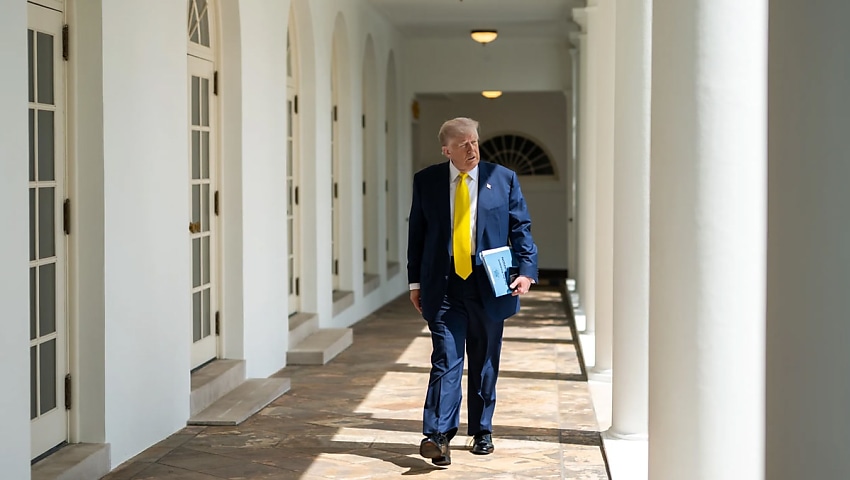
Washington’s growing pressure on Australia’s defence spending has sparked push-back from parts of the strategic policy community, many put off by the Trump administration’s brashness and overlooking the reality that America can’t do it alone.
In the aftermath of the Second World War, the world entered the era of Pax Americana, a period in which the United States emerged as the dominant global power, securing peace and stability through a mix of military strength and economic innovation.
This order was underpinned by institutions such as the World Bank, the International Monetary Fund and other Bretton Woods creations, alongside alliances like NATO. Together, they fostered cooperation, reconstruction and an unprecedented level of global stability.
Armed with vast economic resources and unmatched military capability, the US assumed the role of global policeman, responsible for containing communism, ending imperial conflicts and laying the foundations for a transformative international order.
Over the following decades, this dominance was cemented through a far-reaching network of alliances and trade agreements that brought predictability to international relations and delivered decades of remarkable global growth.

By the late 20th century, however, signs of decline had emerged. America’s unipolar moment was being eroded by shifting economic power, rising multipolarity and challenges resistant to Cold War-era strategies. The burden of sustaining a global military presence, coupled with domestic political division, economic uncertainty and the rise of other great powers, has steadily undermined the inevitability of US primacy.
Australia’s role in this shifting order remains pivotal. For decades, Canberra has enjoyed the security and economic stability of a close alliance with Washington. But as the global system moves towards a more multipolar “new normal”, Australia faces the need to recalibrate, balancing its place in Pax Americana with deeper engagement in the Indo-Pacific and a more diversified foreign policy.
Now, with an American president openly seeking the “best deal”, Australia’s responsibilities, prosperity and security under the US umbrella are also up for negotiation, demanding fresh thinking and a willingness to adapt to the realities of a new world order.
This reality has only been further confronting for Australian policymakers as the returned US president, Donald Trump has placed increasing pressure upon its friends and partners to increase their respective defence budgets in order to ease the burden on the overstretched United States.
Highlighting the impact of this shifting world is James Curran of The Australian Financial Review in a timely opinion piece, titled Trump’s memo to Canberra: America alone can’t deter China over Taiwan, in which he articulated the proverbial elephant in the room: America can’t do it all by itself.
Don’t be fooled by Trump’s bluster, this isn’t merely about defence spending
While much of the anxiety, anger and disdain for the Trump administration’s “transactional” focus has been largely framed through the lens of abrupt requests-cum demands of increased Australian defence spending, particularly for Prime Minister Anthony Albanese, the reality is that this push-back is more about bruised egos and offended sensibilities than anything else.
Curran highlighted the real motivation for the Americans, saying, “The US is now publicly and privately confronting the Albanese government over whether it will commit to joining American forces in planning to defend Taiwan from a Chinese takeover.
He added, “The confrontation is not just about defence spending or the delivery to Australia of US nuclear submarines. The message is that the US alone does not offer credible deterrence to China and that key allies, including Japan, South Korea and Australia, must commit now to providing unequivocal support to the deterrent power of American forces to make China pause in any military intervention to take control of Taiwan.”
For whatever reason, Australia’s policymakers have fallen straight into the trap of assuming that Trump’s demands are based more out of his never-ending pursuit of “better deals” for America, as a core pillar of his America First campaign commitments. In doing so, they have left Australia at the mercy of mercurial, ego-driven politicians on both sides.
Curran hinted at this, saying, “Given the nature of the Trump administration, the confrontation with Australia could easily blow up into a major crisis, one that tests, wounds or even ends the 71-year-old ANZUS alliance. And Canberra has to think about heavy trade penalties if it does not fall into line.”
Bringing us back to Trump’s America First policy and the growing push to focus on homeland defence, through big ticket items like the “Golden Dome” and a scaling back of America’s balancing forces in Europe, much to the chagrin of many Western European nations who, much like Australia, have grown increasingly dependent on the strategic balancing power of the United States.
Curran summarised this best, stating, “However, the key strategic issue now, bluntly expressed, is not American determination to defend democracy in Taiwan, but about defending the American homeland ... In the words of one US official briefing in Australia recently (revealed to this column by an insider), what the loss of Taiwan would mean is breaching the ‘first island chain’, the defensive perimeter articulated by American diplomat John Foster Dulles in 1951 that extends from Japan though Okinawa to Taiwan and the Philippines.”
Such an occurrence presents a significant challenge to both American and Australian security, should they come to pass, which is exactly why the Trump administration is placing mounting pressure on the Australian government to increase its defence spending to 3.5 per cent of gross domestic product, with an additional 1.5 per cent to be spent on “resilience” building infrastructure and capabilities.
Curran added, “In the minds of the Trump Pentagon, Australia’s commitment to preserving first-island-chain defences is urgent and needs to be resolved, even though President Donald Trump has not even vaguely suggested that his dealings with China might imply a commitment to Taiwan’s defence, or Australia’s. America’s China policy more broadly remains opaque. But the upshot is the view that without firm support from Japan and Australia, credible deterrence does not exist.”
He detailed the fallout of this further, adding, “The Trump administration is also slaying some of the dubious strategic shibboleths of recent years. This will be jarring for some in the national security elite in Canberra. Terms such as ‘Indo-Pacific’ are apparently no more. Gone too, at least for some in the US military, is the idea of a single, global theatre of operations, though Asia becomes ‘a single theatre of consequence’. Some in Washington clearly want the Europeans to leave their aircraft carriers at home where they can be more useful.”
Australia’s response to the returned Trump administration and the slowly growing recognition that Trump 2.0 is dramatically different to Trump 1.0 is still working its way through the minds of most of Canberra’s political and security establishment only serves to impact our standing with the United States and, critically, our own security in the Indo-Pacific.
This is something Curran hinted at, saying, “It should be remembered also that all administrations in Washington are studies in the jostle between personalities and their differing perspectives on America’s role in the world. But the chaos and volatility of the Trump White House render a clear understanding of what is happening there extremely difficult. Policymaking under Trump is akin to a Catherine wheel firework on the loose: you’re not sure where it will end up, but you know anything in its path gets burnt.”
Regardless the position on Trump, it is clear Australia needs to do vastly more for its own security, stability and prosperity rather than continuing to cower beneath the protective wings of the American eagle.
Final thoughts
Despite the ambitious rhetoric from both sides of politics, the reality for the average Australian is far from promising. While Australia is blessed with abundant natural resources and immense potential, there is little indication that we are fully harnessing our unique national strengths.
Declining economic opportunities, a rapidly deteriorating global and regional balance of power, and the increasing politicisation of everyday life have deepened a sense of disconnection, apathy and helplessness among many Australians.
Meanwhile, modern Australia has been largely insulated from the harsh realities of conflict, with generations having never experienced food, energy, or medical rationing – let alone understanding the economic and social upheaval such restrictions would bring to our world-leading standard of living.
To safeguard its future, Australia must build the capacity to act as an independent power, developing strategic economic, diplomatic and military capabilities more in line with great power expectations. This shift would not only reinforce Australia’s sovereignty but also position it as a key player in ensuring regional security and prosperity.
Moving beyond the prevailing mindset of “it’s all too difficult” would open unprecedented economic, diplomatic and strategic opportunities for the nation.
As tensions in the Indo-Pacific intensify and China continues to assert its economic, political and military influence, Australia faces a defining choice: remain a secondary power or embrace a larger, more independent role in an era of great power competition. Expanding opportunities for Australians while strengthening economic resilience – and, by extension, reducing vulnerability to economic coercion – must be at the core of government policy.
Only with a strong and dynamic economy can Australia effectively deter threats to its national interests and ensure long-term security and prosperity.
Get involved with the discussion and let us know your thoughts on Australia’s future role and position in the Indo-Pacific region and what you would like to see from Australia’s political leaders in terms of partisan and bipartisan agenda setting in the comments section below, or get in touch at

Want to see more stories from trusted news sources?
Make Defence Connect a preferred news source on Google.
Click here to add Defence Connect as a preferred news source.