

 iscover
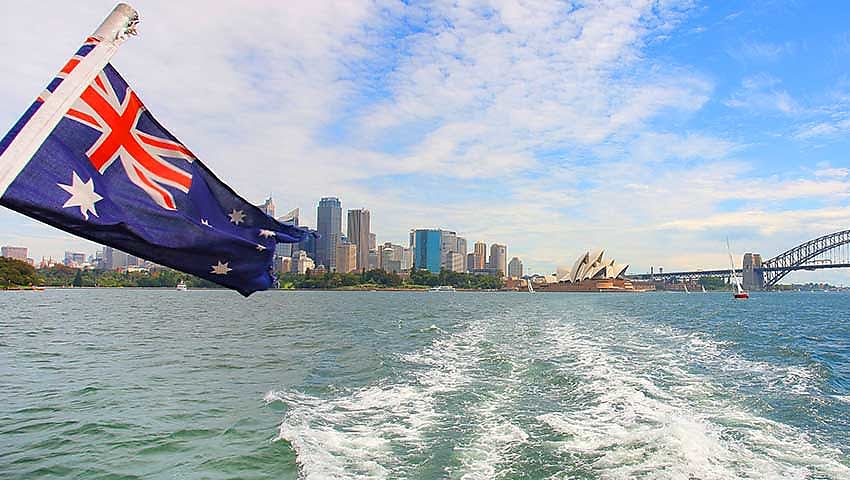
The birth of a new-post World War II order is now inevitable, buoyed by the rise of many formerly “developing” economic, political and strategic powers, resulting in a growing list of “winners” and “losers” – the question for Australia is, which list do we want to end up on?
Competition is, without a doubt, one of the unwritten but most consequential and inescapable universal laws of nature. Whether on the savannah, in the boardroom or on the global stage, both history and nature are characterised by clearly defined “winners” and “losers”.
On the historic stage, kingdoms, empires, peoples and their rules have risen and fallen because of this instinctive and inescapable competition that shapes both the macro and micro level of human nature and on the grand stage of global power dynamics.
In the aftermath of the collapse of the Soviet Union, clearly the loser of the Cold War, Australia – like many nations across the triumphant West – was promised the “End of History” and the end of competition as the United States seemingly emerged as the ultimate winner of the long-running geopolitical competition between global powers.
Fast forward nearly four decades and we now know that this “End of History” optimism was little more than an idealistic pipedream concocted in the elite universities across the Western world, with the inevitable flow of history once again shifting towards the inevitable and inescapable reality of competition and ultimately “winners” and “losers”.
For generations of Australians and Australian policymakers, this new reality comes as quite a shock, where once our primary security partner, the United States, was equally the undisputed global economic and political power, our own region is now the epicentre of the global competition.
Driven in large part by the emergence of the People’s Republic of China and to a lesser extent the rise of India, Indonesia, while more broadly, the emergence of other potential great powers in Brazil, Russia (although this is questionable), Mexico, South Africa, Turkey, Vietnam, Pakistan, Egypt and others across the globe, competition is inescapably the “new normal”.
As a result, we inevitably will face a reality of “winners” and “losers” in this new world order, with Australia not immune from this competition; accordingly, we had best prepare to face this competition with clear eyes.

Touching on this narrative is The Australian Financial Review contributor and author of The fearful rise of markets, John Authers, in a piece titled Predicting winners and losers in the new world order, in which he articulated the new realities facing Australia and the globe more broadly, raising an important question: Does Australia want to be a winner or a loser in this new global competition?
Echoes of (fictional) history
At the core of Authers’ thesis is the recent framing and implications of the meeting between US President Donald Trump and his Russian counterpart, global pariah, Vladimir Putin in Alaska, as once again the world’s great powers negotiate the future of the global order and their respective spheres of influence.
Authers began this analysis, stating, “Vladimir Putin’s encounter with Donald Trump in Anchorage summons bad memories of past summits in Munich or Yalta, in which the destiny of smaller Eastern European nations was decided by greater powers without their participation. But a fictional model from the postwar era seems more prophetic.”
As part of this introduction, Authers drew inspiration from George Orwell’s influential work, 1984 and the division of the world between the three competing yet distinct ideologically and geographically defined blocs (Oceania, Eurasia and east Asia as a recap) and their individual “spheres of influence”.
Authers explained the logic behind his reasoning, saying, “They fight interminably over the contested, poorer parts of the world: the Indian subcontinent, South-East Asia, the Arabian Peninsula, and the rest of Africa. Though alliances shift, they remain in permanent balance: None of the three super-states could be definitively conquered even by the other two in combination. They are too evenly matched, and their natural defences are too formidable. Eurasia is protected by its vast land spaces, Oceania by the width of the Atlantic and the Pacific, East Asia by the fecundity and industriousness of its inhabitants.”
If this feels a bit familiar, don’t worry, you’re not alone, Authers went on to detail this, adding, “What is now taking shape looks closer to the book, with the US, Russia and China trying to consolidate power around them, while countries like India might yet take different sides. Orwell was wrong to predict Russian domination of Western Europe, but the Alaska summit, and the terrified reaction in European capitals as the US has shown a willingness to withdraw support from Ukraine, shows that the possibility remains alive.”
Equally, this analysis drew on important and continuingly relevant historic analogues between the multi-cornered competition between the English, Spanish, Portuguese and French during the expansion into the Americas, the Great Game of the 19th century, which saw the British and Russian empires scrambling for control of central Asia. And of course, who can forget the colonial “Scramble for Africa” as great powers jockeyed for positions of global prestige, dominance and power.
Importantly, this competition was not purely a European or Western phenomenon, as empires across the Middle East, southern Asia and east Asia all engaged in their own, albeit more localised competition for dominance and control through their respective spheres of influence, culminating in truly titanic clashes on the steppes of central Asia, mountains of the Himalayas and waves of the Yellow Sea.
These competitions ultimately resulted in “winners” and “losers”, which ultimately came to shape the world we now find ourselves facing, with the ongoing competition between the world’s great powers continuing to have ramifications well into the coming centuries.
Authers hinted at this global transition and the return of the “great game” between great powers and their ability to invariably decide “winners” and “losers” on the global stage, saying, “The world thus appears to be returning to the concept of spheres of influence. Powers want to feel secure behind a barricade of neighbouring states, without the great imperial ambitions of earlier eras. Ukraine looms large for Russia, and China has gone to the lengths of building islands in the South China Sea as it covets Taiwan.
Unpacking this further, Authers said, “Both aim to make themselves impregnable. The same philosophy animates Trump 2.0 foreign policy. Rather than maintain US control over a broad empire through institutions like NATO or the World Trade Organisation, he wants an impregnable and tightly defined sphere of influence.”
Authers’ comparisons to both real and fictional history don’t end there, with him going further, detailing that empires, as distinct from post-Westphalian nation-states don’t particularly care where their steel comes from, as they typically “control the seas”. Whereas a nation-state needs to be “self-sufficient” over key industrial inputs in order to be truly capable of protecting itself.
On that metric alone, Australia, along with other comparable nations, already falls into the “loser” column and only seems further committed to tumbling down the unofficial list.
Authers added, “Orwell’s three powers required self-sufficiency. That way, there would be no need for dangerous conflicts with others over land or resources – beyond the constant phony wars with which they kept their populations together. Other countries aren’t imposing their own tariff barriers in response to the US, but the widening need for self-reliance – or in economist-speak ‘autarky’ – is clear.”
So where does that leave us?
What makes a ‘winner’ and what makes a ‘loser’?
This inevitably leads to Authers’ analysis of who will form the “winners” and “losers” in this new, hotly contested world order and one that Australia cannot run and hide from, sure that our “tyranny of distance” will protect us.
Through his analysis, Authers identified four key factors that will determine whether a nation is a “winner” or a “loser” in this new global order, beginning with the impact of global, interconnected trade and the post-Cold War rise of globalisation that has come to dominate global and national economies.
In particular, the rapid hollowing out of many formerly advanced, diversified and industrialised national economies (Australia’s included) beginning in the 1970s and then subsequently accelerating throughout the 1980s and 1990s, with Authers stating that, “Countries already less dependent on trade face less upheaval, while small economies heavily oriented toward the trading system face existential difficulties.”
For Australia, this means we are inevitably in for a rough ride, as our trade-dependent economy will be increasingly exposed to the volatility and competition on the global commons. This ultimately leads into the second determining factor identified by Authers and one that has figured regularly in Defence Connect: economic complexity.
Authers articulated the impact of declining economic complexity on “winners” and “losers” in this new great game, stating, “The more complex or hard to replicate a country’s economy, the better its chances. Those that rely on simple and easily substitutable industries, such as mining, have a problem, but countries with a strong infrastructure and workforce with readily transferable skills can flourish.”
That analysis should sound alarm bells for Australians and our policymakers, but as is inevitably, the case we will continue to plod along, happily naive in the myth that is the “Lucky Country”, until the music runs out.
Without referring to Australia, Authers went on to state, “Economies with surprisingly low rankings include Brazil (93rd) and Russia (100th); neither has managed to diversify much from its strengths in resources.”
This brings us to the third point and yet another frequently cited challenge for Australia’s economy, access to capital for investment, particularly poignant following the Treasurer’s recent productivity roundtable, which identified accelerating domestic capital shallowing as a major structural challenge to the nation’s future prosperity, productivity and security.
Authers added, “Foreign capital can be removed much more swiftly than flows of trade can be reversed. As countries repatriate funds to make themselves self-sufficient, the US looks more vulnerable than anyone. According to Russell Napier of Orlock Advisors, foreign holdings of US liquid assets exceed American holdings of foreign assets by 58 per cent. For German or British fund managers, their biggest pools of assets are US Treasuries. National capitalism, the revamped version of mercantilism that is taking hold, will require them to bring that money home.”
Bringing us to Authers’ fourth and final, and arguably most contentious factor which will impact where a nation ranks as a “winner” or a “loser” in the new global order: something he refers to as homogenised ideology. Authers unpacked this concept, saying, “A common philosophy can be discerned today. MAGA Republicanism, Xi Jinping Thought (a descendant of Deng Xiaoping’s ‘socialism with Chinese characteristics’), and the emerging doctrine some call ‘scientific Putinism” all unapologetically put national interests first, allow the state to intervene aggressively in the private sector, and adhere to conservative social norms.”
While that isn’t an endorsement of the particular ideologies espoused by any of the aforementioned government, it does indicate the direction of travel for the global economic, political and strategic environment.
Equally important is the acceptance that Australia still can chart its own path, borrowing what works, discarding what doesn’t and shaping where relevant, the systems to become “Australian” by character so as to avoid our continued managed decline.
If Australia wants to avoid being stuck in the “loser” column, it is becoming clear that while great powers may shape the global environment and global norms, we need to accept that we are the masters of our own destiny and have powerful agency that can, if properly directed and motivated, ensure that the “Lucky Country” story continues well into the future.
Final thoughts
Both government and everyday Australians need to face some hard truths if we’re serious about securing our future.
First, the Indo-Pacific is fast becoming the world’s most hotly contested region. China, India, Pakistan, Thailand and Vietnam are flexing new economic, political and military muscle, while Japan and South Korea are reasserting themselves. Competition is no longer looming on our doorstep – it’s already here, and it’s here to stay. Our “whole-of-nation” strategy must be reset to meet this new reality.
Second, without a sustained surge in investment, reform and long-range planning, we risk more than simply falling behind, we risk being left in the wake of our neighbours’ momentum. If we don’t act now, the next generation of Australians could find themselves living in a nation overshadowed by richer, stronger, more influential powers.
For too long we’ve settled for quick wins and reactive policies. Since Federation, governments have chased the short-term pay-off instead of the long-term prize. But the Indo-Pacific is shifting beneath our feet, and business as usual won’t cut it. We need to think ahead, seize opportunities and blunt the threats before they overtake us.
The real question isn’t whether these challenges are coming, they’re already here. The question is when will Canberra finally roll out a bold, detailed plan that rallies industry and the public behind a clear national vision. When will we see a strategy that keeps Australia resilient in the face of sharpening great-power rivalry?
With China pressing its influence, Australia has a stark choice: sit back as a bystander or step up as a shaper of the Indo-Pacific’s future. The decisions we make today will decide whether we thrive in this new era or get swept aside by it.
Get involved with the discussion and let us know your thoughts on Australia’s future role and position in the Indo-Pacific region and what you would like to see from Australia’s political leaders in terms of partisan and bipartisan agenda setting in the comments section below, or get in touch at

Want to see more stories from trusted news sources?
Make Defence Connect a preferred news source on Google.
Click here to add Defence Connect as a preferred news source.