

 iscover
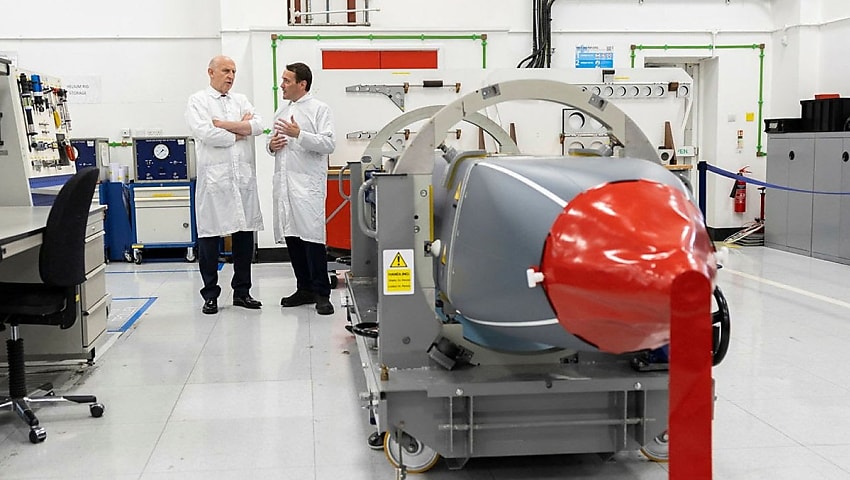
The UK government is seeking to turn an age-old belief that defence spending since the end of World War II does little to boost economic growth and opportunity; by turning this belief of a circular economy on its head, can Australia learn something?
Over the near decade I have spent in the defence, defence industry and national security ecosystem, I have often heard it said – including by some of the nation’s most respected defence analysts and commentators – that defence spending is the perfect example of a circular economy.
That being that much like all forms of direct government spending, it does little in the way of actually boosting economic capacity and outcomes for a nation, because in essence, it produces nothing of genuine “economic value”.
Seeking to turn that narrative on its head, the United Kingdom’s Defence Industrial Strategy 2025: Making defence an engine for growth represents one of the most ambitious attempts in recent memory to reframe the way a Western democracy thinks about defence spending.
Where traditionally, governments have treated defence as a necessary cost, money flowing from the Treasury to defence contractors, creating jobs and keeping armed forces equipped, but rarely viewed as a true driver of wider economic growth.
The UK is now seeking to overturn that logic. Its new strategy positions defence as a growth engine for the entire economy: a catalyst for technological innovation, regional regeneration, industrial resilience and a central pillar of national prosperity.
Secretary of State for Defence John Healey makes the point plainly in his foreword: the strength of the armed forces is inseparable from the strength of the industry that supports them. Britain’s security and economic vitality are interwoven, and by reshaping defence procurement, fostering innovation and investing in skills and industrial capacity, the government intends to ensure defence delivers not only deterrence but also tangible prosperity for citizens across the nation.
The strategy is closely aligned with the UK’s Modern Industrial Strategy and is underpinned by the largest sustained increase in defence spending since the Cold War. The commitment is significant: defence funding will climb to 2.6 per cent of gross domestic product (GDP) by 2027, with an ambition to reach 3 per cent in the following Parliament and an eventual 5 per cent of GDP devoted to the broader national security enterprise by 2035. This long-term trajectory signals both urgency and seriousness of intent.

The logic for such an approach is rooted in the realities of the global strategic environment. Britain’s 2025 Strategic Defence Review made clear that the international order is becoming more contested, unstable and technologically driven. By 2035, the UK intends to field a technologically enabled force, capable of deterring adversaries through the sheer pace of its innovation.
To achieve this, the government recognises that its defence industrial base must not only supply today’s needs but also act as a laboratory for tomorrow’s breakthroughs.
Already, defence sustains more than 460,000 British jobs, nearly 70 per cent of them outside London and the south-east and directs almost £29 billion (AU$59.3 billion) of procurement into UK businesses each year.
Yet the aim is no longer simply to sustain this base; it is to make defence spending multiply, creating spillover benefits into civilian industry, attracting private investment and cementing Britain’s place at the forefront of frontier technologies like artificial intelligence, space, quantum computing, cyber security, semiconductors and advanced materials.
To bring this ambition to life, the strategy sets out six interwoven priority outcomes. Each one tackles a different dimension of how defence can shift from being a circular flow of government funds to an engine of national growth.
Six central pillars
The first priority is making defence an engine for growth itself. The government is deliberately weighing investment towards high-tech sectors with the greatest spillover potential. Regional “Defence Growth Deals” will be rolled out, starting with areas like Barrow and Plymouth, to harness local strengths in shipbuilding, aerospace and advanced engineering.
These deals mirror the approach taken with traditional industrial clusters, combining infrastructure investment, training, SME support and supply chain development to create local growth ecosystems.
A Defence Finance and Investment Strategy will also be launched to crowd in private capital, enabling defence technology firms to scale rapidly and, potentially, become global “unicorns”. The intention is to embed defence firmly in Britain’s net zero ambitions as well, making it a driver of sustainable industrial change.
The second outcome is about backing UK-based businesses. Here the focus is on strategic onshoring of critical capabilities from nuclear deterrence and submarine construction to cryptography, shipbuilding, semiconductors, rare earths, batteries and munitions.
The creation of a new Office of Defence Exports signals the recognition that exportability must be built into procurement from the outset. Britain’s defence sector must be internationally competitive, both to achieve economies of scale and to ensure allied interoperability. Small and medium enterprises are given particular attention.
The MOD has committed to increase SME procurement by £2.5 billion (AU$5.11 billion) by 2028, supported by a dedicated SME Office and simplified pathways to contract. This is designed to make it easier for innovative smaller firms to contribute directly to defence projects rather than being confined to subcontracting roles under large primes.
The third priority is placing the UK at the leading edge of defence innovation. A new agency, UK Defence Innovation, has been created with a ring-fenced budget of £400 million (AU$818 million), which will rise in subsequent years. Crucially, the MOD has committed that at least 10 per cent of its equipment budget will be allocated to novel technologies – including autonomy, AI and unmanned systems.
Britain’s total research and development (R&D) spend in defence is expected to exceed £2.5 billion (AU$5.11 billion) in 2026–27 and will increase steadily thereafter. Alongside funding, the strategy commits to reforming testing, evaluation and regulatory frameworks to remove barriers to experimentation. Innovation “sprints” will fast-track projects from concept to fielding, with an emphasis on rapid exploitation of commercially available technologies.
The objective is cultural as much as financial: Britain’s defence sector must internalise the Silicon Valley mentality of speed, risk tolerance and iteration.
The fourth priority is building a resilient UK industrial base. The strategy accepts that in a more contested and fragile world, supply chains cannot be left to market forces alone. Regular industry-MOD wargames will test vulnerabilities and new legal and policy tools will be considered to secure delivery of critical projects.
Investment is already flowing into sovereign munitions capacity: a £1.5 billion (AU$3.01 billion) “always-on” munitions pipeline and six new munitions factories are under way. At the higher end, £15 billion (AU$30.7 billion) is being directed into the nuclear warhead enterprise. The recent acquisition of Octric Semiconductors illustrates how the government is willing to intervene directly to safeguard critical sovereign capabilities.
The fifth priority addresses procurement reform. The UK’s acquisition system has long been criticised for slowness, complexity and poor outcomes. The new model introduces segmented procurement with strict cycle time targets.
For major platforms such as ships or aircraft, contract time will be cut from six years to two. For modular upgrades, from three years to one. For agile commercial technologies like drones or software, the aim is just three months from requirement to contract.
Supporting this, a new National Armaments director has been appointed with end-to-end oversight of procurement and an £11 billion (AU$22.5 billion) budget to invest in growth-oriented delivery.
Procurement will be re-engineered to provide early demand signals, integrate exportability, and include offset policies requiring foreign suppliers to reinvest in Britain’s economy. In effect, defence acquisition will become both a capability-delivery system and an industrial-policy lever.
The sixth and final priority is forging new and enduring partnerships. Domestically, a Defence Industrial Joint Council has been created to bring government, industry, academia, trade unions and finance together in shared governance. Internationally, Britain is deepening its defence-industrial ties with allies through NATO, the Five Eyes, AUKUS, the Joint Expeditionary Force, OCCAR and the Global Combat Air Program.
The aim is not only interoperability but joint development, co-investment and shared production, strengthening both sovereignty and alliance resilience.
Delivering the central objective
Implementation of this ambitious agenda is carefully staged. In 2025 alone, the National Armaments Director Group, UK Defence Innovation, the Defence Industrial Joint Council, and the Office of Defence Exports are being stood up.
By 2026, the SME Office, offset regime and Defence Finance Strategy will be in place. By 2035, the UK intends to have defence unicorns in the marketplace and to be recognised as a global leader in defence industry. Progress will be tracked annually through the Modern Industrial Strategy, with metrics spanning R&D spend, SME participation, procurement cycle times, exports, regional investment and skills training.
At its heart, the strategy represents a profound shift from circular to catalytic defence spending. In the old model, money is cycled from government to defence suppliers and back again, supporting a stable industrial base but rarely driving wider growth.
In the new model, every pound of defence expenditure is expected to multiply – creating jobs across the regions, stimulating private investment, advancing civilian technologies, supporting exports and embedding resilience.
Defence is recast not as a cost but as a dividend-producing asset.
This holds important lessons for Australia’s own efforts to boost its defence industrial base, broader economic diversity and reindustrialisation following decades of devastating de-industrialisation.
The lessons for Australia are compelling; much like the UK, Australia faces a deteriorating strategic environment and is investing heavily in defence, particularly through AUKUS.
Yet too often, our public debate frames defence purely as an expense, this zero-sum debate establishes defence spending a drain on the budget justified only by the security environment.
Australia’s lessons
Importantly, this shift in thinking, particularly from the UK, shows how defence can instead be a central plank of national reindustrialisation.
For Australia, several insights stand out.
First, defence spending should be aligned with broader economic growth goals. Our investments in shipbuilding, aerospace, space and cyber should be consciously leveraged to drive jobs, exports and industrial capability. Procurement must be designed not only for capability but for growth spillovers.
Second, we should consider adopting segmented and accelerated procurement cycles, ensuring that large strategic platforms progress on realistic timelines while innovative tech like drones and AI is fielded rapidly.
Third, regional Defence growth deals could be transformative. Adelaide’s submarine precinct, Newcastle’s ship repair hubs or emerging tech clusters in regional Queensland could be supported through integrated investments in skills, infrastructure and SMEs, maximising the local and national benefits of defence projects.
Fourth, a dedicated Defence Innovation Agency with ring-fenced funding would ensure we are not left behind in dual-use technologies. Australia should encourage private capital to co-invest in high-potential defence tech firms, just as the UK seeks to build defence unicorns.
Fifth, Australia needs to double down on sovereign capacity in critical areas: munitions, energetics, semiconductors, rare earths and advanced manufacturing. Strategic acquisitions, joint ventures and government-backed factories may all be necessary.
Sixth, SME participation and exportability must become central procurement criteria. Our defence projects should be designed for international markets, giving Australian firms scale and resilience.
Finally, we should create stronger institutional frameworks, such as an Australian equivalent of the National Armaments Directorate and a Defence Industrial Council bringing together government, industry, unions, academia and finance. This would ensure defence industrial policy is guided by a broad coalition rather than siloed decision making.
The UK’s Defence Industrial Strategy 2025 represents a bold reimagining of how defence and the economy intersect. It reflects a world in which security and prosperity can no longer be separated and in which technology, industry and power are increasingly inseparable.
For Australia, it offers a roadmap not only for strengthening our defence industrial base but also for harnessing defence spending as a lever of national renewal. By embedding growth, innovation, resilience and partnership into defence policy, Australia could, like Britain, ensure that every dollar spent on security also builds a more prosperous and resilient nation.
Final thoughts
For Australia to prosper in this turbulent era, both policymakers and the public must face a hard truth: the world is no longer defined by a single dominant power but by a growing number of states shaping events. The Indo-Pacific has become the most fiercely contested region on earth, and it is unfolding on our doorstep.
This shift is being driven by the growing economic, political and strategic weight of China, India, Pakistan, Thailand and Vietnam, alongside the enduring strengths of Japan and South Korea. Together, they are creating a sharper, more competitive environment that demands a decisive Australian response.
Australia can no longer rely on the narrow perspectives and complacent habits that have too often shaped its diplomacy, strategy and economy since Federation. Security and prosperity can no longer be treated as separate pursuits.
To navigate this century, we must commit to a program of industrial renewal and sovereign resilience; rebuilding advanced manufacturing, securing supply chains, investing in science and technology, and ensuring our defence industry can innovate and sustain at scale.
The questions are urgent: when will we see a clear national analysis that confronts both the risks and the opportunities of the Indo-Pacific century? When will leaders offer a strategy that unites business, industry and the public around a shared vision of resilience and prosperity? Without such a narrative, Australia risks being pulled along by events rather than shaping its own future.
As regional competition intensifies and China’s influence expands, we must decide whether to remain a secondary power, dependent on others, or to step forward as an independent and influential nation. That choice cannot be delayed. It requires vision, resources and above all, a commitment to building the industrial and economic foundations of sovereignty.
Australia’s leaders and citizens must resist the lure of short-term politics and recommit to the enduring values that define us – this time underpinned by resilience, sovereignty and economic strength. Prosperity and security are inseparable and only a sovereign, industrially capable Australia will be able to seize the opportunities and withstand the challenges of the Indo-Pacific century.
Get involved with the discussion and let us know your thoughts on Australia’s future role and position in the Indo-Pacific region and what you would like to see from Australia’s political leaders in terms of partisan and bipartisan agenda setting in the comments section below, or get in touch at

Want to see more stories from trusted news sources?
Make Defence Connect a preferred news source on Google.
Click here to add Defence Connect as a preferred news source.