

 iscover
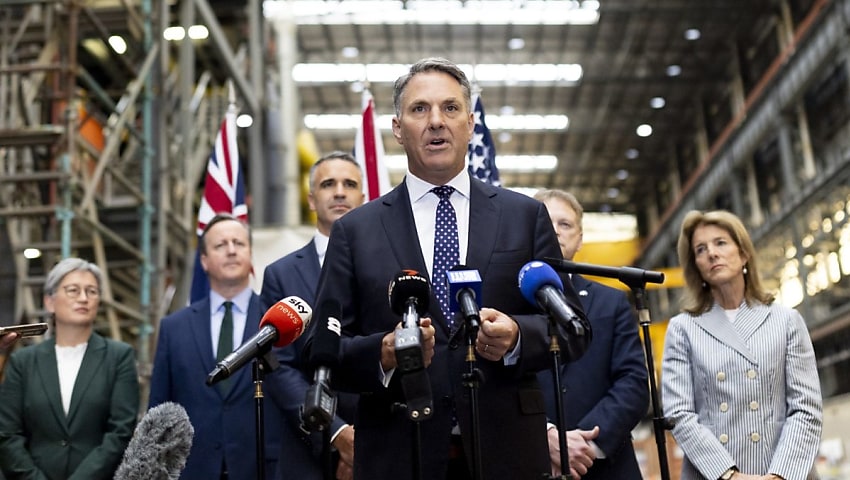
Deputy Prime Minister and Defence Minister Richard Marles has used the government’s weekend AUKUS infrastructure announcement to hint at “increases” to the nation’s defence spending, comparing it to NATO standards, but the truth is far trickier.
Australia’s level of defence spending has long been a source of political, economic and strategic debate. In recent years, this conversation has intensified as the nation grapples with the realities of a shifting global order, a more contested Indo-Pacific, and the need to balance limited resources against growing security demands.
For decades, Australian governments of both major parties have adhered to the principle that defence expenditure should be “affordable and sustainable”, often translating into allocations around 2 per cent of gross domestic product (GDP) as has long been held as the NATO standard.
However, calls have been mounting to lift spending to 3.5 per cent or more, with proponents arguing that only a significant increase can provide the capabilities required to deter or, if necessary, defeat a major power adversary.
The AUKUS security partnership with the United States and the United Kingdom has added both urgency and complexity to this debate. While the nuclear-powered submarine program dominates headlines and budgets, AUKUS extends to advanced technologies such as hypersonics, quantum computing, cyber and artificial intelligence.
Supporters contend that AUKUS gives Australia unparalleled access to cutting-edge capability, reinforcing its security umbrella and deepening strategic ties with its most important ally. Critics, however, highlight cost blowouts, workforce challenges, and the danger of over-reliance on foreign partners at the expense of sovereign capability and independent decision making.
Beyond dollars and platforms, the discussion touches on broader questions about Australia’s role in the region and the world. Should Canberra focus on defending the continent and immediate approaches, or pursue a more outward-looking strategy of regional power projection? How can Australia sustain the industrial base, personnel pipeline and political consensus necessary to meet these ambitions?
This ongoing debate has been exacerbated in recent days as the Albanese government has sought to measure Australia’s levels of defence spending against NATO standards, arguing effectively that Australia’s level of spending is now approximately 2.8 per cent of GDP as opposed to the level of 2.1 per cent previously stated and the long-held and publicised ambition to get it to 2.3 per cent of GDP by FY2033–34.

Deputy Prime Minister Marles said during the media conference following the announcement of a AU$12 billion investment in critical naval shipbuilding and submarine support infrastructure as part of the long awaited Henderson Precinct consolidation: “There are different measures around the world of percentages of GDP. I mean, if you look at the way in which NATO accounts for its own spending in terms of percentage of GDP based on that metric, our spending on GDP today in terms of defence is around 2.8 per cent.”
The Deputy Prime Minister then goes on to illuminate that as part of this calculation, it includes the “almost AU$70 billion (US$46.5 billion)” in reprioritisations outlined in the 2023 Defence Strategic Review and the supporting 2024 National Defence Strategy and Integrated Investment Program, respectively.
“What matters is the dollars that we’re committing, and we’re crystal clear on that. You know, today is a $12 billion commitment of new money over the decade. That is a significant amount of money. And it’s taking our level to almost $70 billion relative to what we inherited back just, you know, over three years ago. And it really is a dramatic increase in Australia’s defence spending and it most definitely moves the needle,” the Deputy Prime Minister told journalists.
Deputy Prime Minister Marles further reinforced this, while under significant pressure from the ABC’s Sabra Lane, saying, “Well, because the number that we focus on is the dollar number. I mean, there are a whole lot of ways in which people can calculate percentages of GDP, and what you see, for example, is that, you know, by reference to how NATO calculates its GDP figure, before yesterday’s announcement, we’d be on 2.8 per cent of GDP.
“So, what actually matters here is the ultimate dollar figure that you’re spending. We’ve been completely transparent about that. And anyone can go off and calculate whatever sums they want off the basis of that. What matters is the dollars that we’re spending on defence. And we are crystal clear about that. And it represents the biggest peacetime increase in Australia’s defence spending in our history,” the Deputy Prime Minister said.
Bringing us to an important question, how exactly are we actually calculating our defence spending and what is the figure actually at? Because however they’re working it out, I would love some of that same creative maths with my monthly pay cheque!

Want to see more stories from trusted news sources?
Make Defence Connect a preferred news source on Google.
Click here to add Defence Connect as a preferred news source.