

 iscover
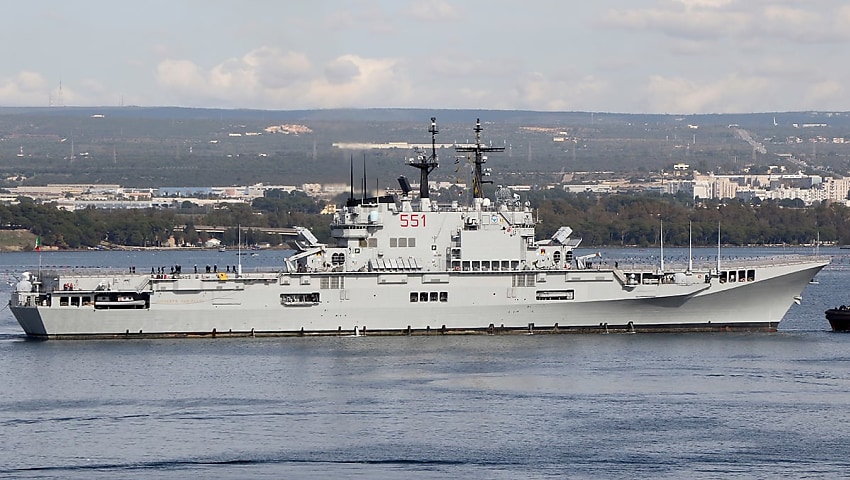
The Indonesian government has allegedly approved a US$450 million (AU$682.5 million) loan to acquire the Italian Navy’s retired aircraft carrier Giuseppe Garibaldi, marking the latest regional power to join the aircraft carrier “club”, leaving Australia behind regional trends and established power projection norms.
The Indo-Pacific is entering a new era of maritime competition, one increasingly defined by aircraft carriers. These vast, floating airbases have long symbolised strategic reach and national ambition, but in the past decade they have become central once again to power politics in the region.
For Australia, this trend carries echoes of its own history. The Royal Australian Navy once operated HMAS Melbourne, a light fleet carrier decommissioned in 1982, and since then, Canberra has eschewed carriers in favour of submarines, surface combatants and alliance-based strategies. Yet the accelerating carrier race across Asia is reshaping the maritime environment in ways that Australia cannot ignore.
China is at the forefront. From the refitted Liaoning to the indigenously built Shandong and the advanced Fujian, Beijing has invested heavily in platforms capable of projecting sustained power far beyond its coastline. Reports of a fourth, potentially nuclear-powered carrier underscore how seriously China views carrier aviation as a tool of influence. These developments are not mere prestige projects: recent exercises involving two carrier strike groups operating beyond the first island chain demonstrate a new capacity to challenge US and allied naval dominance in the western Pacific.
Other regional powers are also adapting. Japan is converting its large “helicopter destroyers” to operate F-35B stealth fighters, a move that revives a capability absent since the Second World War. India continues to expand its carrier fleet, while South Korea and even Southeast Asian nations explore carrier-like options through advanced amphibious assault ships.
The latest of these new carrier powers appears to be one of our nearest neighbours, with the Indonesian government formally approving a US$450 million (AU$682.5 million) loan which will enable the growing major power to acquire the now retired Italian Navy aircraft carrier Giuseppe Garibaldi and convert it into an uncrewed aerial systems-focused aircraft carrier to provide the Indonesian Armed Forces with greater tactical and strategic capability across the region.
Together, these shifts reflect an intensifying contest for control of sea lanes, chokepoints and the ability to project power over vast maritime spaces.
For Australia, positioned at the southern flank of this theatre, the implications are profound. While Canberra has no plans to return to fixed-wing carrier aviation, it has recognised that the seas around it are no longer uncontested and naval airpower will once again serve as a decisive factor in the contemporary battle for Indo-Pacific supremacy.

A flagship and a power projection hub
At the core of Indonesia’s push to acquire the Giuseppe Garibaldi is the rising power’s need for a more flexible approach to projecting power across its vast archipelagic expanses, and critically, the strategically important sea lines of communication and global commerce that flow in and around the islands of Indonesia.
This is highlighted by Gilang Kembara, research fellow at the S Rajaratnam School of International Studies, NTU Singapore, in a piece for ASPI Strategist from March 2025, in which he said, “For a country that straddles two vast oceans and aspires to project force beyond its exclusive economic zone, the acquisition of at least one aircraft carrier may seem like a sound policy. However, consideration of practicalities reveals that this is more like a case of blind ambition.”
As part of the proposed deal, Fincantieri is expected to provide a comprehensive modernisation and refit enabling the vessel to see out it’s approximately 15–20 years of remaining operational life, something stressed by Mauro Manzini, sales director of the naval business unit, who told NavalNews, “The Giuseppe Garibaldi is in good condition and has approximately 15 to 20 years of remaining operational life. The vessel can be transferred following a refit process tailored to the Indonesian Navy’s specific requirements.”
A core part of what has been hinted at by Indonesia is the modification of the Giuseppe Garibaldi to be equipped with a fleet of Turkish-designed and built Baykar Technologies’ Bayraktar TB3, short take-off capable uncrewed combat aerial vehicles (UCAV), similar to those currently being integrated into Turkey’s own aircraft carrier/amphibious warfare ship, the TCG Anadolu, itself based on the Spanish/Australian Juan Carlos/Canberra Class landing helicopter docks.
To this end, Indonesia has reportedly signed a “preliminary” agreement to acquire 60 such drones, including both shipborne and land-based variants of the TB3 series of UCAV, effectively providing the Indonesian Navy with the basis for a fixed-wing naval aviation capability, sans the aircraft carrier, at least at the moment.
These developments come at a time when Beijing is accelerating its own naval aviation capabilities, releasing new footage in recent days of ongoing high-intensity flight training operations aboard the Fujian aircraft carrier, including the successful launch and recovery of the new fifth-generation, twin engine J-35 fighter aircraft, their own carrier-borne airborne early-warning and command aircraft in the waters around Taiwan.
While undoubtedly regional developments are pushing Indonesia’s pursuit of an aircraft carrier and associated fixed-wing naval aviation capability, questions do remain, something Kembara reiterated, saying, “What message would Indonesia be sending to its immediate neighbours if it were to equip itself with such capabilities? Indonesia has already voiced concerns over neighbours acquiring advanced F-35 Lightning fighters, and was also perturbed by the AUKUS announcement...
Kembara added, “An aircraft carrier equipped with offensive aerial assets is vastly different from one operating solely with rotary-wing aircraft for military operations other than war ... If the Indonesian navy is determined to acquire an offensive aircraft carrier, it must first define the role it seeks to play in the global maritime domain. Given current geopolitical complexities in the Indo-Pacific, Indonesia should act with caution. The acquisition of a highly sophisticated asset such as an aircraft carrier must be driven by a strategy of cooperation first, and military posturing second.”
Regardless, for Australia it heralds a major shift in the direction of travel for the regional balance of power and regardless of the relations today, requires significant analysis and further open conversation about the sort of force Australia requires to, as the 2023 Defence Strategic Review established, “unilaterally deter any nation”.
Final thoughts
Both the 2020 Defence Strategic Update and the 2023 Defence Strategic Review highlighted the need to deter coercion closer to home, investing in long-range strike, advanced submarines under AUKUS, and enhanced amphibious and expeditionary capabilities. Australia is also strengthening joint exercises and deepening cooperation with allies such as the United States and Japan to ensure collective capacity can offset China’s growing reach.
The gathering pace of the Indo-Pacific carrier race forces Australia to confront difficult choices. Should it continue relying on allied carriers or pursue asymmetric responses through submarines, missiles and surveillance? How should it balance its limited resources against the need for credible deterrence?
The answers will shape not only the Royal Australian Navy’s future but Australia’s broader strategic role in a region where carriers are once again the ultimate symbol of power and also potent tools for national power projection across air, sea and land domains.
Get involved with the discussion and let us know your thoughts on Australia’s future role and position in the Indo-Pacific region and what you would like to see from Australia’s political leaders in terms of partisan and bipartisan agenda setting in the comments section below, or get in touch at

Want to see more stories from trusted news sources?
Make Defence Connect a preferred news source on Google.
Click here to add Defence Connect as a preferred news source.