

 iscover
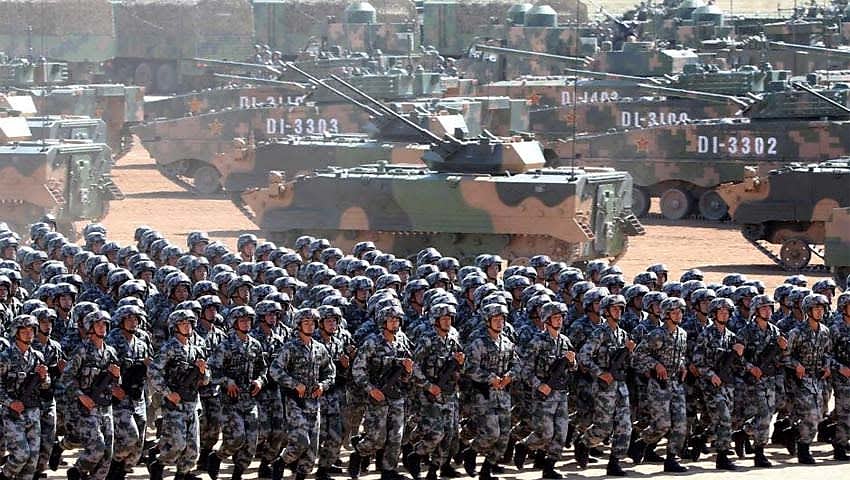
A new report by the Royal United Services Institute has revealed that Moscow is aiding Beijing and its preparations for a potential move on Taiwan, setting the scene for potentially global ramifications when the time comes.
It seems as though the West has successfully (or perhaps unsuccessfully) played itself, steadily driving Russia and the People’s Republic of China closer together over the past three decades.
Now that is not to say that our actions are solely to blame, quite the contrary, as both Vladimir Putin’s Russia and Xi Jinping’s China have firmly established and articulated their ambitions for greater regional power, dominance and primacy.
Nevertheless, we in the West have managed to successfully repeat the failure of German Kaiser Wilhelm II and his unpicking of Otto von Bismarck’s efforts to isolate and neutralise Russo-French-British collaboration in the decades immediately preceding the outbreak of World War I.
What we have seen is, particularly in recent years, the steady formalisation, consolidation and reinforcement of the relationship between Beijing and Moscow, which has only accelerated since Russia’s invasion of Ukraine in early 2022.
This has only served to provide a proof positive of the counter-narrative that has been developed and spread by Russia and China throughout the “developing world”, which has sought to characterise the US-led, “rules-based world order” as a reimagining of the era of imperialism, albeit with more subversive characteristics.
In turn, this has given rise to and reinforced the reasoning behind the creation of parallel multilateral organisations like the Shanghai Cooperation Organisation and the Brazil, Russia, India, China and South Africa economic, political and quasi-strategic blocs seeking to counter the post-war global order.
At the core of this multipronged assault is an attack on the legitimacy of the post-Second World War economic, political, strategic and geopolitical order, and a number of “sacred cows” that remain as potential flashpoints for direct confrontation between the world’s great powers.

Front and centre of these flashpoints is of course Taiwan, the island democracy and “rogue province”, if Beijing’s claims are to be believed that could potentially plunge not only the Indo-Pacific but the wider globe into a civilisation-ending conflagration.
This potential for global calamity has been only further enhanced by the mutual support networks emerging between Russia and China, for both wartime consumables, raw materials, hard currency and, according to the Royal United Services Institute (RUSI), defence materiel, real-world experience from the front lines of Ukraine in order to increase the People’s Liberation Army’s chances of success in Taiwan.
Highlighting this is Oleksandr V Danylyuk and Dr Jack Watling in an analysis commentary for RUSI, titled How Russia is helping China prepare to seize Taiwan, in which the pair unpacked Russia’s offer to support Beijing’s ambitions towards the island democracy by 2027, the deadline set by Chinese President Xi Jinping.
The pair began their analysis, saying, “Chinese President Xi Jinping has directed the People’s Liberation Army (PLA) to be ready to militarily seize Taiwan by 2027. A large-scale amphibious operation is highly risky, with the sites suitable for landing craft to deliver troops and equipment ashore constrained by the gradient and load bearing capacity of the beaches. Seizing airfields could allow troops to flow in by air, but as Russia discovered during its invasion of Ukraine, runways can be quickly denied. The PLA is therefore eager to identify ways of diversifying both the methods and locations at which it can move units onto Taiwan.”
Birds of a feather, flock together
It is undoubtable that at the core of this closer collaboration between the two nations is an ambition to subvert and eventually replace the US-led, post-Second World War economic, political and strategic order, with one that can be best described as the “law of the jungle”, whereby strong nations do what they want and weak/er nations must grit and bear it.
Hence the ever increasing relationship between the two revisionist powers; however, Beijing’s efforts to unify the mainland and Taiwan isn’t without its challenges.
Enter Moscow and its willingness to extend support for President Xi’s broader ambitions towards Taiwan. In particular, the geographic challenges for China is that a large-scale amphibious operation to achieve this goal is extremely risky.
The beaches suitable for landing troops are few; their gradients and ability to bear loads make them difficult for heavy equipment, airfields might offer a way in, but as Russia has found in Ukraine, runways can be quickly denied, which would ultimately prove disastrous for Beijing.
Danylyuk and Watling said, “According to contracts and correspondence obtained by the Black Moon hacktivist group, Russia agreed in 2023 to supply the PLA with a complete set of weapons and equipment to equip an airborne battalion, as well as other special equipment necessary for airborne infiltration of special forces, along with a full cycle of training for operators and technical personnel to use this equipment.”
Because of these challenges, the People’s Liberation Army (PLA) is very interested in diversifying its methods and possible approaches of inserting troops and forces into Taiwan. In this respect, Russia has become a critical partner: it has capabilities in air manoeuvre, parachute or airborne insertions of armoured vehicles and special forces that China currently lacks or has less experience with.
The pair added further, “In addition, Russia is transferring technologies that will allow China to scale-up the production of similar weapons and military equipment through localisation and modernisation,” with particular materiel deliveries, designed to enhance the survivability and offensive capabilities of the PLA, including 37 BMD-4M light amphibious assault vehicles with a 100mm gun and 30mm automatic cannon, 11 Sprut-SDM1 light amphibious anti-tank self-propelled guns with a 125mm cannon, 11 BTR-MDM “Rakushka” airborne armoured personnel carriers and several Rubin command and observation vehicles and KSHM-E command vehicles.
Danylyuk and Watling added, “The agreements state that all armoured vehicles must be equipped with Chinese communication and command and control suites, and with verification of their electromagnetic compatibility with Russian electronic equipment. This is due both to the need to maintain interoperability with other Chinese units, and the better technical capabilities of Chinese equipment. The Russians must also prepare the equipment and software for the use of Chinese ammunition.”
In order to support the upskilling of the Chinese forces, while also ensuring interoperability, Russia is training Chinese paratroopers, drivers, crews, and command and control personnel, with the training to happen both in Russia (for specific equipment and simulators) and then in China for collective battalion-level exercises.
This would be further supported by the creation of a Centre for Technical Maintenance and Repair of Russian Equipment in China, and all necessary technical documentation transferred so China can localise production and modernisation in future.
As a result of this collaboration, Russia is seeking to provide China with a decisive advantage, allowing the rising superpower with the ability to pull-off an invasion of Taiwan and locking it down, well before the United States, Japan, Australia and other allies from across the Indo-Pacific can react, while also providing the PLA with the capability to entrench themselves, serving as a decisive deterrent against a US-led response.
Wide-reaching implications
Both Danylyuk and Watling argued that the goal of all this cooperation is to give the PLA more options for a forced entry into Taiwan, or more precisely, for the establishment of what military planners call a “lodgement”: a foothold from which to bring in enough combat power to seize vital terrain and defeat Taiwanese counter-efforts.
They emphasise that “the capacity to airdrop armour vehicles on golf courses, or other areas of open and firm ground near Taiwan’s ports and airfields, would allow air assault troops to significantly increase their combat power and threaten seizure of these facilities to clear a path for the landing of follow-on forces”.
There’s also concern that China may need to conduct multiple phases of insertion, since its existing transport aircraft fleet (notably Il-76s) is smaller than what might be needed to move a full battalion’s worth of Russian-supplied equipment all at once. But these contracts suggest China intends to persist: it includes not just equipment, but training, command and control, and scaling up domestic production.
However, one area that seems to be overlooked by both Danylyuk and Watling is the Russian/Soviet playbook from the Soviet Invasion of Afghanistan, where commercial aircraft were used to facilitate Soviet airborne deployment and the implications such a surprise attack would have.
Despite this newfound collaboration, it isn’t without its challenges, with Danylyuk and Watling detailing enduring Russian concerns about giving away its military-technical edge to China, due to fears of intellectual property loss. But Moscow seems increasingly willing, possibly because of perceived benefits: in strengthening its position as a supplier, in shaping global order, and in maintaining or increasing leverage over Beijing.
Meanwhile, the partnership would see China benefit not just in terms of hardware, but in doctrine, practice and procedural knowledge. This is further exacerbated by continued investment in Russian military industry, helping Russia sustain its war effort in Ukraine, which China apparently sees as helpful in keeping NATO and other Western capacities preoccupied.
Final thoughts
For Australia, the consequences are direct and inescapable.
First, regional stability is further eroded by the tightening of Russia–China military cooperation, in particular, Beijing’s access to Russian airborne doctrine, combat-proven equipment, and technical expertise strengthens its capacity to conduct high-risk, high-reward operations across the region.
This makes a Taiwan contingency more plausible and complex, placing greater pressure on Canberra’s alliance commitments with the US and other partners.
Second, the PLA’s pursuit of airborne manoeuvre warfare capabilities means Taiwan’s defence, and by extension the credibility of US deterrence in the Indo-Pacific, will be harder to assure. If Washington is drawn into a major conflict, Australia will face immense strategic and operational demands, whether through direct military contributions, hosting US forces or securing regional sea lanes.
Finally, the analysis underscores the growing danger of great-power collusion. By aiding China, Russia not only gains economically but also helps Beijing accelerate capabilities that threaten Australia’s broader strategic environment.
Canberra will need to factor into its defence posture the likelihood of a more unpredictable, multi-domain Chinese assault on Taiwan, one that could escalate rapidly and reshape the Indo-Pacific order.
Ultimately, this means that Australia must prepare for a regional future where deterrence is harder to sustain, response timelines are shorter, and reliance on traditional assumptions of Chinese weakness in amphibious warfare and unrivalled US military primacy is no longer safe.
Get involved with the discussion and let us know your thoughts on Australia’s future role and position in the Indo-Pacific region and what you would like to see from Australia’s political leaders in terms of partisan and bipartisan agenda setting in the comments section below, or get in touch at

Want to see more stories from trusted news sources?
Make Defence Connect a preferred news source on Google.
Click here to add Defence Connect as a preferred news source.