

 iscover
Since the release of the 2023 Defence Strategic Review and 2024 National Defence Strategy, Australia’s defence strategy has been effectively rebranded by a doctrine of “impactful projection”, but the deeper one digs, the more it looks like a siege mentality.
For much of the late 20th century, Australia’s defence policy was shaped by a strategic orthodoxy known as the “Defence of Australia” doctrine which was formalised in the 1987 Defence white paper, culminating in a posture that prioritised continental defence and control of the northern approaches over power projection or expeditionary operations.
Emerging as a result of the strategic anxieties of the 1970s and 1980s, this doctrine reflected both the end of the Vietnam War and the withdrawal of Britain “east of Suez”. Australia sought to stand on its own feet, building a “self-reliant” defence capability focused on deterring and defeating an adversary that might attempt to strike the continent directly.
The guiding logic was geographic: Australia’s vast landmass, its sparse population, and the maritime expanse of its northern approaches made direct invasion improbable but required control of key air and sea lines to ensure warning time and denial of access, essentially forming the “sea-air” moat.
This defensive orientation found expression in the 1987 Defence white paper, which institutionalised the concept of a layered defence in depth across the nation’s north, built on surveillance, strike aircraft and submarines.
It was, in many ways, a modern echo of medieval siegecraft, a fortress strategy in which the nation itself became a walled citadel, designed to repel rather than proactively deter or actively pursue threats.
Just as a medieval castle relied on moats, watchtowers and outlying defences to deter besiegers, Australia’s defence planners constructed a strategic moat in the surrounding seas and a network of northern bases and sensors as the modern equivalents of ramparts and parapets.
The enemy, if it came, would be worn down before it reached the heart of the fortress.

Yet by the early 21st century, this fortress mentality was increasingly at odds with the shifting character of the Indo-Pacific and the erosion of Australia’s strategic warning time.
The rise of China, the proliferation of long-range precision strike capabilities, cyber and space warfare, and the intensification of grey zone coercion blurred the boundary between peace and conflict. In this new environment, simply waiting behind the walls was no longer viable. The besiegers could strike from afar and the moat could no longer guarantee safety.
The 2023 Defence Strategic Review marked the definitive end of the Defence of Australia era. In its place came the doctrine of national defence, built around the concept of impactful projection. This shift represents the transition from a strategy of passive denial to one of active deterrence: the ability to hold an adversary’s forces at risk well before they reach Australian shores.
Meanwhile, the 2024 National Defence Strategy consolidated this approach, emphasising long-range strike, integrated domains and collective deterrence through regional partnerships.
While it could be argued that in medieval terms, Australia has moved from manning the walls of a besieged fortress to commanding the field beyond them. Impactful projection is not about aggression, but about strategic mobility and reach, ensuring that Australia can shape its environment, not merely survive within it. The age of the fortress has given way to the age of the counter-siege.
The question is, has anything really changed?
Same, same but different?
Much of the 2024 National Defence Strategy represents a profound reimagining of how Australia conceives, organises and employs its military power.
Where once the nation’s defence doctrine was anchored in the Defence of Australia concept, a fundamentally continental and reactive posture, the modern framework of “National Defence” and “Impactful Projection” signals a decisive shift towards deterrence by denial through forward, integrated and scalable military power.
The government argues it marks Australia’s transition from a strategic fortress to an active player in the contested Indo-Pacific battlespace.
At its core, National Defence acknowledged that Australia’s security can no longer be preserved by geography alone. The comfortable warning times and defensive depth that underpinned Cold War planning have evaporated.
Instead, the National Defence Strategy centres on the defence of the nation as a system, not merely its territory, encompassing sovereign control over decision making, freedom of movement through critical trade routes and resilience across supply chains, industry and technology.
It recognises that an adversary need not invade Australia to coerce it; the ability to disrupt or isolate the nation economically or technologically could prove equally decisive.
The operational embodiment of this shift is impactful projection, a term coined in the 2023 Defence Strategic Review to describe Australia’s need to project force through long-range strike, maritime denial, cyber capabilities and regional partnerships in ways that deter aggression before it reaches Australian shores.
The term is deliberately nuanced. It does not imply imperial reach or offensive adventurism, but rather the capacity to project influence and lethality at sufficient distance to impose cost and uncertainty on any potential aggressor.
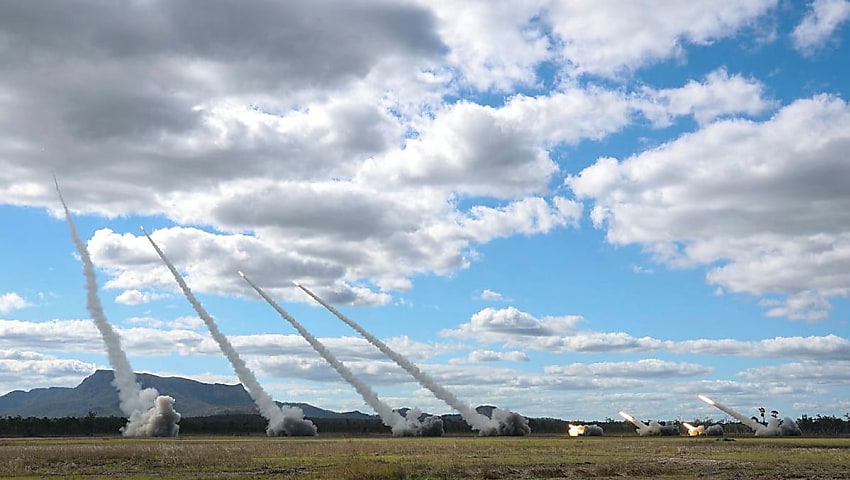
In practice, this means reshaping the Australian Defence Force into an integrated joint force capable of coordinated action across land, sea, air, cyber and space. Long-range precision fires, such as the High Mobility Artillery Rocket System and the future precision strike missile, will allow the Army to contribute meaningfully to maritime denial operations.
The Navy’s emphasis is shifting towards undersea warfare and long-range strike platforms, while the Air Force is evolving into a networked strike and sensor hub capable of controlling unmanned systems and delivering effects across the region. Cyber, space and electronic warfare capabilities form the connective tissue of this system, ensuring that the ADF can operate with speed, resilience and precision.
This modern posture, when viewed through the lens of medieval siege warfare, offers intriguing parallels and contrasts. Medieval strategy was defined by the interplay between siege and counter-siege, between the fortified city and the besieging army.
A ruler’s power depended on the strength of their fortifications, the endurance of their supplies and their ability to either resist or break an encirclement. The “Defence of Australia” era was unmistakably defensive akin to a kingdom retreating within the walls of its strongest castle, trusting its moats, towers and archers to fend off incursions.
By contrast, “Impactful Projection” represents the logic of the counter-siege. In medieval terms, it is akin to sending forth mobile forces, knights, archers and sappers to disrupt the besieger’s camp before they can surround the city.
It is a strategy of pre-emption and disruption, one that recognises that the walls alone cannot hold if the adversary can bombard from beyond bowshot. The introduction of long-range strike weapons, autonomous systems and space-based sensors parallels the historical transition from castle defence to field warfare, where mobility, reconnaissance and reach began to outweigh static defence.
Yet, the analogy has limits.
Medieval fortresses embodied permanence and locality; their power was bound to stone and geography. The “National Defence” framework, by contrast, is built on fluidity, digital networks, regional partnerships and technological agility.
The modern “walls” of Australia’s defence are no longer made of granite, but of code, alliances, and deterrence by distance. Where the medieval ruler sought to hold out until relief arrived, Australia’s doctrine seeks to ensure the siege never begins.
That said, the essence of siegecraft, control of space, management of resources and endurance under pressure remains central.
National defence emphasises resilience: stockpiles of fuel and munitions, sovereign industrial capacity and secure logistics chains. These are modern equivalents of medieval granaries and wells, the provisions that allow a fortress or, in this case, a nation to withstand prolonged strategic pressure. Similarly, impactful projection requires not just weapons but sustained capability: training, maintenance, intelligence and political will.
Ultimately, national defence and impactful projection reflect a return to strategic fundamentals dressed in modern armour. The fortress remains but its walls are extended across thousands of kilometres of ocean, its watchtowers are satellites and its catapults are precision missiles.
It has also been argued that Australia is no longer content to sit behind its moat and hope the enemy never crosses. Instead, it seeks to meet potential besiegers in the field, to shape the battle, not merely survive it.
In this sense, the evolution of Australian defence policy has come full circle: from fortress to field, from isolation to engagement, from static defence to dynamic deterrence. The medieval logic of siege warfare endures, but now, the siege is global, the walls invisible and the outcome dependent on whose reach proves most impactful.
But what Australia needs to grasp is that simply lobbing missiles over increasingly longer ranges from the safety of the Australian mainland invariably leaves the nation’s critical regional, economic, political and strategic interests exposed, and still resembles our siege mentality.
Final thoughts
If Australia is to not only endure but genuinely thrive amid an era of shifting great power rivalry, our policymakers and the wider public must recognise that the world is becoming increasingly multipolar, and that the Indo-Pacific is fast emerging as the most fiercely contested region on Earth.
This transformation is being driven by the rising economic, political and strategic weight of nations such as China, India, Pakistan, Thailand and Vietnam, alongside the established and resurgent power of South Korea and Japan. Together, they are shaping a highly competitive strategic environment right on Australia’s doorstep.
At the same time, Australia must confront the reality that its principal security partner, the United States, is facing constraints on its ability to project and sustain power, as influence becomes more dispersed across a growing number of capable actors.
Meeting these challenges and seizing the opportunities they present will require Australia to move beyond the narrow assumptions that have guided our diplomatic, strategic and economic policies since Federation.
To fully grasp and respond to the sweeping changes underway across the Indo-Pacific, Australia needs a long-term, whole-of-nation perspective. The pressing question now is: when will we see a comprehensive assessment and coherent response to these developments?
When will a clear narrative and national strategy emerge, one that helps industry, government and the community alike understand not just the risks, but the immense and largely untapped opportunities that lie ahead?
As regional power dynamics continue to evolve and China extends its influence, Australia must decide whether it is content to remain a secondary player or ready to step up and take on a more independent, confident and influential role in an increasingly contested Indo-Pacific.
Get involved with the discussion and let us know your thoughts on Australia’s future role and position in the Indo-Pacific region and what you would like to see from Australia’s political leaders in terms of partisan and bipartisan agenda setting in the comments section below, or get in touch at

Want to see more stories from trusted news sources?
Make Defence Connect a preferred news source on Google.
Click here to add Defence Connect as a preferred news source.