

 iscover
For nations like Australia, deterrence has long been seen as the preserve of nuclear superpowers. Yet today, conventional deterrence is becoming a defining tool for middle powers, and the evolving approach of the US Navy offers valuable lessons for Australia’s own strategy.
The arrival of the atomic age in the final days of the Second World War irreversibly transformed humanity’s understanding of power. Where once the European empires of the “Old World” relied on vast colonial manpower to project force, the United States, itself a former colony, emerged from the war as the pre-eminent global power, armed with a weapon that could destroy entire cities in seconds.
That monopoly on nuclear capability was short-lived. The Soviet Union’s successful test of an atomic bomb in 1949 shattered America’s exclusivity, soon followed by the United Kingdom, France, China, India, and Pakistan.
Despite the proliferation of nuclear weapons, their very existence arguably preserved peace. The logic of “Mutually Assured Destruction” (MAD), the idea that any nuclear exchange would ensure the annihilation of both sides, deterred direct great power conflict and defined the tense but relatively stable equilibrium of the Cold War.
Yet as political scientist John Mearsheimer has long argued, deterrence does not rest solely on the threat of nuclear annihilation. His theory of conventional deterrence emphasises that states can prevent aggression through credible, ready and capable conventional military forces.
A potential aggressor must believe that a conventional attack will be both costly and uncertain of success. Nuclear weapons may prevent total war but conventional forces prevent limited or coercive conflicts that fall below the nuclear threshold – the very kinds of contests now emerging in the Indo-Pacific.
The post–Cold War period, once heralded as the “End of History”, has instead given rise to renewed competition. Nuclear disarmament never truly materialised and the return of great power rivalry has exposed the fragility of the global order.
For Australia, the security guarantee of the US’ “extended nuclear umbrella” – underpinned by the American nuclear triad of submarine-launched missiles, land-based intercontinental ballistic missiles and strategic bombers – has long been the foundation of national defence policy.

But questions now loom large. Can the United States sustain its global leadership amid growing domestic division and strategic overstretch? And what happens if Washington’s commitment to regional stability wavers?
This debate has found expression in recent Australian policy. Deputy Prime Minister and Defence Minister Richard Marles captured this shift with his call for “impactful projection”, the ability to hold potential adversaries at risk far from Australian shores. Likewise, the 2023 Defence Strategic Review acknowledged a hard truth: Australia can no longer assume US protection as a given. It concluded that Australia must develop the capacity to unilaterally deter hostile actions against its forces or territory.
In this emerging era, Australia’s task is clear, to build a credible conventional deterrent that complements, rather than depends upon, the fading certainties of nuclear-era security. But from where can we draw inspiration?
While Australia’s future conventionally armed, nuclear-powered submarines will form part of the nation’s conventional deterrence triad, they are only a small part of the maritime leg of the nation’s burgeoning conventional deterrence triad.
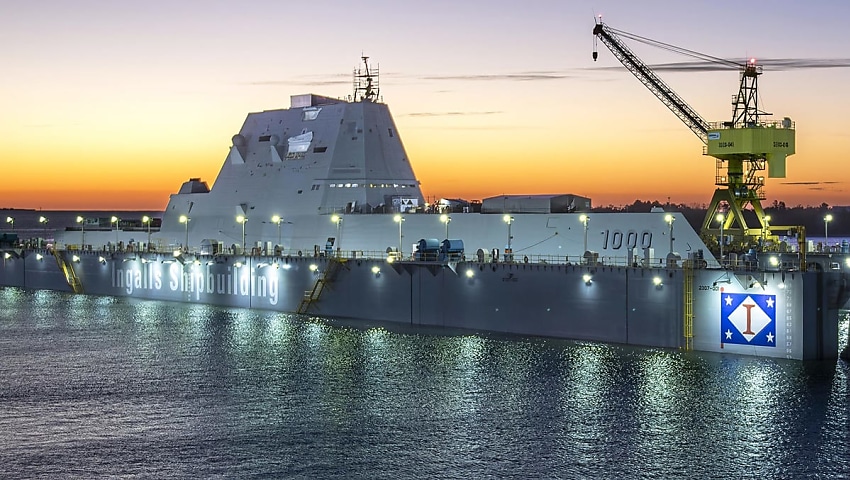
Well thankfully, the US Navy is using the world’s second most expensive surface combatants, the Zumwalt Class, as a testbed for developing and fielding a conventional deterrence capability that will ultimately complement similar technologies to be integrated into the US Navy’s submarine fleet.
Reinventing the stealth giants
When the United States Navy first unveiled the Zumwalt Class destroyers, they were heralded as the future of surface warfare – sleek, stealthy and far ahead of their time. Yet for much of their existence, the three ships of the class – USS Zumwalt, USS Michael Monsoor, and USS Lyndon B Johnson – were more a cautionary tale of ambition outpacing technology and doctrine.
Originally, the vessels were intended as land-attack platforms to deliver precision fire support for forces ashore, the class’ massive 155 mm Advanced Gun Systems fell into redundancy when the cost of their bespoke guided ammunition spiralled out of control. For years, the Zumwalts seemed destined to linger at the fringes of relevance, a futuristic design in search of a mission.
That changed decisively with the Pentagon’s reorientation towards great power competition, especially in the Indo-Pacific. As China and Russia advanced anti-access and area denial systems capable of holding US and allied bases at risk, the need for rapid, survivable, long-range strike options grew urgent. The answer came in the form of the Conventional Prompt Strike (CPS) program, America’s first operational sea-based hypersonic missile system – and a plan to make the Zumwalt Class its first test platform.
Beginning in 2023, USS Zumwalt entered dry dock at Ingalls Shipbuilding in Mississippi for a two-year refit. Her twin 155 mm gun mounts were removed and replaced with four large-diameter launch tubes, each capable of holding three CPS missiles, a total of 12. These missiles, designed to travel at speeds above Mach 5, will give the ship a precision strike capability exceeding any previous naval platform.
The Zumwalt’s integrated power system and stealth profile make it uniquely suited to testing such a capability. Sea trials and live-fire testing are anticipated around 2027–28, with the two ships to follow.
The significance of this shift extends well beyond the US Navy. Strategically, it marks the beginning of a new era of conventional deterrence, one grounded in the ability to strike swiftly and decisively with non-nuclear weapons. In the framework articulated by theorists like Mearsheimer, effective conventional deterrence rests on convincing an adversary that any act of aggression will provoke an immediate and costly response. By deploying hypersonic weapons at sea, the United States aims to restore the credibility of that threat, even against near-peer powers.
Yet the Zumwalt program is only the first phase. The lessons learned from its retrofit will be fed directly into the next step: integrating the same CPS system into the Virginia Class attack submarines. Beginning with Block VI submarines in the early 2030s, these boats will feature a new payload module designed specifically to carry hypersonic missiles. Submarine deployment will make the system far more survivable, stealthy and globally deployable, transforming the Navy’s conventional strike posture.
The Zumwalts then serve as a technological and doctrinal bridge between experimental capability and operational force.
Viewed through the lens of deterrence, the logic is clear. Hypersonic missiles drastically reduce warning time and compress the decision window for any adversary. Their speed, manoeuvrability and low flight paths make interception exceedingly difficult, if not impossible, with current defences. A stealthy Zumwalt operating in the Pacific, armed with a dozen such weapons, can hold critical targets at risk from thousands of kilometres away without exposing land bases or carrier strike groups.
Because these weapons are non-nuclear, they provide policymakers with credible response options that do not automatically escalate to a nuclear exchange.
For Australia, the implications are profound. As a close ally and AUKUS partner, Canberra stands to benefit from the technological and operational insights generated by the Zumwalt and CPS programs.
The US Navy’s progress in integrating hypersonic systems at sea will directly inform AUKUS Pillar II, which includes cooperation on advanced strike capabilities, autonomous systems and undersea warfare. Australian officials have already signalled interest in developing indigenous long-range strike options such as the Hypersonic Attack Cruise Missile and potential ship-launched variants and US testing provides a critical model for integration and risk management.
Moreover, the Zumwalt’s evolution underscores a broader strategic trend that Australia must adapt to the maritime diffusion of conventional deterrence. In a region increasingly defined by precision strike and counter-strike dynamics, the ability to hold targets at range, without reliance on static bases, is vital. Hypersonic weapons on surface ships or submarines offer that flexibility. For the Royal Australian Navy, now modernising its surface combatant fleet and pursuing nuclear-powered submarines, the clear lesson is that hypersonic integration must be baked into future design philosophies rather than retrofitted later at great expense.
At a political level, the presence of hypersonic-armed Zumwalts and future Virginia submarines in the Indo-Pacific will also serve to reinforce allied deterrence, strengthening Australia’s strategic umbrella. These platforms enhance the credibility of the United States’ extended deterrence commitments and add another layer to the regional balance of power – complementing Australia’s growing strike capabilities.
For Canberra, close operational cooperation, data sharing and potential industry participation in hypersonic development could provide both strategic and economic dividends.
Still, challenges remain. The Zumwalt’s retrofit has faced delays and the CPS program itself is costly and technically demanding. Integrating such systems into submarines will push the limits of naval engineering. Yet as the Zumwalt Class returns to sea later this decade, it will symbolise more than just American ingenuity, it will mark the first tangible step towards a multi-domain, allied hypersonic strike network, capable of imposing cost, complexity and hesitation on any adversary in the Indo-Pacific.
For Australia, that network is both shield and opportunity: a deterrent foundation on which to build its own sovereign strike capabilities and a signal that the next phase of maritime power projection will belong to those who can think and strike at hypersonic speed.
Final thoughts
If Australia is to deliver on its stated long-term objective of unilaterally deterring any adversary as outlined in the 2023 Defence Strategic Review, we as a nation are going to have to get more comfortable about deterrence as a concept and the mechanisms for delivering it with a distinct Australian flavour.
Critically, this will equally require some novel and tried-and-tested models for delivering it, while also recognising that the increasingly complex geopolitical and strategic environment that is emerging across the Indo-Pacific will require a balanced, conventional deterrence capability that combines both kinetic and non-kinetic capabilities from across the air, land, sea, space and cyber domains.
However, as the past half decade has shown, sustainable deterrence requires more than just traditional and novel military capabilities, it is more than just a series of platforms and troops, it is about sustainable combat mass and the supporting industrial capacity to sustain high-intensity combat operations for months and years against a peer competitor.
Ultimately, this will mean Australia will need to act with urgency, foresight and intent.
Get involved with the discussion and let us know your thoughts on Australia’s future role and position in the Indo-Pacific region and what you would like to see from Australia’s political leaders in terms of partisan and bipartisan agenda setting in the comments section below, or get in touch at

Want to see more stories from trusted news sources?
Make Defence Connect a preferred news source on Google.
Click here to add Defence Connect as a preferred news source.