

 iscover
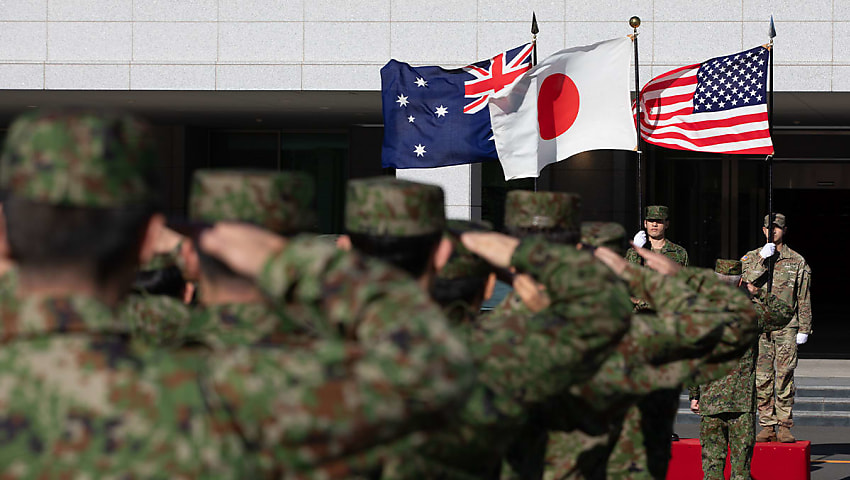
Opinion: The emerging partnership between the US, Japan, and Australia, centred on initiatives like J-StarX and Project Dynamis, demonstrates a practical model for allied defence industrial cooperation that accelerates innovation, enhances interoperability and strengthens deterrence across the Indo-Pacific, details Bernice Kissinger, founder and CEO, Kissinger Advisors.
A “build allied” defence industry sector provides a compelling rationale, especially between the United States, Japan and Australia. The US brings scale, systems integration capacity and global production lines.
Japan has strengths in world-class precision manufacturing, advanced shipbuilding and dual-use technologies. Australia offers geographic advantages for manufacturing, supply chain logistics support and a niche innovation and research base. Pooling these strengths creates opportunities to share risk, lower unit costs and accelerate deployment of advanced systems that no single partner could efficiently field alone.
A range of initiatives (largely research and development focused) are already being pursued in emerging and dual-use technological areas between Australia and the US under AUKUS Pillar II.
Japan is a relatively new player in this space due to long-standing self-imposed restrictions. This is rapidly changing, especially with Australia, and is an area that will grow more substantially with the recent Australian government decision to procure the Mogami Class frigate from Japan.
Japan’s Ministry of Defense and the Ministry of Economy, Trade and Industry is central to this transformation. Recognising the rapid development of commercial technologies and the fiscal constraints on defence research and development, both ministries have emphasised the necessity of collaborating with external organisations, both domestic and international, to enhance national security capabilities.
As the Japanese government looks to further leverage its large and diverse dual-use technology sector into global defence and national security supply chains, opportunities are emerging for greater allied nation, including Australian SMEs and MMEs, teaming and partnerships.
Two separate case studies – J-StarX and Project Dynamis

Initially designed as an international start-up acceleration platform, J-StarX now plays a subtle but growing role in Japan’s effort to cultivate dual-use technologies – those applicable to both civilian and military domains.
J-StarX is a comprehensive support platform for Japanese start-ups seeking to enter international markets. It provides targeted overseas dispatch opportunities to innovation hubs globally. The program offers multiple sector-specific tracks, each designed to align with high-impact global trends and emerging technology domains.
The United States Marine Corps’ Project Dynamis is emerging as a pivotal accelerator for the Pentagon’s Combined Joint All-Domain Command and Control (CJADC2) vision. Designed to modernise command, control and communications, transition networks to hybrid cloud, federate authoritative data, and upskill the Marine Corps’ workforce, Dynamis is increasingly positioned as a joint force integrator.
Dynamis aims to consolidate disparate service-specific command, control, communications, computers (C4) systems, transition capabilities to the cloud, enable data use for artificial intelligence/machine learning and other modern analytical tools, and enhance workforce cyber literacy thereby dramatically accelerating modernisation across the joint force.
Project Dynamis builds on the USMC participation in joint innovation experiments such as the Army’s Project Convergence, the Navy’s Project Overmatch, and the Air Force’s Advanced Battle Management System, positioning the corps as the connective integrator across the joint force. It has also been integrated into the Navy’s Overmatch initiative for greater scale and interoperability.
For regional allies such as Japan and Australia, Project Dynamis offers a valuable template for interoperability and joint modernisation. Because Dynamis prioritises cloud-based C4 integration, data federation and multinational operational picture sharing, these allies can more seamlessly plug into US command architectures.
Furthermore, the defence–industrial synergy that Dynamis fosters, including rapid testing, commercial innovation, and scalable deployment, can benefit partner nations by providing models, standards, or even shared infrastructure, reducing the barrier to fielding advanced, integrated systems.
As Australia and Japan invest in their own JADC2-aligned architectures, they can potentially adopt interoperable solutions co-developed or tested within Dynamis frameworks, enhancing coalition readiness and collective deterrence across the Indo-Pacific.
Connecting the dots
In February 2025, the PaCT Defense/Dual-Use Technology Conference took place in Honolulu led by a US non-profit organisation, PICHTR (Pacific International Center for High Technology Research). PICHTR was established during the Reagan and Nakasone administrations to support technology exchanges between the US and Japan.
The PaCT conference convened INDOPACOM and Japan defence officials, contract requirements writers, contracting officers, industry, investors, and allied government, innovators, and military liaison officers to INDOPACOM to collectively address a Commander’s Intent in a Tabletop Exercise and for US-allied industry teams formed at the event to respond to a formal Dynamis Request for Information (RFI).
The RFI has led to contracts and CRADAs awarded for dual-use technologies in maritime domain awareness, coalition interoperability and CJADC2 solutions.
The tabletop exercise forced agile teaming to respond to immediate near-conflict needs, followed by a detailed tutorial on how to best respond to the RFI, while PaCT broadened the conversation to other services’ acquisition opportunities and operational problem sets.
Together, the events reinforced Dynamis as a mechanism not only for USMC modernisation but also for coalition integration in the Indo-Pacific.
Several intersections stand out. First, the PaCT agenda mirrored Dynamis’ priorities. Sessions emphasised data federation, allied interoperability and the coordination of disparate data sources for MDA, precisely the pain points that Dynamis seeks to address. In this sense, PaCT served as a venue where allied stakeholders validated the operational problems that Dynamis has been designed to solve.
Second, PaCT’s focus on challenge-based acquisition and upcoming contracts intersected with Dynamis’ rapid modernisation ethos. The same week as the PaCT conference, the USMC released a request for information (RFI) tied directly to Project Dynamis, subsequently updated on 14 March.
Third, coalition interoperability was a central theme across both the workshop and PaCT. Dynamis has already demonstrated the ability to integrate coalition data links through commercial solutions such as Ultra Intelligence & Communications’ ADSI system.
PaCT extended this dialogue to Indo-Pacific allies, notably Japan and Australia, both of whom are investing in CJADC2-like architectures. By aligning early with Dynamis frameworks, these partners can better synchronise their command-and-control modernisation, reducing future interoperability frictions.
J-StarX’s role within PaCT was significant. The J-StarX accelerator was explicitly woven into the PaCT Conference program. Through PaCT, J-StarX companies gained a showcase platform among potential US and allied buyers and military end users, enabling them to explore partnerships, capacity building, and collaborative ventures that complement their dual-use ambitions.
This integration achieved multiple outcomes:
- Ecosystem integration: J-StarX companies benefited from engagement with US defence innovators, investors, and policymaker networks assembled at PaCT, accelerating their entry into dual-use markets.
- Strategic alignment: By aligning with PaCT’s themes – such as data-sharing, climate-resilience tech, and challenge-based acquisition – J-StarX start-ups honed their offerings for coalition-ready applications.
- Brand and program strengthening: Embedding J-StarX within PaCT underscored the Japanese government’s commitment to dual-use innovation and served as a model for triangular initiatives between government, industry and allied partners.
Most importantly, it led to a range of allied nation composite organisations being linked into RFPs contracting opportunities for the USMC.
Conclusion
Operationalising defence industrial and technology cooperation between the US, Australia, and Japan offers significant strategic, economic and operational benefits. By pooling resources, expertise and industrial capacity, the three nations can accelerate the development of advanced capabilities, strengthen supply chain resilience and reduce dependence on vulnerable global markets.
The smart play for governments in parallel with traditional large-scale procurement projects is genuine investment in rapid, agile programs like the J-StarX/PaCT model – delivering practical commercial outcomes linked to government contracts and providing the path to rapid prototyping, testing, evaluation and production for the warfighter. Easier said than done but critical to mission success.
Bernice Kissinger is founder and CEO, Kissinger Advisors and government dual-use technology adviser.
Want to see more stories from trusted news sources?
Make Defence Connect a preferred news source on Google.
Click here to add Defence Connect as a preferred news source.