

 iscover
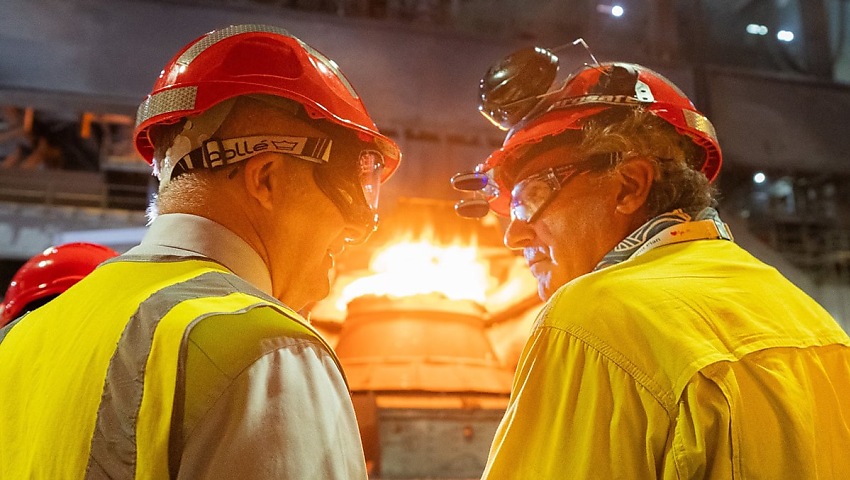
Prime Minister Anthony Albanese has promised to “rebuild” Australia’s declining industrial and manufacturing base, transforming us into a manufacturing “powerhouse” as part of a “Back Australia” campaign amid increasing global geostrategic competition.
For the latter half of the 20th century, Australia was widely considered a modern “industrial power”, backed by a robust and diverse industrial base building cars, ships, steel, machinery and chemicals for both home and export.
Post-war reconstruction, strong migration, the “Baby Boom” and protective tariffs built a robust manufacturing base that once employed a quarter of the workforce and produced everything from locomotives to precision instruments.
By the late 1980s, manufacturing contributed over 15 per cent of gross domestic product (GDP), driven by domestic demand, foreign investment and a skilled workforce the spirit of which was captured by Australian pub-rock titan Jimmy Barnes in Working Class Man.
However, this “golden age” of manufacturing and industrialisation was short-lived, when from the 1990s, globalisation and economic reform transformed the economy. Tariff cuts, the floating of the Australian dollar and waves of privatisation heralded a shift towards services, property and relatively uncomplex resource extraction saw manufacturing hollowed out.
Today, manufacturing accounts for less than 6 per cent of GDP. Australia ranks among the least industrially self-reliant nations in the Organisation for Economic Co-operation and Development. Once home to integrated supply chains and thriving hubs in Victoria, South Australia and NSW, the nation now imports mostly complex goods.
The result is comprehensive deindustrialisation at a time when global power competition again makes industrial strength central to national security. COVID-19, the Ukraine war and conflict in the Middle East exposed the dangers of relying on distant markets for energy, materials and defence equipment, yet little has changed.
Australia remains perilously under-industrialised. Harvard’s Atlas of Economic Complexity ranks us 105th globally, between Botswana and the Ivory Coast, two well-known industrial powerhouses in their own right (just kidding) serving as an indictment for a wealthy nation.

Rising tensions in the Indo-Pacific, including China’s militarisation and trade coercion, highlight that industrial capability underpins sovereignty and defence at a time when the post-Cold War era of American-guaranteed peace and stability is waning, giving rise to a multipolar world defined by nation-state competition.
In response, manufacturing and the national industrial base is once again figuring prominently for both sides of Australia’s political debate, with Prime Minister Anthony Albanese the latest Australian politician to join a growing chorus of politicians, business tycoons and analysts emphasising the importance of a robust, diverse and competitive industrial base for our national security.
The Prime Minister’s push comes mere weeks after opposition leadership contender, Andrew Hastie launched his own public push to open up debate and conversation about reindustrialisation becoming a key pillar of a potential Coalition policy platform, ironically drawing fire from government MPs, economists and his own Coalition colleagues.
But at least the conversation is starting to gain some traction!
Misguided nostalgia v a ‘new’ industrial revolution
At the core of this reinvigorated push, Prime Minister Albanese told The Daily Telegraph’s Joe Hildebrand, “Australia needs to be a nation that makes things ... We were a manufacturing powerhouse before and we can be again. We have the best and brightest businesses in the world and we need to ensure they reach their full potential.”
Delivering this ambitious task however requires a comprehensive and coordinated effort, bringing together government, the bureaucracy, industry, academia and the Australian public to collaborate and pull in the same direction in order to support the development, or perhaps redevelopment of Australia’s ailing industrial base.
One of the key priorities for the Prime Minister is the need for a new, central tzar responsible for streamlining the entire regulatory ecosystem that underpins the national industrial and manufacturing economy, drawing comparisons to the era of Essington Lewis, the BHP executive and industrialist, turned director general of the department of munitions during the Second World War.
Echoing the Prime Minister’s push is a growing chorus of business leaders, including Andrew “Twiggy” Forrest, Dick Smith, Harvey Norman and Katie Page, supporting the “Back Australia” campaign to back Australian manufacturers and producers.
Not to be left out, Opposition Leader Sussan Ley expressed her support behind the initiative, telling Hildebrand, “Every time we buy Australian made, we are backing our workers, protecting our jobs and building our future ... Australia must always be a country that makes things. From our farms to our factories, backing Australian made means backing Australia’s future.”
However, this campaign isn’t without its detractors, with the editorial staff of The Australian Financial Review pushing back against the “moribund” fetishisation of such efforts to reindustrialise the Australian economy, with the masthead stating, “Back Australia’s chief complaint is that Australian manufacturing today is less than a quarter of what it was in 1960, ‘putting a drag on the economy and endangering our national security”. Its call to put local industries at the heart of the economy echo Hastie’s lamentations that ‘we are a nation of flat-white makers when we could be making beautiful cars like [a Falcon] again’.”
Going further, the Financial Review editorial added, “The fetishisation of manufacturing has captured governments of advanced economies around the world who are leaning towards repatriating and protecting vital industries through protectionist measures. For example, Donald Trump’s obsession with restoring blue-collar jobs, reviving factories and weaning off from China captures a similar nostalgia for industrial glory days. But attempts to reverse the structural forces of globalisation and technological advancement are destined to fail.”
Much of this criticism comes from the same naive, elitist frame of mind that dominated much of the pro-hyperglobalisation class of academics, economists and politicians, people who by and large would struggle to point out a cow, much less understand how to change their own oil.
And herein lies the problem, the elitist disconnect from reality, which is further reinforced by the Financial Review commentary, which stated, “The iron economic law is that as nations grow wealthier, employment naturally shifts from manufacturing to services. After languishing in the late 1970s and 1980s, Australia’s productivity surged in the 1990s with the decline in manufacturing, introduction of microeconomic reforms and the growth of new service industries (wholesale trade, finance and insurance in particular) which underpinned strong growth in gross domestic product at an average of nearly 4 per cent a year in that decade.
“The transition to a service economy allowed Australia to specialise, import cheaper goods and focus scarce capital and labour on higher-value activities that made us richer and more competitive. The service sector now generates roughly 80 per cent of total GDP,” the Financial Review commentary detailed.
The irony of this being that someone seems to have forgotten to tell the manufacturing powers of South Korea, Taiwan, Germany and Japan that the wealthier an economy gets, the “dumber” and less “hands on” it needs to become.
Now yes, these nations face their own distinct challenges, however, most are the result of the successful lobbying of these same people, namely in the energy space (just look at Germany’s industrialised economy being ravaged by high energy prices) and the double-edged sword of unrestricted mass migration that is serving to drain public resources at a time when conflict is around the corner.
I know those points in particular will no doubt trigger some people, but the proof is in the pudding; don’t believe me, have a look here, here, here, here and here.
How do we skin this cat?
Importantly, Australia can achieve this, despite the defeatist, “tall poppy” syndrome and elitist mindset that is perpetuated by the likes of the Financial Review with ideas that contemporary manufacturing and industries are the same as those of the 1960s and 1970s, rather than highly skilled and knowledge-driven value-adding jobs.
Just look at a Tesla gigafactory; one would hardly describe those workers as being dumb and dirty, rather they are among the most highly skilled, productive and competent workers in the world, benefiting from a host of regulatory, policy and legislative settings that enable their host economies to compete against the likes of China.
Ultimately, much of the contemporary debate and conversation, as it stands, devolves into accusations and a debate between the camps of “picking winners” versus “creating the environment” for competitive industry to be established and thrive, rather than a hybrid approach.
Avoiding this reductive dichotomy will prove essential if we’re going to both avoid the mistakes of our past and begin taking advantage of the opportunities presented by the voracious economic demands of the Indo-Pacific.
This brings me back to the theories proposed by the Australian Strategic Policy Institute’s Marc Ablong, who identified four key pillars for supporting the reindustrialisation of the Australian economy, namely:
- Demand signalling and stability: The government must act as a dependable, long-term partner to industry, not just as a sporadic customer. By providing clear and consistent demand signals, it can reduce investment risk for private industry and support the growth of critical capabilities. This requires moving from stop-start procurement cycles to a steady, strategic partnership, recognising that Australian industry is an essential component of national defence capability rather than simply a supplier.
- Sovereign capability prioritisation: Australia must clearly define and protect its genuinely sovereign industrial capabilities, those vital to producing, sustaining and adapting key defence systems without relying on external supply chains. Targeted onshoring of production in areas where overseas disruption poses a strategic vulnerability is critical to ensuring national self-reliance and resilience.
- Skills and workforce mobilisation: National preparedness depends on people. Australia must develop a coordinated approach to maintaining and expanding the skilled workforce needed for defence production and sustainment, including engineers, technicians and tradespeople. This extends beyond Defence itself to the network of small and medium enterprises that form the backbone of the broader industrial base, allowing for the broader transfer and consolidation of skills.
- Legislative and administrative readiness: Australia requires robust legal and administrative frameworks that can swiftly mobilise and coordinate civil and industrial resources in a crisis. This means having pre-tested plans, clear lines of authority and an established understanding across government of how to balance military demands with essential civilian needs, but these also provide the opportunity for Australia to more broadly develop the national industrial base, through the development of a “platform” agnostic manufacturing capacity.
With this in mind, one can’t help but feel that perhaps Hastie’s early and very public push to relight the fires of Australia’s industrial base might have finally gained the traction and attention it needed.
Final thoughts
Building Australia’s strength as an independent power, one with the economic weight, diplomatic clout and military muscle of a great power isn’t just an ambition. It’s a declaration of sovereignty.
It signals an Australia ready to take full responsibility for its own security and to play a leading role in shaping a stable, prosperous Indo-Pacific.
For too long we’ve been cast as stuck between China’s markets and America’s alliance, caught in the middle of someone else’s great power contest. It doesn’t have to stay that way. In a world dividing between autocracy and democracy, Australia must have an honest, open conversation about where we stand and where we’re headed.
That discussion must include the Australian people those who will pay the price, carry the load and defend the choices made in their name.
Success demands transparency, collaboration and trust between government, industry and the public. It means inspiring Australians to believe once again in a shared national project, one that strengthens our economy, secures critical industries and builds resilience against economic coercion.
A strong, diverse and self-reliant economy is the bedrock of national power and the best deterrent against coercive external pressure.
Just as vital is a national reckoning with our ambitions. Are we content to remain a “middle power” or is it time to step up and act as a genuine regional leader – a nation that shapes events rather than reacts to them?
As American historian and author Arthur Herman wrote of the United States, “whether we call it industrial policy or something else, we urgently need a new paradigm ... because the development of advanced technologies can rapidly transform economies of scale and determine the course of future innovation”.
The same applies to Australia. Without bold investment in capability, innovation and self-reliance, we risk stagnation and with it, the slow erosion of our power, prosperity and independence.
Get involved with the discussion and let us know your thoughts on Australia’s future role and position in the Indo-Pacific region and what you would like to see from Australia’s political leaders in terms of partisan and bipartisan agenda setting in the comments section below, or get in touch at

Want to see more stories from trusted news sources?
Make Defence Connect a preferred news source on Google.
Click here to add Defence Connect as a preferred news source.