

 iscover
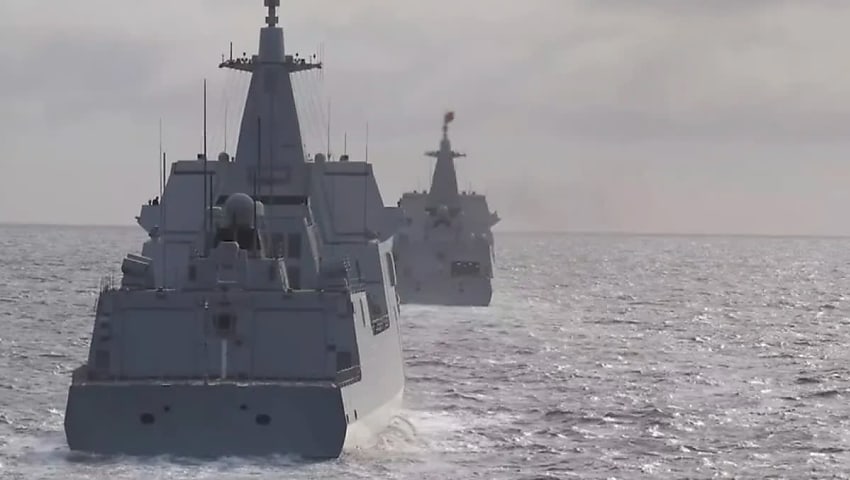
Speculation that another Chinese naval taskforce is steaming south with Australia once again in its sights should be reinforcing the nation’s vulnerability, all while we continue to debate what amounts to little more than lines on a spreadsheet.
Few, if any, Australians alive today would remember in first person the Fall of Singapore or the Japanese attacks on Darwin, or Sydney Harbour, or the loss of HMAS Sydney in 1941.
Even few Australians today would have had or remember conversations with their grandparents, great aunts or uncles or great grandparents about these events and the immense psychic repercussions on the Australian public consciousness.
As only a small, young nation at the time of these history-defining events, Australia and Australians had been accustomed to the benevolent protection of the British Empire, then our primary security partner.
Each of these events, beginning with the Fall of Singapore, dramatically and irreparably shattered the public belief that Australia was protected by its “Tyranny of Distance” and that this concept was rather a double-edged sword.
Following the Second World War, some of the lessons were learned and incorporated into the nation’s post-war strategic posture and policy, particularly during the era of “Forward Defence”, which saw Australia actively pursue a policy of engaging with and strategically deterring future aggression and expansionism across the Indo-Pacific, with extended nuclear deterrence provided by the United States.
This era would ultimately come to an end following Australia’s disastrous participation in the Vietnam conflict and significant domestic upheaval and disconnection from the broader geopolitical and strategic challenges due to our national distance from the major threats of the era, resulting in the nation pivoting towards a “continental defence” focus.
Ultimately, this quasi-isolationist policy and doctrine would accelerate post-Cold War and the ensuing “Peace Dividend” theory, which further entrenched a psychology of disconnection from the “real world” and the challenges posed by simmering economic, political, strategic and ethno-religious tensions, ambitions and designs we believed had passed into the pages of history.

Simply put, Australians have forgotten the lessons of the Second World War and the risks and threats posed by direct kinetic and non-kinetic threats to the nation, its economic, political and strategic interests and our way of life.
One would be forgiven for thinking that the circumnavigation of the Australian landmass by a particularly potent Chinese naval taskforce in March and April of 2025 would serve to wake the Australian people from the comforting slumber from the realities of the new global order.
This comes despite the increasing rhetoric from successive Australian governments since as far back as 2009 regarding the very real security challenges posed by the rise of the People’s Republic of China and its growing ambitions for the post-Second World War order. Of course, this is also increasingly complicated by the rise of other emerging nations, particularly in the Indo-Pacific serving to further complicate decisions made by Australian policymakers.
Recent revelations that another Chinese naval taskforce is now operating in the Philippine Sea and looks to be travelling south through maritime south-east Asia has served to re-highlight the very real threats posed to Australia at a time when we appear to be going around in circles, debating line items on a Microsoft Excel spreadsheet.
In her assessment of Australia’s strategic environment, former naval officer and ANU National Security College expert associate Jen Parker, in a piece for the Australian Strategic Policy Institute titled, Facing Chinese military coercion, Australian defence spending is insufficient, argued that the country is entering an era where military force is once again a routine instrument of coercion, and that Australia is underprepared for it.
Significant mismatch – rhetoric v actions
At the centre of her analysis, Parker pointed to recent Chinese naval deployments, including a full circumnavigation of the Australian continent, as deliberate demonstrations of reach and intent rather than benign maritime activity. These actions, paired with increasingly risky intercepts of Australian aircraft in international airspace, illustrate a pattern: the People’s Republic of China is prepared to apply military pressure to shape behaviour and signal dominance.
Parker made the case that Australia can no longer rely on comforting assumptions about distance, strategic warning time or a passive regional security environment. The Indo-Pacific has become more contested, and coercive state behaviour is growing normal. Yet Australia’s defence posture, in capability, readiness and funding has not kept pace.
Importantly, Parker stressed that China isn’t the only threat to our national security and our interests, particularly as the world and the Indo-Pacific in particular becomes more competitive, challenging and strategically threatening, stating, “States increasingly use military coercion to solve their problems. Countries that cannot resist coercion will struggle to defend their interests and way of life. Australia is already experiencing degrees of military coercion.”
Her critique of current capability gaps is pointed. Australia does not possess modern mine-countermeasure systems, leaving its ports and shipping lanes exposed in the event of grey zone pressure or conflict. Land-based missile-interception capabilities remain limited and insufficient to protect critical infrastructure or population centres.
Australia also lacks sovereign space-based surveillance and communications assets, making it dependent on allies for awareness and targeting support. These deficiencies weaken both deterrence and crisis response.
Perhaps most concerning, in Parker’s view, is the impact of budget constraints on operations. Rather than increasing readiness and tempo to match strategic conditions, the Australian Defence Force is being asked to sail less and fly less to save money.
This hollows out training, reduces presence and signals to adversaries that Australian forces lack the depth and resilience needed for a prolonged challenge. While defence spending has increased in raw dollars, Parker noted that as a share of gross domestic product (GDP), it remains well below earlier periods of geopolitical tension. Australia commonly spent close to 3 per cent of GDP on defence during the Cold War and the 1950s.
Parker said, “We are trying to meet a rapidly changing strategic environment on a lean budget, spending about 2 per cent of GDP on defence. In the Cold War it was around 2.7 per cent; in the 1950s, about 3 per cent.”
Today’s figure, hovering around 2 per cent, simply does not align with the strategy articulated by government ministers.
However, it is worth noting that while nominally we may be spending “more”, in reality that isn’t necessarily the case. Parker stressed this, saying, “In nominal terms we are spending more, but as a share of the economy it is significantly less. As a result, we cannot afford many of the critical capabilities needed to protect ourselves from the increasing trends of military coercion and conflict.”
The result, she warned, is a widening gap between Australia’s stated strategic ambitions and the resources actually committed to achieve them. In a more dangerous region, Australia risks presenting a posture that looks strong rhetorically but lacks the substance required to deter coercion or respond effectively if a crisis unfolds.
Time for a step change in spending, capability
Parker’s central message is that incremental, long-term increases to defence funding will not be sufficient. The government’s current trajectory, which modestly raises defence expenditure over the coming decade, is far slower than the rate at which Australia’s strategic risks are intensifying.
She made clear that Australia must confront a structural underinvestment in its defence ecosystem, not just in major platforms, but in the deeper foundations of capability: stockpiles, sustainment, trained personnel, sovereign industrial capacity and operational readiness. These elements have been allowed to erode over many years and reversing that trend requires a decisive shift rather than marginal adjustments.
Parker added that a credible defence posture in today’s environment must be backed by both capability and tempo. That means more ships and aircraft available for operations, deeper fuel and munitions reserves, and the domestic industrial capacity to produce and replenish key systems. Without such foundations, Australia risks fielding a force that appears sizeable on paper but lacks endurance and credibility in practice.
Parker detailed this, saying, “While there are many steps Australia must take to prepare for this change, one point is fundamental: to withstand military coercion we must have the military capability to deter it where possible or to respond if it cannot be prevented.”
Parker also raised a broader national concern: inadequate defence spending undermines Australia’s ability to build and sustain sovereign industry. In an era where supply chains are contested and major powers are prioritising domestic production, Australia cannot afford heavy dependencies on foreign suppliers for critical military capabilities. Strategic independence requires a robust industrial base, not just procurement announcements.
“Although the Albanese government has announced major plans for new submarines, new surface ships and an expanded missile inventory, we still lack a range of key capabilities that are essential to reducing the impact of military coercion and, in the worst case, responding to conflict,” Parker added.
Her conclusion is unambiguous. Australia is facing a rapidly deteriorating security environment shaped by great-power competition and the normalisation of military coercion. To navigate this future, the nation must be willing to fund and field a defence force proportionate to the challenge, one that can deter coercion, respond decisively and sustain operations independently if necessary.
Parker reinforced this, saying, “The government’s plan to reach 2.3 per cent of GDP by 2033–34 does not match the pace or scale of the strategic deterioration we face. If we are serious about resisting coercion and protecting our national interests, defence funding must rise beyond that level, and soon. Delay only heightens our vulnerability to military coercion.”
Final thoughts
Australia and Australians urgently need to wake up; we owe it to our children and grandchildren.
This requires a seismic rethink about the nation, our people, our way of life and how we both see ourselves and fit within the evolving global and regional struggle for dominance and prominence.
The Indo-Pacific has become the hottest contested region in the world. China, India, Pakistan, Thailand and Vietnam are all asserting new influence, while Japan and South Korea are returning to a more prominent regional role. This isn’t competition on the horizon, it has already arrived, and it’s not going anywhere. Our national strategy needs a fundamental reset to reflect this reality.
Without meaningful, sustained investment and long-term planning, we won’t simply fall behind – we’ll be overtaken by the accelerating momentum of our neighbours. If we fail to act, the next generation will inherit a nation overshadowed by wealthier, more powerful and more influential states.
For too long, successive governments have chased short-term gains and reactive fixes. But the strategic landscape is shifting rapidly. Business as usual is no longer an option. We need to look ahead, capitalise on emerging opportunities and blunt potential threats before they gather pace.
The issue isn’t whether these challenges will materialise, they’re already here. The real question is when will Canberra finally put forward a bold, detailed plan capable of rallying industry and the public around a clear national vision?
With China continuing to press its advantage, Australia faces a stark choice: remain a passenger in our own region or step up as a genuine shaper of the Indo-Pacific’s future. The decisions we make now will determine whether we prosper in this new era or find ourselves swept aside by it.
Get involved with the discussion and let us know your thoughts on Australia’s future role and position in the Indo-Pacific region and what you would like to see from Australia’s political leaders in terms of partisan and bipartisan agenda setting in the comments section below, or get in touch at

Want to see more stories from trusted news sources?
Make Defence Connect a preferred news source on Google.
Click here to add Defence Connect as a preferred news source.