

 iscover
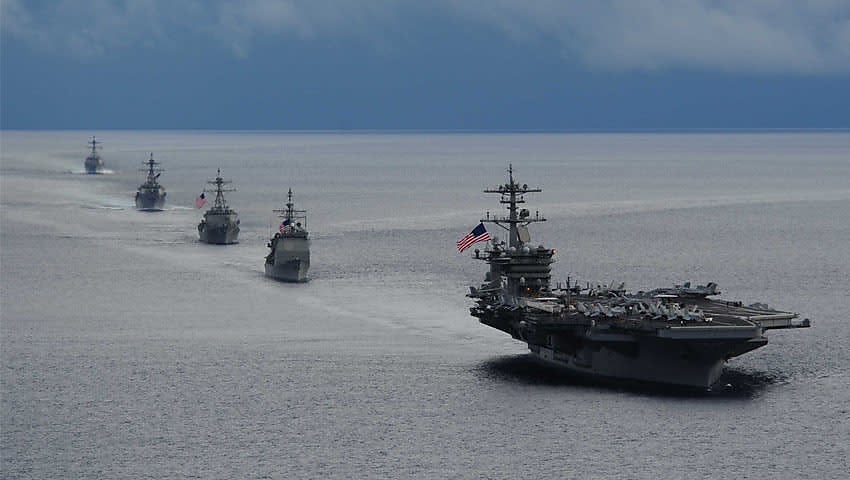
Beijing’s growing power projection capabilities, on display close to home, have once again demonstrated a growing need for regional nations, including Australia, to rethink their relationship with power projection capabilities.
For much of the 20th century, Australia’s approach to power projection was modest and heavily dependent on allies. We accepted that our security lay not in a large, independent force but in being a reliable partner to Britain and, after the Fall of Singapore in 1942, to the United States.
This saw Australia’s post-war doctrine guide the acquisition of specialist platforms (HMA ships Sydney and Melbourne, Canberra and the F-111 bombers) where necessary, hosting allied basing, and shaping our force posture around alliance contributions rather than autonomous long-range power projection capabilities.
That conservative logic began to shift only slowly: successive white papers and strategic updates nudged investment towards greater self-reliance, but Canberra’s marching orders remained pragmatic rather than grandiose, prioritising geography, sustainment, and interoperability.
The past decade, however, has seen a sharper recalibration.
Strategic documents and funding packages, and, most notably, the AUKUS announcement, marked a clear pivot from dependence towards the pursuit of sovereign, high-end platforms and the infrastructure to host them.
AUKUS, in particular, commits Australia to acquiring nuclear-powered submarines and embedding Australian personnel and industry in allied submarine programs, signalling a determination to acquire undersea power projection and strategic power projection capabilities that Canberra has never possessed at scale.
Meanwhile, concurrent investments in shipbuilding, dockyards and workforce development underscore that this is not merely an equipment purchase but a long-term national industrial endeavour.

Parallel to Australia’s strategic evolution, China’s own maritime ambitions have matured from a continental force focused on coastal defence to a blue-water navy purpose-built to assert influence across the wider Indo-Pacific.
Beijing has invested heavily in surface combatants, amphibious ships and carrier aviation, progressing from its first carrier to more advanced carriers and electromagnetic catapult technology; developments that materially extend Beijing’s ability to operate far from its shores.
China’s toolkit for influence is not restricted to capital ships. It has blended maritime law enforcement, a growing coast guard and a maritime militia to exert control in contested waters, particularly the South China Sea, where reclamation and coercive peacetime operations have reshaped the status quo.
These layers, coupled with conventional naval growth, and the largest peacetime military expansion and modernisation, operating alongside irregular, pseudo-political and paramilitary instruments, make Chinese power projection both more resilient and more ambiguous in intent.
Taken together, Australia’s turn toward sovereign, high-end capabilities and China’s rapid naval modernisation create a strategic inflexion in the region.
For Canberra, the challenge is to translate big-ticket acquisitions into credible, enduring deterrent effects while managing the political, industrial and environmental costs of a more assertive posture; for the region, the balance between coercion and stable security architectures is now the central strategic question of our time.
This has only become more critical as Deputy Prime Minister and Defence Minister Richard Marles confirmed that the Australian Defence Force was monitoring a Chinese People’s Liberation Army-Navy (PLAN) naval taskforce in maritime south-east Asia.
"I want to confirm today that Defence is monitoring a Chinese PLAN task group which is currently in the Philippine Sea. But I also want to put this into some context. We maintain constant maritime domain awareness in our geographic areas of interest – that’s south-east Asia, north-east Asia, the north-east Indian Ocean, and the Pacific," the Deputy Prime Minister said.
Going further, Minister Marles added, “Let me emphasise again that this particular task group, which was the subject of the report last Thursday, is currently in the Philippine Sea, and we do not have a sense of where it is going, but we continue to monitor it. As we monitor all movements until we know that task groups are not coming to Australia, we’re not about to give a running commentary on movements of all Chinese Navy vessels.”
Raising significant questions about how Australia is going about its defence modernisation and recapitalisation efforts and whether our policy, doctrine and acquisition settings are striking the right balance.
Speaking exclusively to Defence Connect, former commander of US Indo-Pacific Command (USINDOPACOM), Admiral (Ret’d) Phil Davidson issued a strong warning for the US and its allies like Australia, who will be expected to do more of the heavy lifting.
“It’s not enough to have only denial forces like drones, or purely asymmetric capabilities. You have to have the capability to project power, to punish as well,” ADM Davidson said.
So where does that leave Australia?
Hedging our bets
Australia’s strategic conversation over the past decade has been defined as much by what Canberra cannot sustainably do on its own as by what it must be prepared to deter.
Highlighting this fact and in many ways reinforcing the sentiment of ADM Davidson is Bryan Clark and Dan Patt of the Hudson Institute, in an analysis paper titled Hedging bets: Rethinking force design for a post-dominance era, in which they articulated that we are now entering a “post-dominance era”.
Clark and Patt’s “hedging bets” insists that we are entering a post-dominance era in which the United States, long the region’s guarantor, can no longer be assumed to possess unfettered military superiority everywhere, all the time.
Their starting point is blunt: the proliferation of sensors, precision munitions and networked systems, combined with China’s concentrated, geography-driven modernisation, means some contingencies (a short-notice amphibious assault against Taiwan being the exemplar) could push allied general-purpose forces beyond acceptable risk.
From that problem statement flowed the report’s central prescription: hedge forces.
Clark and Patt defined a hedge force as a narrowly tasked, geographically focused set of capabilities intended to reduce risk in low-probability, high-consequence scenarios without forcing the wholesale remodelling of the general-purpose force.
Hedge forces are deliberately simpler, cheaper to buy and sustain, and designed to be forward-based so they can influence an adversary’s calculus, not by winning every fight outright, but by adding friction and uncertainty to make certain courses of action unattractive, or in its truest sense: deterrence.
The historical analogues are useful: just as nuclear and special operations forces were once conceived as targeted hedges, 21st century hedge forces would play a similar stabilising role.
Now if at first you’re thinking, wait, this sounds like the “integrated, focused force” model proposed by the 2023 Defence Strategic Review, 2024 National Defence Strategy and Integrated Investment Program, you’re correct, at least in part.
As Clark and Patt’s frame of reference is the US Armed Forces, it isn’t exactly a one-for-one model for emulating in the Australian context, rather, it is more an impassioned argument for a more “balanced” approach to defence capabilities.
The most fully realised example in the paper is the Taiwan Bulwark Activation Force (TBAF). Rather than rely on more submarines or stealth aircraft alone, the TBAF leans heavily on attritable, largely uncrewed systems.
This model includes uncrewed surface vessels, uncrewed underwater vehicles, loitering munitions and simple airborne effectors, emplaced on mobile platforms and in forward anchorages around the Sakishima and northern Philippine islands.
The concept is intentionally granular: mass low-cost “minelike” effects that can pin and disrupt an amphibious fleet long enough for survivable, long-range fires from “traditional” assets and capabilities to inflict decisive damage.
That narrow focus makes fielding quicker and more affordable while avoiding some of the logistics and personnel burdens that come with scaling crewed platforms.
Trial and error
Crucially, Clark and Patt back the concept with modelling and many-on-many simulation work that suggests a well-designed hedge force can materially lower the probability of a successful invasion while preserving the wider force’s versatility, thus reinforcing the base-level of deterrence.
One simulation variant, where the hedge force pins the invasion fleet and high-end forces strike supporting nodes, produced markedly higher survivability for crewed units and denied the red force a lodgement in all model runs. That is the strategic payoff: more options for the defender and more uncertainty for the attacker.
Clark and Patt remain clear-eyed about the risks and limits of hedge forces.
First and foremost, hedge forces can be politically sensitive: forward basing in Japan or the Philippines raises host-nation and escalation questions, and dependence on allies creates brittle seams if domestic politics shift.
Equally influential is the institutional inertia in acquisition, competition for budget, and the DOD’s cultural preference for multi-mission crewed platforms also complicate implementation.
The pair therefore recommend tying hedge forces to flexible acquisition authorities, placing fielding and evolution under geographic combatant commands (INDOPACOM in this case), and organising small joint taskforces with delegated contracting and sustainment authorities so the hedge can iterate faster than traditional programs.
In the Australian context, it is equally important to understand and avoid our propensity to seek the cheapest, most effective “silver bullet” solution to solve all of our defence problems. So what does this mean for Australia?
First, defence planners and policymakers should regard hedge concepts as a complement – not a replacement – to alliances and, most critically, Australia’s own force traditional planning, structure, acquisition and development programs.
Second, Canberra’s investments in uncrewed systems, logistics nodes in the north, and resilient C2 architectures materially increase interoperability with allied hedges and enhance deterrent posture at modest cost.
Finally, the political and diplomatic work of host-nation access and norms around uncrewed forward forces will be as important as the technologies themselves. Clark and Patt do not offer a panacea; instead they provide a pragmatic, affordable way to expand deterrent options in an era where outright dominance can no longer be assumed.
ADM Davidson highlighted this, telling Defence Connect, “Just because we’re entering an era in which the maritime, air and space domains will be dominant does not mean that ground forces for example, are no longer necessary. You do have to have some war winning forces.”
“So you also have to have power projection capabilities in order to be able to deter, to fight, and to win. That’s a complete deterrent,” ADM Davidson added.
Final thoughts
If Australia is to not only endure but genuinely thrive amid an era of shifting great power rivalry, our policymakers and the wider public must recognise that the world is becoming increasingly multipolar, and that the Indo-Pacific is fast emerging as the most fiercely contested region on Earth.
This transformation is being driven by the rising economic, political and strategic weight of nations such as China, India, Pakistan, Thailand and Vietnam, alongside the established and resurgent power of South Korea and Japan. Together, they are shaping a highly competitive strategic environment right on Australia’s doorstep.
At the same time, Australia must confront the reality that its principal security partner, the United States, is facing constraints on its ability to project and sustain power, as influence becomes more dispersed across a growing number of capable actors.
Meeting these challenges and seizing the opportunities they present will require Australia to move beyond the narrow assumptions that have guided our diplomatic, strategic and economic policies since Federation.
To fully grasp and respond to the sweeping changes underway across the Indo-Pacific, Australia needs a long-term, whole-of-nation perspective. The pressing question now is: when will we see a comprehensive assessment and coherent response to these developments?
When will a clear narrative and national strategy emerge? One that helps industry, government and the community alike understand not just the risks, but the immense and largely untapped opportunities that lie ahead?
As regional power dynamics continue to evolve and China extends its influence, Australia must decide whether it is content to remain a secondary player or ready to step up and take on a more independent, confident and influential role in an increasingly contested Indo-Pacific.
Get involved with the discussion and let us know your thoughts on Australia’s future role and position in the Indo-Pacific region and what you would like to see from Australia’s political leaders in terms of partisan and bipartisan agenda setting in the comments section below, or get in touch at
*The full podcast interview with Admiral (Ret’d) Phil Davidson will be available shortly.

Want to see more stories from trusted news sources?
Make Defence Connect a preferred news source on Google.
Click here to add Defence Connect as a preferred news source.